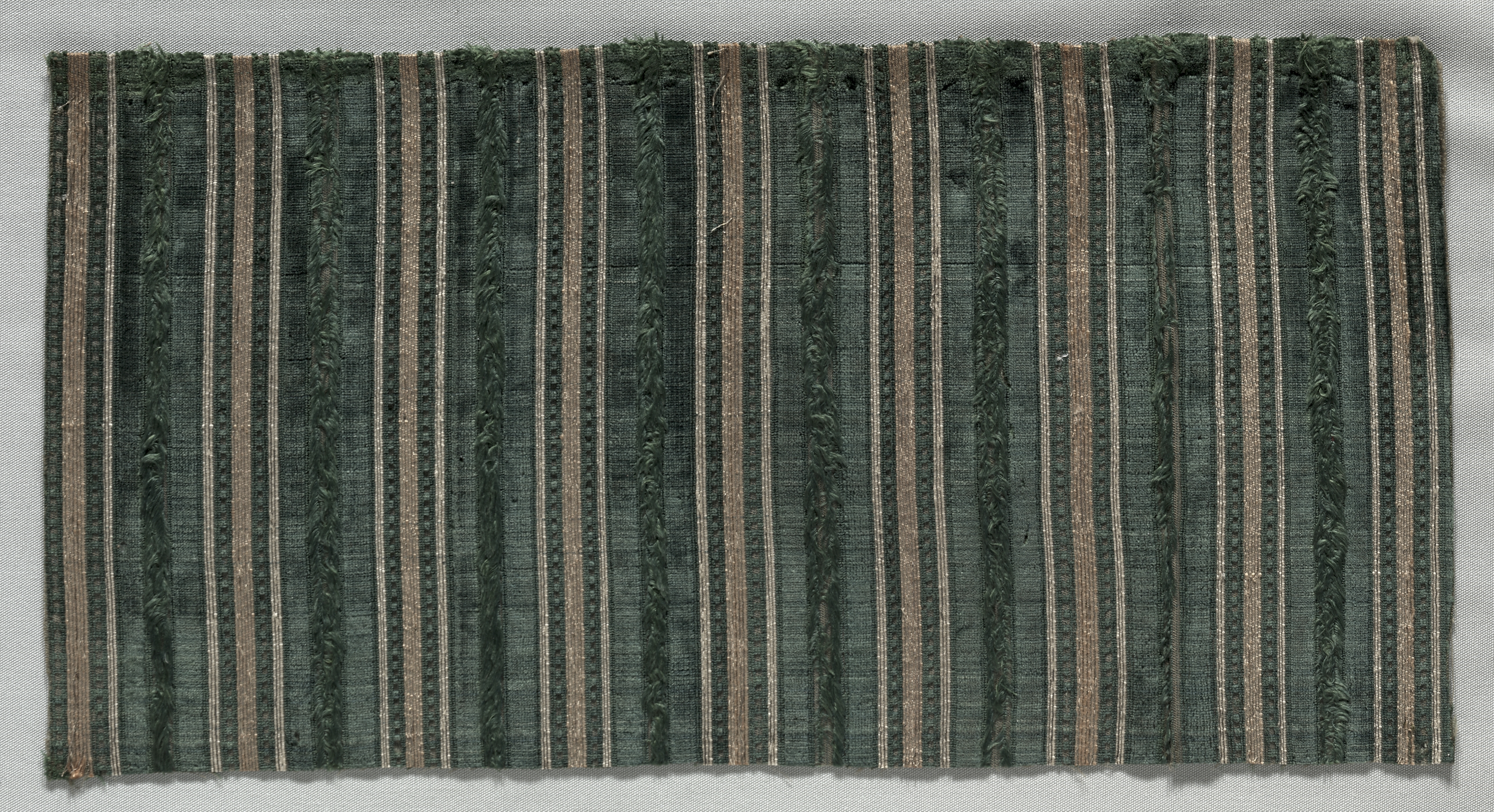
Deconstructing the Velvet Fragment: An Avant-Garde Analysis for Zoey Fashion Lab
At Zoey Fashion Lab, our mission is to transcend conventional garment construction and explore the latent narratives embedded within textile fragments. This analysis focuses on a singular artifact: a fragment of 18th-century Italian velvet. Designated as “New DNA Strand,” this piece is not merely a historical remnant but a blueprint for avant-garde innovation. By deconstructing its technical, historical, and aesthetic properties, we aim to extract a new design language—one that honors the past while violently propelling it into the future.
Technical Dissection: The Velvet Matrix
The fragment exhibits the hallmark characteristics of cut velvet (velluto cesellato), a technique perfected in Italian workshops during the 1700s. The base structure is a warp pile weave, where supplementary warp threads are looped over wires and then cut to create a dense, plush surface. Under magnification, the pile height is approximately 2.5mm, with a pile density of roughly 80 threads per centimeter. This density creates a deep, almost liquid absorption of light.
The ground weave is a twill or satin base, providing structural integrity. The fiber content is likely a combination of silk (for the pile) and linen or hemp (for the ground warp), a common practice in 18th-century Italy to balance luxury with durability. The silk pile has undergone significant oxidation, shifting from its original deep crimson or emerald to a muted, earthy burgundy. This patina is not a flaw but a record of time—a chemical diary of exposure, humidity, and handling.
From an avant-garde perspective, the velvet’s technical DNA is a system of controlled chaos. The cutting of loops is a deliberate act of destruction that creates beauty. The pile direction creates a directional sheen, a phenomenon we can exploit in modern fabrication. For Zoey Fashion Lab, this suggests a new material: a “deconstructed velvet” where the pile is selectively burned, laser-cut, or chemically eroded to reveal the ground weave beneath. This would create a topographical map of decay, where the original luxury is interrupted by voids—a metaphor for lost memory.
Historical Context: The Italian 18th-Century Velvet as a Symbol of Power
This fragment originates from a period when Italian velvet was a geopolitical statement. Cities like Genoa, Venice, and Florence produced velvet for European courts, ecclesiastical vestments, and aristocratic interiors. The velvet was not just fabric; it was a currency of status. Its deep, uniform pile signified wealth, while its complex patterns (often featuring pomegranates, acanthus leaves, or heraldic motifs) conveyed dynastic power.
The fragment’s pattern, though partially obscured, suggests a large-scale symmetrical design typical of the Baroque period. The repeat unit likely measured 40-50cm, intended for wall hangings or ceremonial garments. The use of voided velvet (where the pile is absent in certain areas to create a contrast with the ground) was common, allowing for intricate, almost sculptural motifs.
For Zoey Fashion Lab, this historical weight is not a burden but a provocation. The 18th-century velvet represents a rigid social order. Our avant-garde reinterpretation must dismantle this order. We propose a process of “historical rupture”: taking the velvet’s original pattern and digitally distorting it through algorithms that simulate seismic activity or organic growth. The resulting print would be a ghost of the original—a palimpsest of power disrupted by entropy.
Avant-Garde Reinterpretation: The New DNA Strand
The reference “New DNA Strand” is a conceptual key. In biology, DNA is a double helix that encodes instructions for growth, replication, and decay. This velvet fragment is a cultural DNA strand, encoding the instructions for 18th-century luxury. Our task is to mutate this strand—to splice it with modern technology and deconstructivist philosophy.
We identify three core avant-garde strategies for this fabric:
1. Deconstructive Pile Manipulation: Instead of preserving the velvet’s plush surface, we will introduce controlled destruction. Using a CNC milling machine or ultrasonic cutter, we will remove pile in a pattern that mimics the fragment’s original voids but in a chaotic, non-repeating manner. The result will be a fabric that is half velvet, half exposed ground—a literal deconstruction of the pile. This creates a haptic tension: the soft, luxurious velvet adjacent to the rough, utilitarian ground.
2. Digital Weaving and Light Interference: The original velvet’s sheen is directional, responding to light. We will replicate this using a smart warp—a combination of silk and optical fibers or metallic threads. The pile will be woven with a gradient of metallic content, creating a surface that changes color or reflectivity based on viewing angle. This is a digital mutation of the 18th-century “changeant” effect, where silk and linen created a subtle shimmer. Here, the shimmer becomes a programmable, interactive surface.
3. Structural Fragmentation: The fragment is a remnant, a piece of a larger whole. Our design will embrace this incompleteness. Garments will be constructed from multiple velvet fragments, each cut from a different historical source (or digitally printed replicas), then joined with exposed seams, raw edges, and tension cables. This creates a collage of time, where the 18th-century fragment sits alongside a digitally woven panel, connected by industrial zippers or surgical sutures. The garment becomes a museum of fashion history, deconstructed and reassembled.
Material and Process Recommendations
For Zoey Fashion Lab’s prototype, we recommend the following:
Base Material: A silk-hemp ground weave (60% silk, 40% hemp) to echo the original’s weight and drape. The pile should be a blend of silk and recycled polyester (for durability and sheen).
Pile Erosion: Using a laser cutter set to low power (to avoid burning the ground), we will remove pile in a pattern derived from the fragment’s voided areas but distorted through a Perlin noise algorithm. This creates organic, cellular voids that suggest biological decay.
Structural Joining: The fragmented panels will be joined using visible stainless steel cables and heat-set silicone grommets. This industrial hardware contrasts with the velvet’s softness, creating a dialogue between luxury and utility.
Light Integration: In the digital weave panel, we will incorporate electroluminescent wires woven into the pile. These wires will be programmed to pulse or shift color in response to movement or ambient light, creating a living, breathing garment.
Conclusion: The Velvet as a Catalyst
This 18th-century Italian velvet fragment is not a relic to be preserved under glass. It is a catalyst for new design paradigms. By deconstructing its technical DNA—its pile density, its weave structure, its historical symbolism—we extract a vocabulary of destruction, mutation, and reassembly. The resulting garment will be a tribute to the original’s opulence, but a tribute filtered through the lens of avant-garde deconstruction: raw, fragmented, and alive with contradiction. Zoey Fashion Lab will not replicate the past; we will re-sequence its genetic code, creating a fashion that is both ancient and alien.