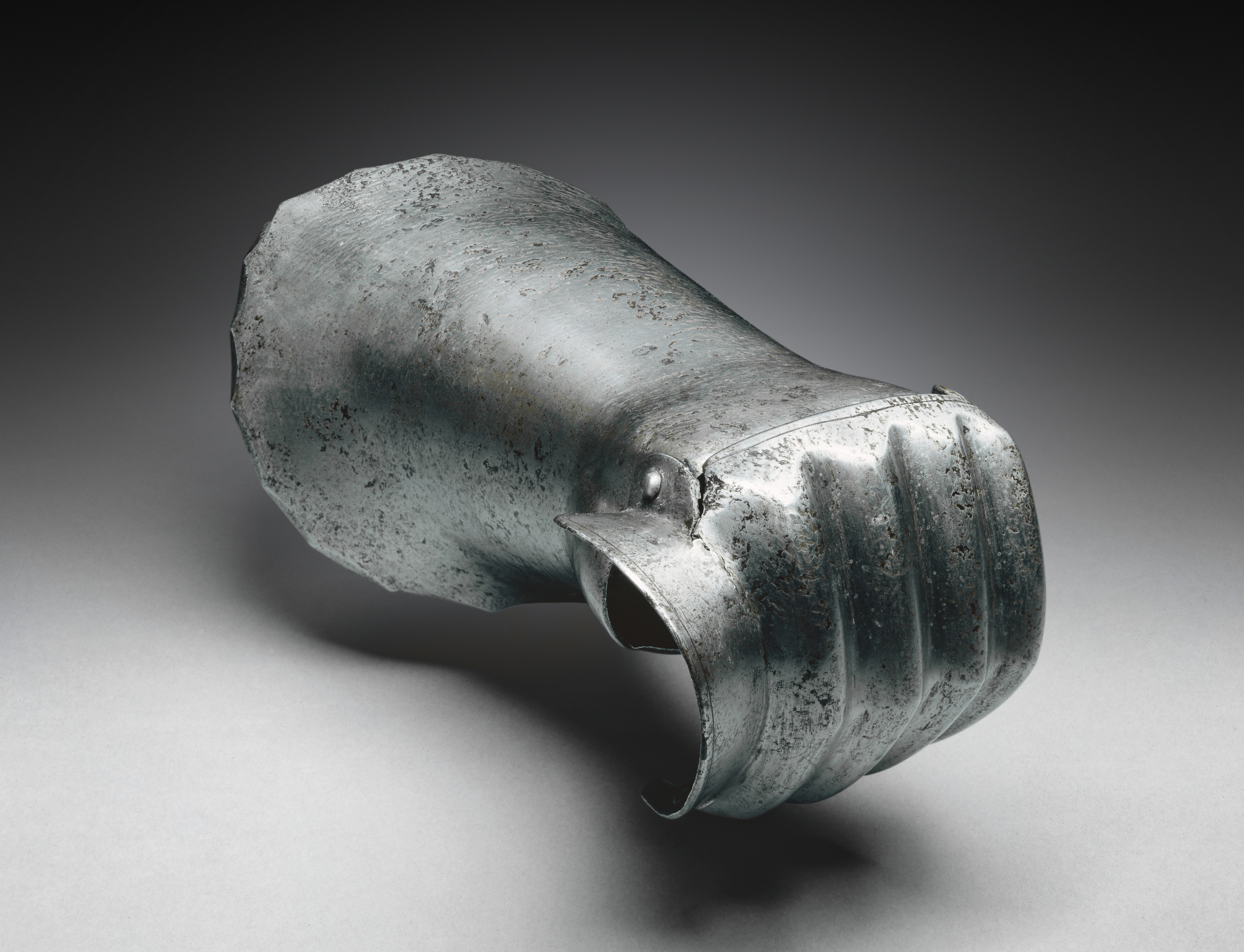
Deconstructing the Main-de-Fer: An Avant-Garde Analysis for Zoey Fashion Lab
As Chief Fabric Deconstructionist at Zoey Fashion Lab, I am tasked with dissecting historical artifacts not merely as relics, but as living blueprints for radical, avant-garde design. Our latest subject, the 16th-century South German Jousting Glove, or Main-de-Fer Gauntlet, presents a paradox: a rigid, protective shell forged for the extreme violence of the tournament, yet possessing an architectural elegance that resonates with the future of fashion. This analysis will deconstruct the gauntlet’s material, form, and function, treating it as a New DNA Strand—a genetic code to be spliced, mutated, and re-expressed in a contemporary, avant-garde context.
Materiality and the Steel Codex
The gauntlet’s primary material, steel, is our first point of departure. In the 16th century, this was the ultimate expression of protection—a second skin of immense strength, but one that came at the cost of weight and complete immobility. The avant-garde designer must see this not as a limitation, but as a provocation. The New DNA Strand here is not about replicating steel, but about translating its properties. We ask: what is the essence of steel? It is hardness, reflectivity, resistance, and the ability to hold a precise, cold edge.
For Zoey Fashion Lab, this translates into exploring materials that perform like steel but feel like fabric. Consider liquid-metal coatings on high-tenacity nylon, or 3D-printed titanium alloys that mimic the gauntlet’s articulated plates. The key is to deconstruct the weight. The gauntlet’s steel is a statement of power through mass. Our new strand must achieve the same visual and protective impact through structural engineering and surface finish. Think of a garment that appears to be forged from a single, seamless sheet of metal, yet drapes and moves like a second skin. The gauntlet’s patina—the subtle rust and wear of centuries—becomes a textural language. We can replicate this through chemical etching, laser abrasion, or even digital weaving that creates a gradient of metallic sheen, simulating age and narrative.
Articulation and the Architecture of Movement
The genius of the Main-de-Fer lies in its articulated construction. The gauntlet is not a solid block; it is a series of overlapping, riveted plates—the cuff, the metacarpal, the knuckles, and the fingers—each moving in a controlled, limited arc. This is a kinetic architecture. The avant-garde designer must study how these plates interact: the way they slide over one another, the precise angles of their overlap, the way they lock into place to protect the hand while allowing the grip on a lance.
Our New DNA Strand extracts this principle of controlled articulation. For Zoey, this means designing garments that are not sewn, but assembled from modular, interlocking components. Imagine a jacket whose panels are not stitched but connected via a system of hidden, flexible joints, allowing for a sculptural silhouette that changes with the wearer’s movement. The gauntlet’s knuckles—the most complex area—offer a specific lesson: the need for graduated protection. The fingers are more flexible, the back of the hand more rigid. This translates into a garment where zones of high articulation (shoulders, elbows, hips) are constructed from smaller, more mobile scales, while zones of static protection (torso, back) are built from larger, more solid plates.
Furthermore, the gauntlet’s cuff is a crucial transition point—it connects the rigid hand to the flexible arm. This is a threshold zone we must exploit. In our avant-garde interpretation, the cuff becomes a dramatic, exaggerated collar or a shoulder piece, a flared, architectural element that bridges the body and the garment. The rivets themselves are not just functional; they are ornamental anchors. We can reimagine them as magnetic closures, snap fasteners, or even LED-lit nodes that create a visual rhythm across the surface of the garment.
Function and the Performance of Power
The gauntlet’s primary function was protection from impact. In the joust, the hand was a target. The gauntlet was a weapon as much as a shield. This duality—defense and offense—is our third strand. The avant-garde designer must ask: what does protection mean in a non-combat context? It is not about physical safety, but about psychological armor. The gauntlet is a symbol of invincibility, of controlled aggression, of a singular, focused purpose.
Our New DNA Strand reinterprets this as performative protection. The garment becomes a shell that alters the wearer’s posture, gait, and presence. The weight is not physical, but visual and conceptual. For Zoey, this could manifest as a garment that changes shape in response to the environment—a smart fabric that stiffens when the wearer is in a crowd, or a series of air-filled chambers that inflate to create a protective, sculptural silhouette. The gauntlet’s grip—the way it holds the lance—is a lesson in ergonomics. We can design garments with integrated handles, straps, or tension systems that allow the wearer to actively engage with the clothing, transforming it from a passive covering into an interactive tool.
The gauntlet’s ornamentation—often with etched floral patterns or religious iconography—is not mere decoration. It is a narrative code. It tells a story of wealth, status, and allegiance. For our avant-garde strand, this becomes a surface language. We can use digital embroidery, thermochromic inks, or micro-LED arrays to create patterns that shift and reveal hidden messages, or that respond to the wearer’s biometrics. The gauntlet’s history is etched into its steel; our garment’s history is written in real-time by its wearer.
Conclusion: Forging the Future from the Past
The 16th-century South German Jousting Glove is not a relic to be copied, but a genetic blueprint for a new species of garment. As Chief Fabric Deconstructionist, I see in its steel plates a language of protection, articulation, and performance. Our New DNA Strand is not about making a gauntlet for the hand, but about making a gauntlet for the entire body—a suit of armor for the 21st century, where the battlefield is the city street, the runway, or the digital realm.
Zoey Fashion Lab will not simply replicate the Main-de-Fer. We will deconstruct its logic, extract its core principles, and re-synthesize them into a collection that is both a tribute to the past and a radical proposition for the future. The result will be a garment that is hard yet fluid, protective yet expressive, historical yet utterly contemporary. This is the art of deconstruction as creation—where the steel of a jousting glove is reborn as the fabric of a new reality.