Deconstructing the Trojan War: A Tapestry of Structural Dissent for SS26
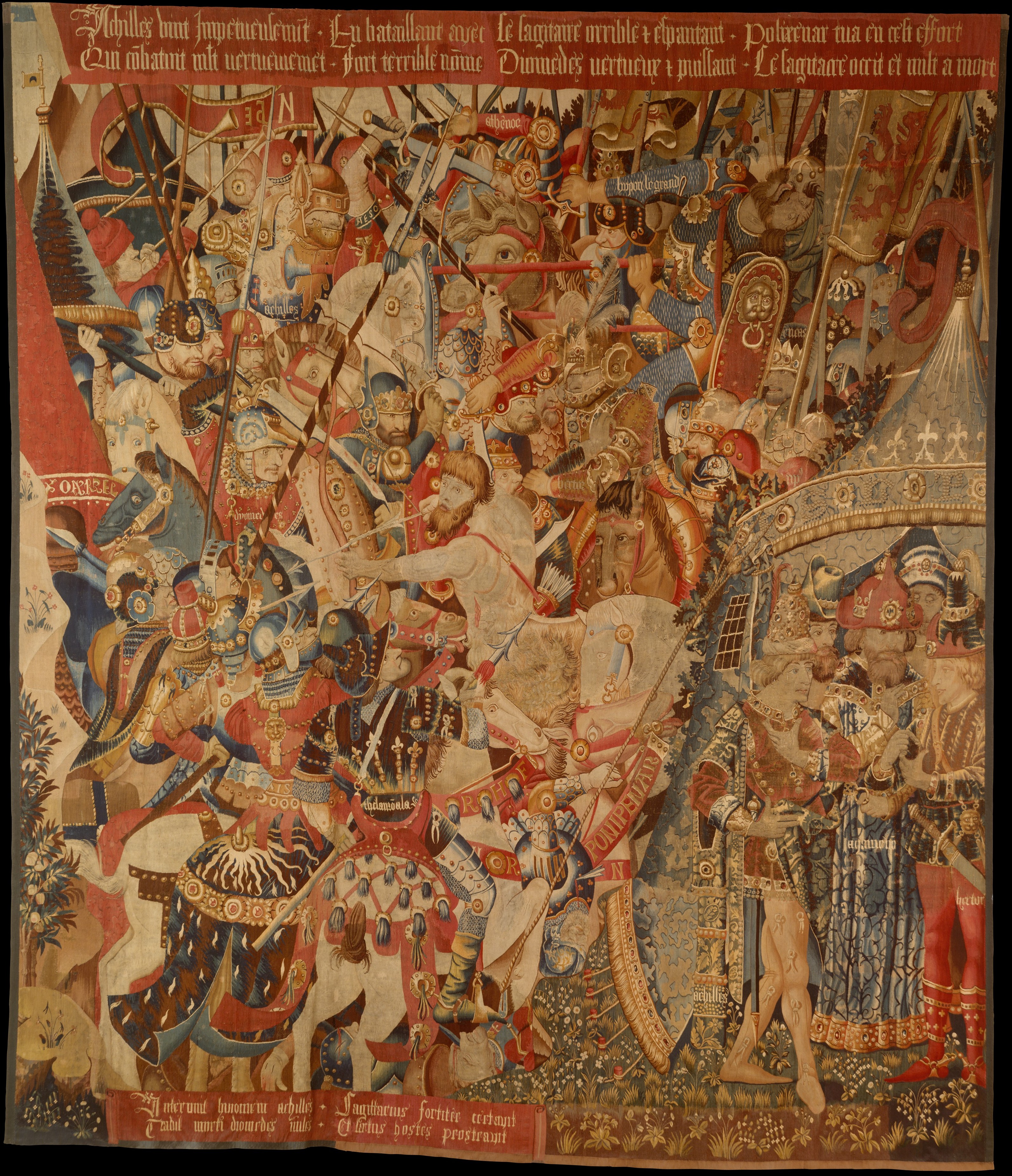
The historical tapestry, "The Battle with the Sagittary and the Conference at Achilles' Tent," rendered in wool warp and wefts with a whisper of silk, is not merely a narrative artifact. For Zoey Fashion Laboratory, it becomes a primal schematic—a blueprint for dissecting power, vulnerability, and the architecture of conflict. This South Netherlandish piece, with its dense, woven narrative of archers, tents, and warriors, offers a radical departure from traditional textile interpretation. For SS26, we are not replicating its form; we are extracting its structural tension. The wool and silk wefts become a metaphor for the friction between brute force and fragility, between the heavy warp of history and the fleeting, luxurious weft of the present. Our analysis reimagines the tapestry's scenes as a dialogue between two distinct, yet symbiotic, avant-garde silhouettes: the Armored Silhouette of the Sagittary and the Vulnerable Structuralism of Achilles' Tent.
I. The Sagittary Silhouette: Armored Deconstruction and the Architecture of Aggression
The Sagittary, a mythical archer, is the embodiment of kinetic tension. In our SS26 interpretation, this figure is translated into a deconstructed armor system that defies traditional tailoring. The wool warp—heavy, dense, and structural—is the primary material. We are proposing a double-layered, offset shoulder construction where the outer shell is a rigid, woven wool exoskeleton that appears to be peeling away from the body, exposing a softer, silk-weft underlayer. The key innovation is the asymmetrical, cantilevered sleeve. One arm is encased in a sculpted, almost architectural sleeve that extends beyond the hand, mimicking the drawn bowstring. This sleeve is not sewn but held together by tension points—strategic, exposed seams that use metallic thread (a nod to the silk wefts' subtle shimmer) to create a visual and structural anchor. The other sleeve is entirely absent, replaced by a cut-out, circular armhole that reveals the bare arm, symbolizing the vulnerability of the archer's stance. The torso is a crisscross of woven panels, each one a fragment of the tapestry's narrative, that are not attached at the sides but suspended from a central spine. This creates a floating, aero-dynamic silhouette that shifts with movement, the wool panels clashing and separating like plates of armor. The hem is deliberately jagged and raw, frayed to mimic the torn edges of the tapestry, emphasizing that this is a garment in a state of perpetual conflict.
II. The Conference at Achilles' Tent: Vulnerability as Structural Innovation
In stark contrast, the conference scene—a moment of negotiation and exposed vulnerability—informs our second silhouette. Here, the tent is not a shelter but a transparent, tensile structure. We are introducing a negative-space garment built from light, semi-transparent silk wefts and gossamer wool threads. The silhouette is a draped, asymmetrical cocoon that is more about absence than presence. The back is completely open, forming a hollow, concave volume that reveals the wearer's spine and back, a direct reference to the tent's open flaps. The front is a single, continuous panel that wraps from the left shoulder, across the chest, and is then suspended by a single, tensile cord at the right hip. This cord, made of twisted wool and silk, is the only point of structural integrity. The garment's weight is carried entirely by this one knot, creating a gravity-defying, floating drape. The sleeves are non-existent; instead, the armholes are dramatically enlarged and asymmetrical, one reaching to the waist, the other to the collarbone. This creates a silhouette of radical exposure. The hem is a waterfall of raw, un-finished edges, with the wool wefts deliberately pulled loose, creating a fringe that mimics the frayed edges of the tent's fabric. The entire garment is a study in controlled chaos, where the material seems to be in a state of perpetual unraveling, yet is held together by the single, decisive knot.
III. The Dichotomy of Material: Wool as Armor, Silk as Vulnerability
The tapestry's material composition—wool warp with a few silk wefts—is not a limitation but a core design principle. We are exploiting the inherent tension between these fibers. For the Sagittary silhouette, the wool is felted and stiffened to create a rigid, almost ceramic surface. It is treated with a resin finish that gives it a matte, lunar sheen, transforming the humble wool into a futuristic armor. The silk wefts are strategically placed as stress points—at the shoulders, the elbows, and the hips—where they are woven in a dense, almost metallic pattern, creating a visual and textural contrast. For the tent silhouette, the silk is the dominant fiber. It is used in its rawest form, almost like a liquid second skin, while the wool is reduced to a supporting role, used as a structural webbing that holds the silk in place. The wool threads are deliberately thick and coarse, creating a grid-like pattern that is visible through the translucent silk. This grid is not hidden but celebrated, becoming a visible architectural framework. The result is a garment that feels both impossibly fragile and structurally rigorous, a direct reflection of the conference's tense negotiation.
IV. Futuristic Silhouettes: The SS26 Manifesto
These two silhouettes are not separate; they are a dialectic of conflict and resolution. The Sagittary silhouette represents the armored future—a world of aggressive, deconstructed protection where the body is both shielded and exposed. The tent silhouette represents the vulnerable future—a world of radical transparency and structural lightness, where the garment is a fragile, temporary shelter. For SS26, we propose a third silhouette: the synthesis. This is a modular garment that can be worn in two distinct states. In its "battle" state, it is the armored, asymmetrical exoskeleton. In its "conference" state, the exoskeleton is unlatched and falls away, revealing the tensile, transparent cocoon beneath. The transformation is not a simple unzipping but a ritual of structural collapse, where the wearer actively deconstructs their own silhouette. The key innovation is a system of magnetic tension points—small, powerful magnets embedded in the wool panels that can be detached and repositioned. This allows the wearer to shift between the two silhouettes in a single, fluid motion. The final result is a garment that is not a fixed form but a process, a living, breathing architecture that embodies the eternal battle between aggression and vulnerability, between the heavy warp of history and the fleeting, luxurious weft of the present. This is the definitive avant-garde statement for SS26: a tapestry of structural dissent.