Introduction: The Alchemy of Avant-Garde and Ancient Craft
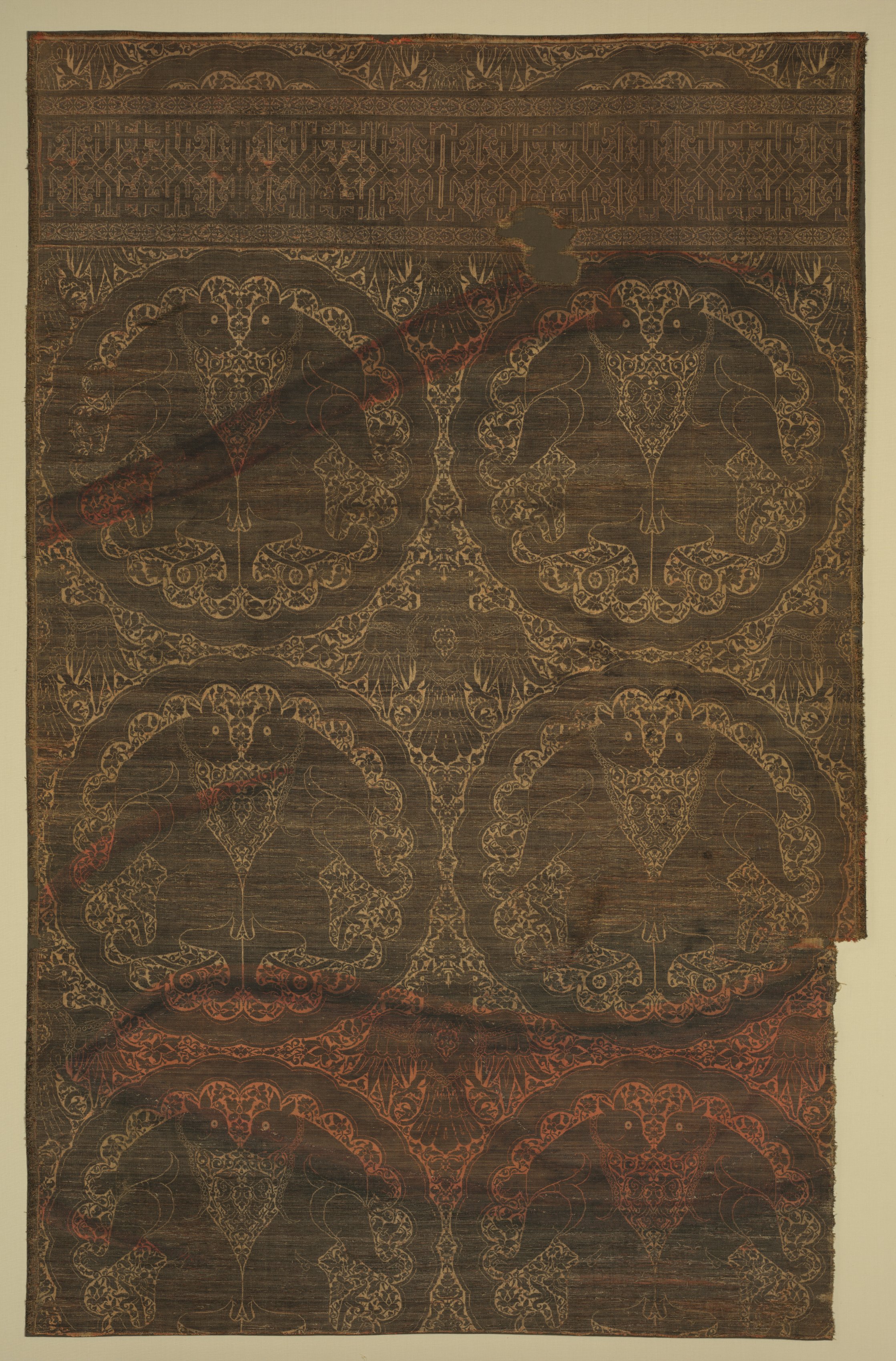
At Zoey Fashion Lab, we operate at the intersection of historical reverence and radical innovation. The subject of this analysis—a fragment of lampas-woven cloth of gold from Northeast Iran, featuring a dynamic interplay of felines and eagles—presents a unique opportunity for deconstruction and reinterpretation. This textile, executed in silk and gold thread, is not merely an artifact; it is a genetic blueprint. By applying our "New DNA Strand" methodology, we can extract its core technical and symbolic DNA and re-sequence it into an avant-garde fashion statement that challenges contemporary norms of luxury and narrative.
Technical Deconstruction: The Lampas Weave and Material Alchemy
The Structural Matrix
Lampas is a compound weave structure, typically featuring a ground weave (often a plain or twill) and a pattern weave that floats across the surface. In this Northeast Iranian example, the ground is likely a fine silk warp and weft, providing a supple, lustrous base. The pattern is created by supplementary gold thread—gilded silver or gold strips wound around a silk core—introduced as an additional weft. This technical choice is not merely decorative; it is a structural declaration of power. The gold thread, rigid and reflective, creates a tactile and visual hierarchy against the soft, matte silk. For Zoey Fashion Lab, this juxtaposition of materials is a primary source of inspiration.
The "New DNA Strand" Interpretation
Our "New DNA Strand" approach treats the textile's technical composition as a sequence of codons. The silk represents flexibility, fluidity, and organic origin—the foundational amino acids. The gold thread represents rigidity, luminosity, and synthetic intervention—the modifying elements. The lampas structure itself is the replication mechanism, a repeating pattern that creates both order and variation. In our avant-garde re-imagining, we would not replicate this weave but rather mutate it. Imagine a garment where the silk base is laser-cut into a lattice, and the gold thread is not woven but applied as a conductive, electroluminescent filament. The historical technique becomes a metaphor for wearable technology, where the gold’s original function—to catch and reflect light—is amplified into a programmable, interactive surface.
Iconographic Analysis: Felines and Eagles as Avant-Garde Archetypes
The Predator Dialectic
The felines (likely lions or leopards) and eagles are not arbitrary decorative motifs. In the context of Northeast Iran, these animals are royal and cosmic symbols. The feline represents terrestrial power, stealth, and regal authority. The eagle represents celestial dominion, vision, and transcendence. Together, they form a complete axis of power—earth and sky, material and spiritual. For Zoey Fashion Lab, this duality is a rich vein for conceptual exploration. The avant-garde is not about rejecting tradition but about recontextualizing archetypes.
Deconstructing the Motif
We propose a radical departure from literal representation. Instead of weaving a recognizable eagle, we would extract its essential geometry. The sharp, angular lines of an eagle’s wing can be translated into a series of asymmetric, sculptural seams on a tailored blazer. The feline’s sinuous spine can become a draped, bias-cut panel that mimics the animal’s fluid movement. The gold thread, in this new context, would trace these structural lines, creating a luminous skeleton of the garment. The motifs are no longer seen; they are felt as structure. This is the core of our avant-garde methodology: making the invisible visible through technical innovation.
Cultural and Historical Resonance: The Avant-Garde as a Time Machine
Northeast Iran as a Crossroads
The textile’s origin in Northeast Iran places it at the historical crossroads of the Silk Road, a zone of constant cultural and technical exchange. This region was a melting pot of Sogdian, Persian, and later Islamic influences. The cloth of gold itself is a product of this hybridity—a fusion of Chinese silk technology, Persian iconography, and the local mastery of metal thread. For Zoey Fashion Lab, this historical hybridity is a direct precedent for the avant-garde. We are not creating something from nothing; we are continuing a tradition of radical synthesis.
The Avant-Garde Recontextualization
Our design intervention would honor this history by making the textile’s journey visible. Imagine a garment that appears to be a deconstructed robe, with one sleeve referencing a Sogdian caftan and the other a modern, architectural silhouette. The gold thread would be used not as a surface decoration but as a connective tissue between these disparate eras. A digital print of the original textile’s pattern could be applied to a sheer organza layer, while the structural gold is reserved for the garment’s inner seams—a secret luxury known only to the wearer. This approach transforms the garment into a wearable archive, a conversation between the 10th century and the 21st.
Material Innovation: From Gold Thread to Bio-Responsive Fiber
Re-engineering the Gold
Historical gold thread is static. It reflects light but does not change. Our "New DNA Strand" methodology demands evolution. We propose developing a bio-responsive gold alloy that shifts color or intensity based on the wearer’s body heat or movement. This is not science fiction; it is an extension of the original gold thread’s purpose—to signify status and dynamism. In an avant-garde context, this material becomes a living surface. A feline motif might glow when the wearer is in motion, echoing the animal’s predatory alertness. An eagle’s wing might dim when the wearer is at rest, suggesting a dormant power.
The Silk as a Canvas for Deconstruction
The silk base of the original textile is pristine, a testament to the weaver’s skill. In our deconstruction, we would disturb this perfection. Techniques such as burn-out, fraying, and selective disintegration would be applied to the silk, creating a textural counterpoint to the precision of the gold. This is a deliberate act of creative violence, transforming a historical object into a contemporary statement. The felines and eagles would not be woven but embroidered in a deliberately irregular, almost chaotic stitch, as if the animals are breaking free from the fabric’s constraints. This tension between order and chaos is the essence of the avant-garde.
Conclusion: A New Lineage for Luxury
The cloth of gold from Northeast Iran is not a relic to be preserved in a museum vitrine. It is a living code—a sequence of technical, iconographic, and cultural information that can be re-sequenced for a new era. At Zoey Fashion Lab, our analysis reveals that the textile’s true value lies not in its age but in its potential for transformation. By deconstructing its lampas weave, reinterpreting its feline and eagle motifs, and re-engineering its gold thread, we create an avant-garde garment that is both a homage and a rebellion. This is the future of luxury: not the accumulation of historical artifacts, but the active, intelligent re-imagining of their DNA. The result is a fashion that is not worn but inhabited—a second skin that carries the weight of history and the light of innovation.