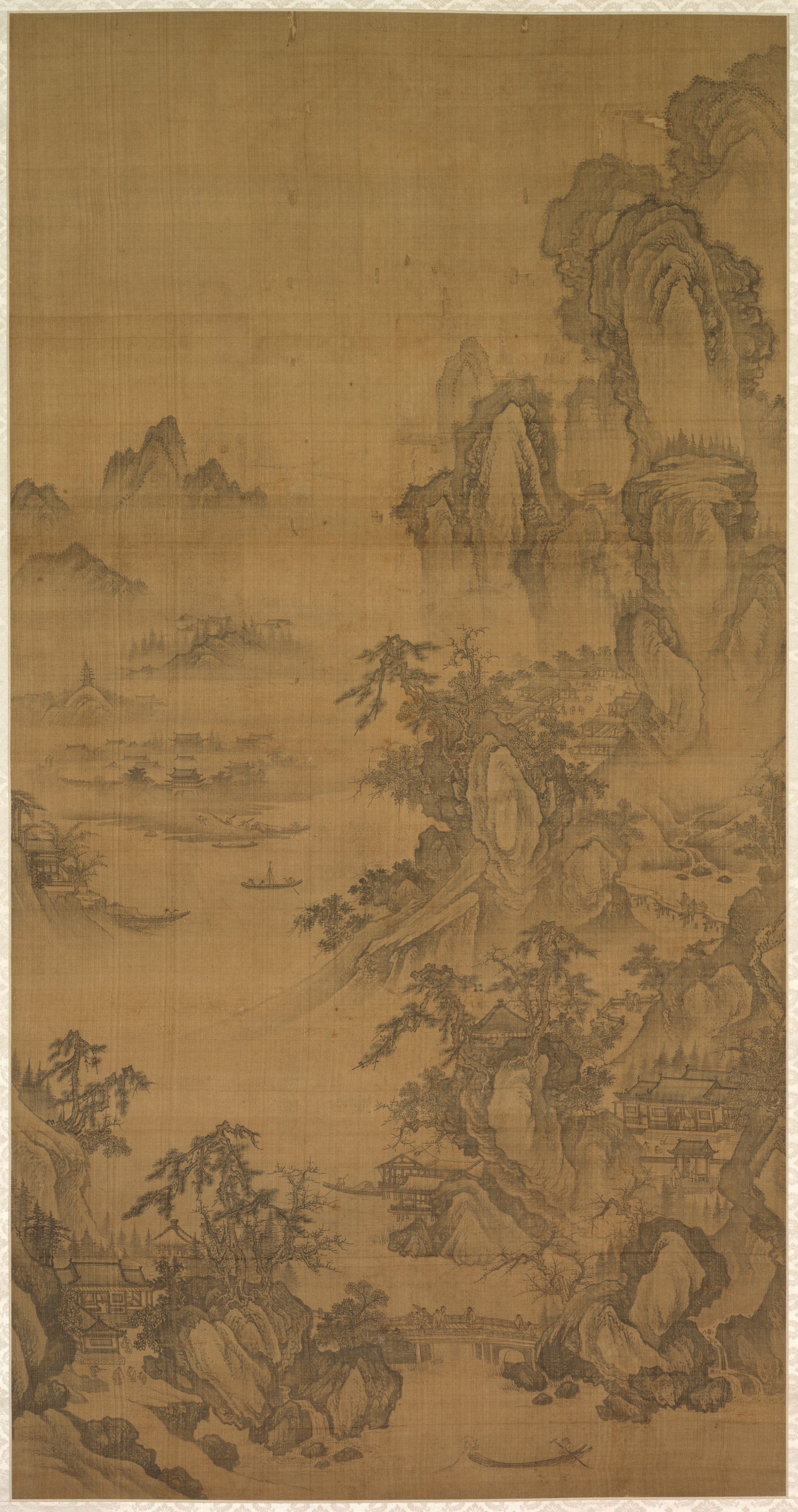
Deconstructing the Joseon Landscape: Mountain Market, Clear with Rising Mist
At Zoey Fashion Lab, the role of the Chief Fabric Deconstructionist is to unravel the threads of historical textiles and artistic traditions, weaving them into the avant-garde lexicon of contemporary fashion. The subject under analysis—Mountain Market, Clear with Rising Mist, a hanging scroll from Korea’s Joseon dynasty (1392–1910), executed in ink on silk—presents a profound opportunity. This work, with its quiet equilibrium of mist-shrouded peaks and bustling market activity, is not merely a static artifact. It is a New DNA Strand for the lab, a genetic blueprint that, when spliced with avant-garde methodology, can yield a collection that transcends time. This analysis deconstructs the scroll’s formal, material, and conceptual elements, proposing how they might be reimagined through the lens of radical fashion design.
Formal Deconstruction: The Architecture of Mist and Market
The scroll’s composition is a masterclass in layered transparency. The ink washes—ranging from pale, almost ethereal grays to dense, charcoal blacks—create a spatial depth that is both illusionistic and tactile. The “rising mist” is not a passive background but an active agent, dissolving the boundaries between the distant mountain peaks and the foreground market stalls. For the fabric deconstructionist, this translates directly into a study of sheer overlays and gradation. Imagine a garment where multiple layers of organza or silk chiffon are printed with varying opacities of ink-like pigment. The “mist” becomes a series of detachable, translucent panels that can be layered or removed, altering the silhouette from a sharp, defined form to a blurred, atmospheric one. The market—a cluster of small, irregular shapes suggesting tents, figures, and goods—offers a counterpoint of dense, granular detail. This can be recreated through intricate beadwork, micro-pleating, or laser-cut appliqués that mimic the chaotic yet ordered energy of a marketplace. The scroll’s vertical format, a hanging scroll, suggests a draped, elongated silhouette—a long, flowing coat or a column dress that echoes the scroll’s unfurling form.
Material Analysis: Ink on Silk as a Textile Dialog
The medium itself—ink on silk—is a foundational text for our deconstruction. Silk, in the Joseon context, was a luxury material, often associated with courtly life and scholarly pursuits. The ink, made from soot and animal glue, is a permanent, staining medium. The interaction between the two is one of absorption and resistance. The silk’s weave dictates how the ink spreads, creating soft, feathery edges or sharp, defined lines. For an avant-garde collection, we can subvert this relationship. Instead of painting on silk, we weave the ink into the fabric through digital jacquard techniques, creating patterns that mimic the brushstrokes. Alternatively, we can treat the silk with reactive dyes that respond to environmental factors like humidity or heat, causing the “mist” to appear or fade as the wearer moves through different climates. The staining quality of ink can be translated into bold, irregular splashes of color—perhaps using natural indigos or rust dyes—that appear to bleed into the fabric, echoing the scroll’s spontaneous yet controlled brushwork. The material itself becomes a living document, changing over time, just as the scroll’s ink has aged and oxidized over centuries.
Conceptual Weaving: Tranquility and Chaos in Avant-Garde Form
The conceptual heart of the scroll lies in its duality: the serene, eternal mountain versus the transient, human market. This tension is ripe for avant-garde interpretation. The “clear with rising mist” suggests a state of becoming—a moment of clarity emerging from obscurity. In fashion, this can be expressed through transformable garments. A dress might be constructed with multiple closure systems—snaps, ties, zippers—that allow the wearer to shift between a fully enclosed, mist-like silhouette and a more open, market-inspired structure. The rising mist can be literalized through the use of structural elements like horsehair braid or wire-reinforced hems that create a sense of upward movement, lifting the fabric away from the body. The mountain’s stability can be represented by rigid, architectural shoulders or a corseted waist, while the mist’s fluidity is captured in flowing, asymmetrical panels. The market’s chaos—the haggling, the movement, the goods—can be woven into the garment’s surface through pockets, pouches, and detachable accessories that reference the stalls and wares. This is not a literal translation but a conceptual one: the garment becomes a microcosm of the scroll’s world, where order and disorder coexist.
Avant-Garde Synthesis: The New DNA Strand in Practice
To integrate this analysis into a collection, Zoey Fashion Lab must treat the scroll as a genetic code. The “New DNA Strand” implies a recombination of elements that yields something unprecedented. Here is a proposed framework for the collection:
Silhouette: The primary silhouette should be elongated and vertical, referencing the hanging scroll. This can be achieved through floor-length coats, columnar dresses, and high-waisted trousers that create a continuous line. However, these forms should be deconstructed—sliced open, layered asymmetrically, or suspended from the body using straps and harnesses. The mist can be rendered as a sheer, floating outer layer, while the market appears as a denser, more structured inner layer. The overall effect should be one of controlled chaos, where the garment appears to be in a state of dissolution or formation.
Color Palette: The palette must be drawn from the scroll’s ink washes: charcoal, slate gray, ivory, and deep black. However, to inject avant-garde energy, introduce accent colors that reference the market’s vibrancy—a sudden flash of vermilion (from traditional Korean textiles) or a muted ochre (from earth pigments). These accents should be placed strategically, like the small figures in the scroll, to draw the eye and create focal points.
Textile Innovation: The lab should experiment with biodegradable silks that mimic the scroll’s aged patina, or recycled synthetic fibers that can be printed with ink-like patterns using zero-waste digital printing. The mist can be achieved through water-soluble fabrics that partially dissolve upon exposure to moisture, revealing the “market” underneath. This is a direct reference to the scroll’s transient mist, but it also introduces a performative element—the garment changes in response to the environment, much like the scroll’s ink has changed over time.
Embellishment and Detail: The market’s granular detail can be recreated through hand-stitched embroidery that mimics the brushstrokes of the ink. Use metallic threads to suggest the glint of goods in the market, or irregular seed beads to evoke the texture of rough mountain stone. The mist can be suggested by sheer panels that are lightly embroidered with a fog-like pattern, or by cutouts that reveal the skin, creating a sense of dissolution. The overall effect should be one of luxurious decay—a garment that feels ancient yet futuristic.
Conclusion: The Scroll as a Living Garment
In deconstructing Mountain Market, Clear with Rising Mist, Zoey Fashion Lab has uncovered a New DNA Strand that is both rooted in Joseon tradition and radically forward-looking. The scroll is not a relic to be copied but a generative source—a set of principles that can be recombined into avant-garde forms. The layered transparency of the mist, the granular chaos of the market, the vertical architecture of the scroll, and the material dialog between ink and silk—all of these elements can be translated into garments that challenge the boundaries of fashion. The final collection should not simply reference the scroll; it should become the scroll—a living, breathing artifact that moves with the wearer, dissolving and reforming like the mist on a Korean mountain. This is the essence of avant-garde deconstruction: not to destroy, but to reveal the hidden structures that make art, and fashion, eternal.