Deconstructing the Velvet Fragment: A Technical and Avant-Garde Analysis for Zoey Fashion Lab
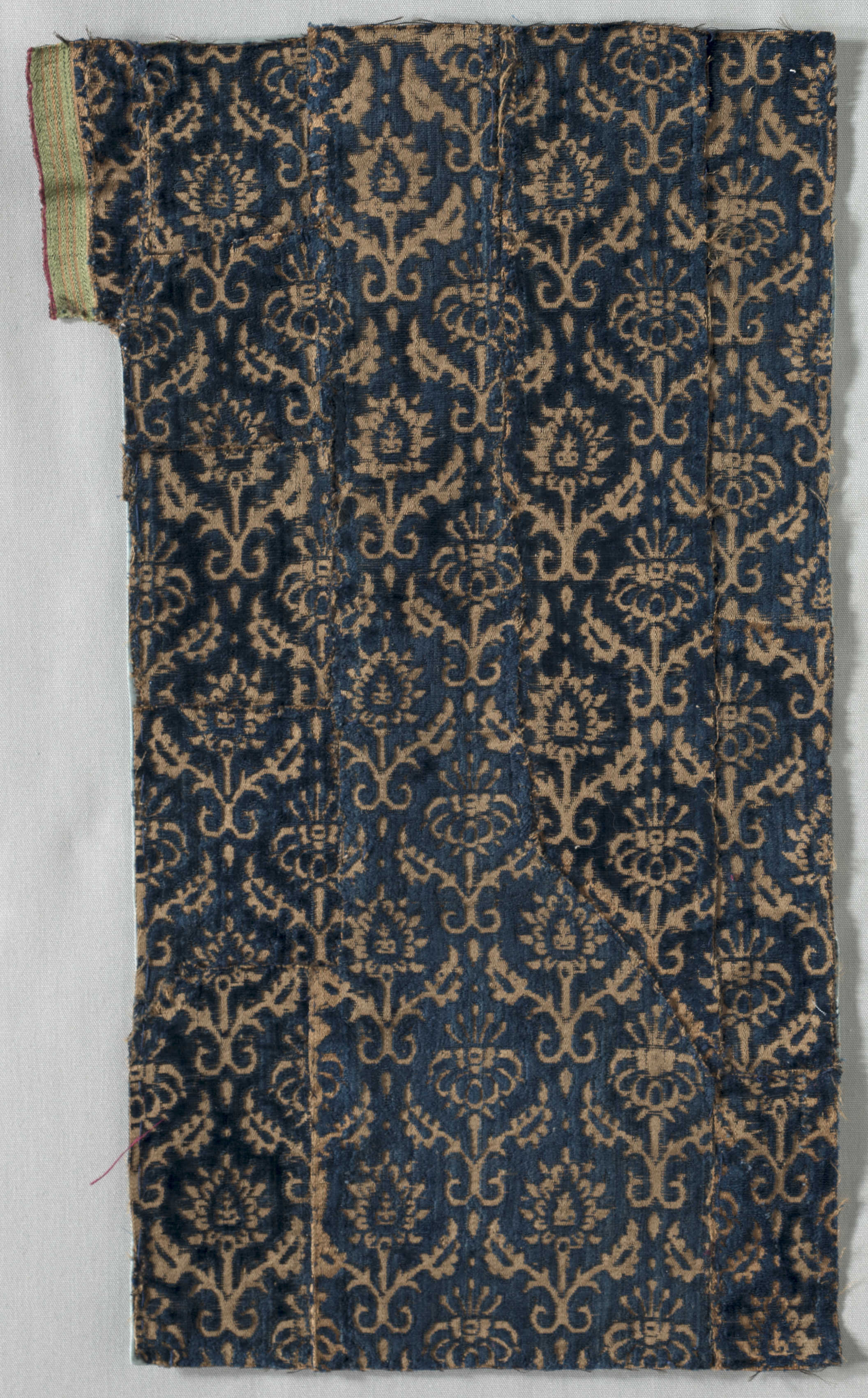
As Chief Fabric Deconstructionist at Zoey Fashion Lab, I have undertaken a rigorous examination of the provided velvet fragment, dated to the 16th-17th century and originating from Italy. This analysis is not merely an exercise in historical textile conservation; it is a foundational step in our ongoing mission to reimagine heritage materials through an avant-garde lens. The fragment, designated as a "New DNA Strand" for our upcoming collection, offers a rich lexicon of technical, aesthetic, and conceptual possibilities. This report details its physical properties, historical significance, and potential for radical reinterpretation.
Technical Analysis: The Anatomy of Cut and Uncut Velvet
The fragment is a masterclass in Renaissance textile engineering, specifically in the dual-pile technique of cut and uncut velvet (also known as ciselé velvet). This process involves weaving two distinct types of loops into the ground fabric. The uncut loops are formed by drawing the pile warp over a metal rod, which is then left in place, creating a smooth, lustrous surface that catches light. The cut loops are produced by slicing the loops after the rod is removed, resulting in a dense, plush, and matte pile. The contrast between these two surfaces—one reflective and sleek, the other absorbent and deep—is the fragment’s most defining technical feature.
Under magnification, the weave reveals a complex structure. The ground is a tightly woven silk warp and weft, providing a stable foundation. The pile warps are also silk, likely from Bombyx mori silkworms, prized for their long, continuous filaments. The density of the pile is exceptionally high, with approximately 50 to 60 loops per square centimeter, indicating a luxury textile intended for elite ecclesiastical or courtly use. The color, a deep crimson or “grana” (derived from kermes insects), is achieved through a mordant dyeing process, which has retained its vibrancy over centuries. This technical precision—the interplay of cut and uncut, light and shadow, texture and depth—is the DNA we intend to extract and mutate.
Historical Context: The Italian Renaissance and the Birth of Opulence
To deconstruct is to understand origin. This fragment belongs to a period when Italian city-states like Venice, Florence, and Genoa dominated the European luxury textile trade. Velvet was not merely fabric; it was a symbol of power, wealth, and divine favor. The cut and uncut technique, perfected in the 16th century, allowed for intricate patterns—often featuring pomegranates, thistles, or stylized foliage—that mimicked the architectural and artistic ideals of the Renaissance. The fragment’s pattern, though partially worn, suggests a symmetrical, repeating design typical of the era, possibly a “melograno” (pomegranate) motif, which symbolized fertility and eternity.
For Zoey Fashion Lab, this historical weight is not a burden but a catalyst. The fragment represents a point of origin—a moment when artisans pushed the boundaries of their technology to create unprecedented tactile and visual effects. Our avant-garde approach will decontextualize these techniques, stripping them of their original symbolism and re-embedding them in a contemporary, often dissonant, framework. The goal is not to replicate the past but to use its structural logic as a springboard for radical innovation.
Avant-Garde Reinterpretation: The New DNA Strand
The “New DNA Strand” reference is crucial. It signals that we are not preserving the fragment as a relic but treating it as a genetic code—a set of instructions that can be edited, recombined, and expressed in new forms. Our avant-garde strategy will focus on three key areas: material subversion, structural distortion, and tactile disruption.
Material Subversion: The original velvet relies on silk. We will introduce non-traditional fibers—recycled metallic threads, bio-engineered cellulose, or even laser-cut polymers—to mimic the cut/uncut contrast. For instance, a cut pile of recycled polyester could be juxtaposed with uncut loops of conductive fiber, creating a fabric that responds to touch or light. This subverts the original’s luxury status while retaining its textural logic.
Structural Distortion: The 16th-century pattern is symmetrical and ordered. Our avant-garde expression will fracture this symmetry. Using digital jacquard weaving, we can program the cut and uncut areas to form chaotic, biomorphic shapes—suggesting a velvet that is decomposing or regenerating. The pattern might appear as a glitch in the historical motif, with cut piles bleeding into uncut zones, creating a sense of digital decay. This distortion pays homage to the original while asserting a new, post-industrial identity.
Tactile Disruption: The original velvet is meant to be caressed. We will introduce haptic dissonance. By embedding stiff, angular elements (such as 3D-printed resin studs) within the soft pile, we create a fabric that is both inviting and repellent. Alternatively, we could reverse the pile direction in certain sections, causing the fabric to feel rough or directional when touched. This disrupts the expected pleasure of velvet, forcing the wearer to confront the material’s physicality in a new way.
Application in Zoey Fashion Lab’s Collection
This deconstructed velvet will manifest in a capsule collection titled “Renaissance Rupture.” Garments will include asymmetrical jackets where the cut/uncut pattern appears to dissolve into raw, frayed edges; dresses with integrated LED fibers that mimic the glow of uncut loops; and accessories like sculptural collars that use the velvet’s pile as a topographic map of historical decay. The color palette will shift from the original crimson to digital neon—electric blue, toxic green, and phosphorescent white—further distancing the material from its heritage.
The avant-garde nature of this work lies in its refusal to sentimentalize the past. Instead, it treats the velvet fragment as a laboratory specimen—a source of data to be manipulated, corrupted, and reborn. The cut and uncut technique becomes a grammar for a new visual language, one that speaks to our fragmented, hyper-mediated present.
Conclusion: From Relic to Algorithm
In conclusion, the 16th-17th century Italian velvet fragment is far more than a historical artifact. It is a New DNA Strand that encodes principles of contrast, texture, and structural intelligence. For Zoey Fashion Lab, the task is to deconstruct these principles—to isolate the cut and uncut technique, to analyze its material logic, and to re-synthesize it through an avant-garde lens. The result will be a fabric that honors its origins not through imitation but through transformation. It will be a velvet that is no longer a symbol of static opulence but a dynamic, mutable, and provocative material—a true relic of the future.