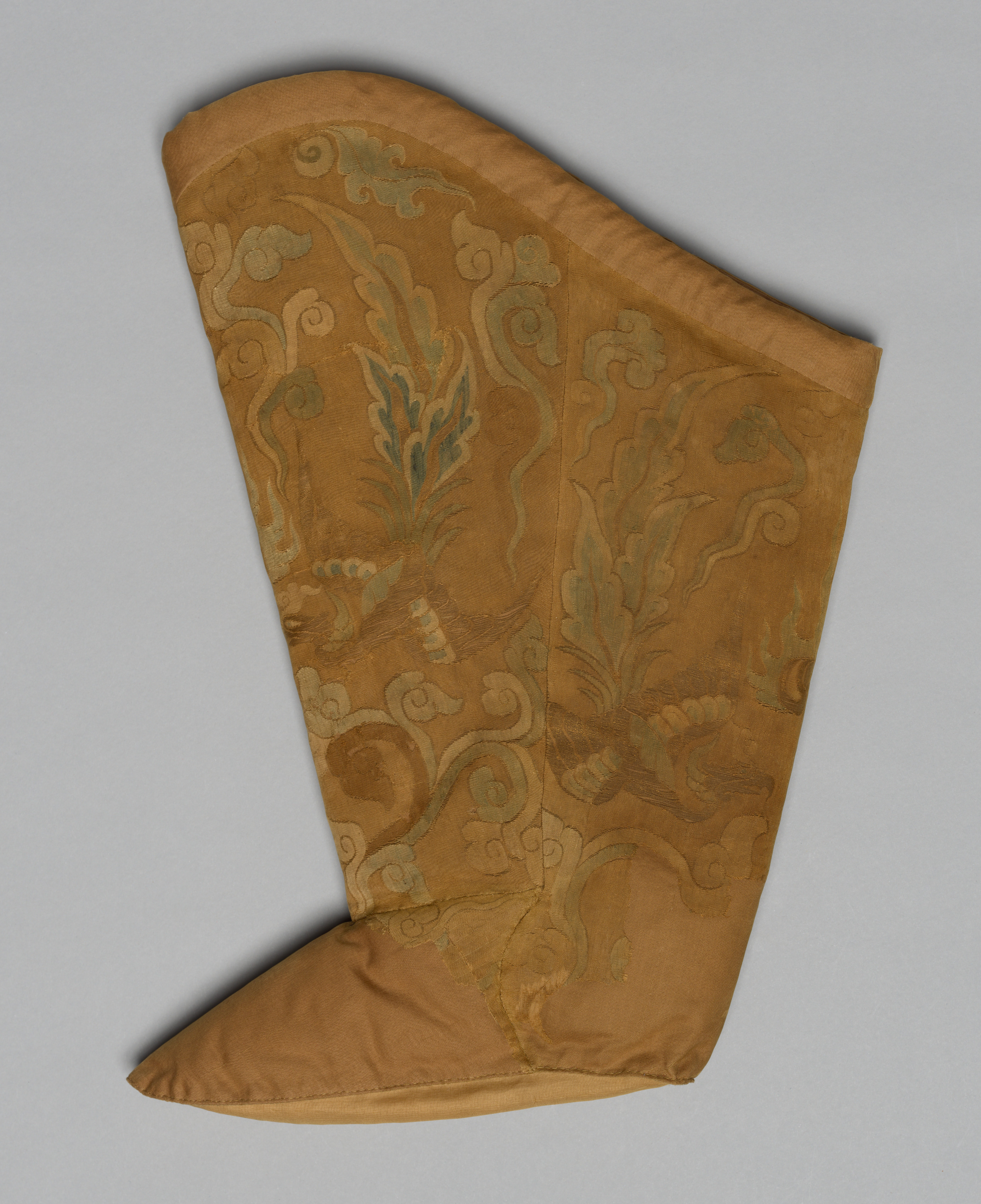
Deconstructing the Liao Dynasty Boot: An Avant-Garde Analysis for Zoey Fashion Lab
At Zoey Fashion Lab, our mission is to unearth the radical potential within historical artifacts, recontextualizing them as blueprints for avant-garde design. The subject of this analysis—a boot from the Liao dynasty (907-1125) of Northern China—presents a compelling case study. Crafted from silk in a tapestry weave and incorporating two distinct types of metal threads, this object transcends its functional origins. It becomes a resonant artifact of cultural synthesis, technical mastery, and aesthetic audacity. By deconstructing its materiality, structure, and implicit symbolism, we can extract core principles that directly inform a forward-thinking, avant-garde fashion collection.
Material Alchemy: Silk and Metal as a Dialectic
The boot’s primary material—silk in a tapestry weave—immediately signals luxury and technical sophistication. Silk, a natural protein fiber, is inherently fluid, lustrous, and strong. The tapestry weave, or kesi (cut silk), is a complex technique where weft threads are individually manipulated to create patterns, resulting in a fabric that is both structurally robust and visually intricate. This is not a passive material; it is a deliberate construction of surface and depth. The inclusion of two types of metal threads—likely flat strips of gilded paper or leather wrapped around a silk core, and finer, twisted metallic filaments—introduces a tactile and visual dialectic. One thread offers a broad, reflective plane of gold or silver; the other provides a textured, shimmering line. Together, they create a surface that oscillates between hard and soft, static and dynamic, ancient and futuristic.
For the avant-garde designer, this material pairing is a manifesto. It challenges the binary of natural versus synthetic. We can extrapolate a principle of “material dissonance”: combining opposing substances to generate new sensory experiences. In a contemporary context, this could translate to embedding photovoltaic threads into a silk substrate, or weaving recycled metallic waste into biodegradable cellulose fibers. The Liao boot teaches us that luxury is not about purity but about the tension between elements—the friction between the organic drape of silk and the rigid, reflective insistence of metal. This is a core tenet of Zoey Fashion Lab’s aesthetic: to create garments that feel like living sculptures, where every fold and seam is an argument.
Structural Silhouette: The Boot as Architectural Armature
The boot’s form, while fragmentary, suggests a distinct architectural logic. Liao dynasty footwear, influenced by the nomadic Khitan culture, often featured a high shaft, a rounded toe, and a robust sole suited for riding and rugged terrain. The tapestry weave would have provided a dense, almost felt-like structure, while the metal threads added rigidity and weight. This is not a delicate slipper; it is a piece of wearable armor. The boot encloses the foot and lower leg, creating a defined volume that interacts with the ground. Its silhouette is both protective and assertive.
From an avant-garde perspective, this boot can be read as a “negative space garment”. The form is defined not by the body it covers but by the void it creates. The shaft becomes a cylinder, the toe a capsule, the heel a fulcrum. This is a radical departure from the Western tradition of the shoe as a mere extension of the foot. Instead, it is a prosthetic, a second skin that alters posture and movement. For Zoey Fashion Lab, this inspires a series of “exoskeletal” footwear and legwear—pieces that are not worn but inhabited. Think of molded, laser-sintered polymer shafts that mimic the tapestry’s density, with integrated, flexible metal mesh panels that echo the metallic threads. The boot becomes a modular system, allowing the wearer to add or subtract structural elements—a cuff, a spur, a reinforced toe cap—transforming the silhouette from day to night, from static to kinetic.
Cultural Resonance: Archive as Avant-Garde Blueprint
The Archive Resonance provided—“在人类文明的长河中,器物与绘画不仅是时代技艺的结晶,更是文化碰撞与美学交融的无声见证。十六至十七世纪...”—frames this artifact within a broader narrative of cultural exchange. The Liao dynasty was a period of intense interaction between the sedentary Song Chinese and the nomadic Khitan, Jurchen, and Mongol peoples. The boot, with its Chinese silk and nomadic form, is a material testament to this fusion. It embodies a “transcultural aesthetic” where distinct traditions are not merely blended but recombined into something entirely new. The metal threads, possibly derived from Central Asian or Persian techniques, further underscore this globalized sensibility. This is not a hybrid; it is a synthesis that erases boundaries.
For the avant-garde designer, this is a powerful directive. We are not beholden to a single cultural lineage. The archive is not a repository of static forms but a toolkit for recombination. The Liao boot challenges us to “misread” history—to take its structural and material logics and apply them to contemporary problems. For instance, the boot’s tapestry weave can be reinterpreted as a digital jacquard pattern, where metal threads are replaced with conductive fibers that light up or change color in response to movement. The boot’s silhouette can be exaggerated into a towering, sculptural form, referencing both the Khitan horseman and the modern catwalk. By embracing the archive as a site of radical potential, we can create garments that are not merely nostalgic but prophetic.
Avant-Garde Applications: From Archive to Runway
Synthesizing these analyses, Zoey Fashion Lab can develop a capsule collection that reimagines the Liao boot as an avant-garde archetype. Consider the following design directions:
1. The “Tapestry Armor” Boot: A high-shaft boot constructed from a custom-woven silk and recycled metallic thread fabric. The weave is algorithmically generated to mimic the original kesi pattern but with a fractal, non-repeating motif. The boot is reinforced with a 3D-printed lattice structure at the ankle and heel, echoing the metal threads’ structural role. The sole is made from a bio-based polymer that hardens upon impact, offering both flexibility and protection.
2. The “Dissonant Thread” Legging: A full-leg garment that uses a double-layer construction: an inner layer of silk jersey for comfort, and an outer layer of hand-loomed tapestry with embedded metal threads. The metal threads are arranged in a gradient, from dense at the ankle to sparse at the hip, creating a visual and tactile transition from rigid to fluid. The garment is designed to be worn with or without a separate boot, allowing the wearer to modulate the silhouette.
3. The “Transcultural” Platform: A sculptural platform shoe that abstracts the boot’s form into a pure volume. The upper is a single piece of molded, translucent resin with metallic flakes suspended within, referencing the metal threads. The platform is carved from a single block of compressed cork and recycled rubber, echoing the boot’s robust sole. The shoe is intentionally ambiguous—neither boot nor sandal, neither Eastern nor Western—embodying the Liao dynasty’s spirit of synthesis.
Conclusion: The Boot as Provocation
The Liao dynasty boot is not a relic to be preserved but a provocation to be unpacked. Its silk and metal, its form and function, its cultural and technical origins all converge into a singular object that challenges our assumptions about fashion, history, and identity. For Zoey Fashion Lab, this analysis yields a clear directive: to design garments that are not passive but active, not decorative but structural, not nostalgic but visionary. The boot’s legacy is not in its preservation but in its transformation. By deconstructing its material, structural, and cultural DNA, we can create an avant-garde fashion that resonates with the same audacity, synthesis, and technical brilliance that defined its original creation. The archive is not a mirror of the past; it is a lens for the future.