Deconstructing the Ferry: Lacquerware as a Blueprint for SS26
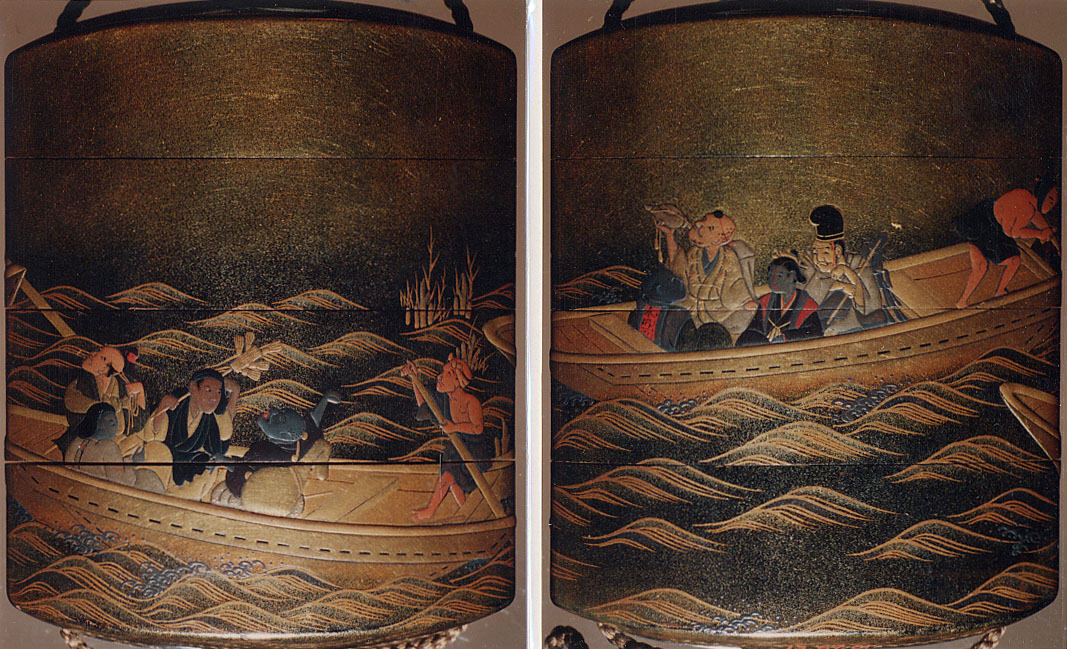
The Case (Inrō) with Design of People Riding in Ferryboats is not merely a historical artifact; it is a manifesto for the avant-garde. Hailing from Edo-period Japan, this lacquer box—crafted with fundame, nashiji, and gold and colored hiramakie—encapsulates a world of movement, layering, and transience. For Zoey Fashion Laboratory, this piece transcends its utilitarian origins to become a radical source code for SS26. We dissect its structural logic, its narrative of passage, and its material paradoxes to forge a collection that redefines futuristic silhouettes. This is not homage; it is a deconstructive appropriation of a cultural treasure to engineer the next frontier of garment architecture.
Structural Innovation: The Inrō as a Modular System
The Inrō’s fundamental design—a stack of nested compartments bound by a single cord—offers a revolutionary template for modular construction. Each tier is a discrete volume, yet they coalesce into a unified whole. For SS26, we translate this into segmented outerwear where each section is detachable and reconfigurable. Imagine a coat composed of three distinct lacquer-like panels: the upper yoke, the middle torso, and the lower skirt. These are not sewn but linked via magnetically sealed seams or interlocking organic fasteners, mimicking the Inrō’s cord-and-toggle system. The result is a futuristic silhouette that can shift from a sharp, compact bolero to an elongated, flowing duster within minutes. This modularity challenges the static nature of traditional couture, empowering the wearer to become a co-creator of form.
The interior nashiji and fundame—the speckled gold and matte ground—inspire a reverse-facing design ethic. We propose garments where the interior is as deliberate as the exterior. A jacket’s lining becomes a second skin of gold-flecked mesh, visible only through strategic slits or when the garment is inverted. This architectural duality echoes the Inrō’s hidden compartments, inviting the viewer to deconstruct the piece visually. The silhouette is not just a shell but a layered system of revealed and concealed volumes, a nod to the Japanese concept of ma—the space between objects.
Narrative of Movement: Ferryboats as Kinetic Silhouettes
The central motif—people riding in ferryboats—is a study in kinetic narrative. The figures are frozen in a state of transit, their forms compressed into the Inrō’s small scale. For SS26, we extrapolate this into garments that capture motion through asymmetrical draping and floating panels. A dress might feature a single sleeve that extends into a boat-like prow, its fabric stiffened with lacquer-infused resin to hold a permanent wave. The hemline is not straight but undulating, like water ripples, achieved through heat-set pleating that mimics the nashiji’s textured surface. The silhouette is futuristic in its refusal of stasis; it suggests a body perpetually in motion, crossing from one state to another.
The gold and colored hiramakie—the raised, flattened metal dust—translates into embossed surfaces that catch light asymmetrically. We envision a bodice where gold leaf is applied in a pattern of ferry wakes, creating a topographical map of the journey. The colors—ochres, deep indigos, and vermilions—are not flat but layered in translucent washes, echoing the fundame’s matte sheen. This is not decoration but structural storytelling: each color shift marks a moment in the narrative, a stop along the ferry route. The wearer becomes a living scroll, their body a vessel for passage.
Material Paradoxes: Lacquer, Fundame, and the Future of Textiles
The Inrō’s materials—lacquer, fundame, nashiji—are a study in contrast: the glossy, the matte, the speckled, the smooth. For SS26, we push this into fabric technology that simulates these effects through biomimetic coatings. A base of recycled silk organza is treated with a liquid crystal polymer that shifts between matte and gloss under different angles, mimicking the fundame’s subtle luster. Nashiji’s gold flecks are recreated via micro-encapsulated metallic particles woven into the fabric, creating a surface that glitters only when touched or moved. This is not ornament but functional architecture: the garment’s surface responds to environmental stimuli, much like the Inrō’s lacquer ages and patinas over time.
The hiramakie technique—raising gold powder into low-relief forms—inspires 3D-printed structural elements that are bonded to fabric. We propose shoulder caps and collar frames that echo the ferryboats’ prows, printed from biodegradable photopolymer and gilded with recycled gold leaf. These elements are not sewn but laminated onto the textile, creating a seamless union of hard and soft. The silhouette becomes a hybrid of body and architecture, where the garment’s structure is both support and ornament. This is deconstruction at the material level: breaking down the Inrō’s components to rebuild them as wearable, futuristic forms.
Futuristic Silhouettes: The Body as a Vessel
The Inrō’s compact, rectangular shape—designed to hang from a belt—inspires a new proportion for SS26. We envision elongated torsos with compressed waistlines, achieved through corseted panels that mimic the Inrō’s stacked compartments. The silhouette is not hourglass but architectural: a series of horizontal bands that visually segment the body, each band a different material or texture. The ferryboat motif is abstracted into diagonal seams that cut across these bands, suggesting the prow’s angle. The result is a futuristic silhouette that is both rigid and fluid, a paradox that defines the collection.
For evening wear, we propose a floor-length cape that opens at the front to reveal a nashiji-inspired interior—a gold-speckled lining that contrasts with the matte black exterior. The cape’s shoulders are exaggerated, formed by lacquer-like resin panels that curve outward like the sides of a boat. This is not a garment but a portable environment, a vessel for the body. The wearer becomes a figure in transit, suspended between the past and the future. The SS26 collection is not about clothing the body; it is about enclosing space, creating volumes that define and redefine the wearer’s relationship to their surroundings.
Conclusion: The Inrō as a Radical Blueprint
The Case (Inrō) with Design of People Riding in Ferryboats is a masterclass in compression, layering, and narrative. For Zoey Fashion Laboratory, it is a radical blueprint for SS26, challenging us to think beyond the garment as a simple covering. Through modular construction, kinetic draping, material innovation, and architectural silhouettes, we transform this Edo-period artifact into a futuristic manifesto. The collection is not a reproduction but a deconstructive analysis, a conversation between centuries. The avant-garde is not about the new; it is about the recontextualization of the old into something that has never been seen. This Inrō is our ferry, carrying us into the unknown waters of SS26.