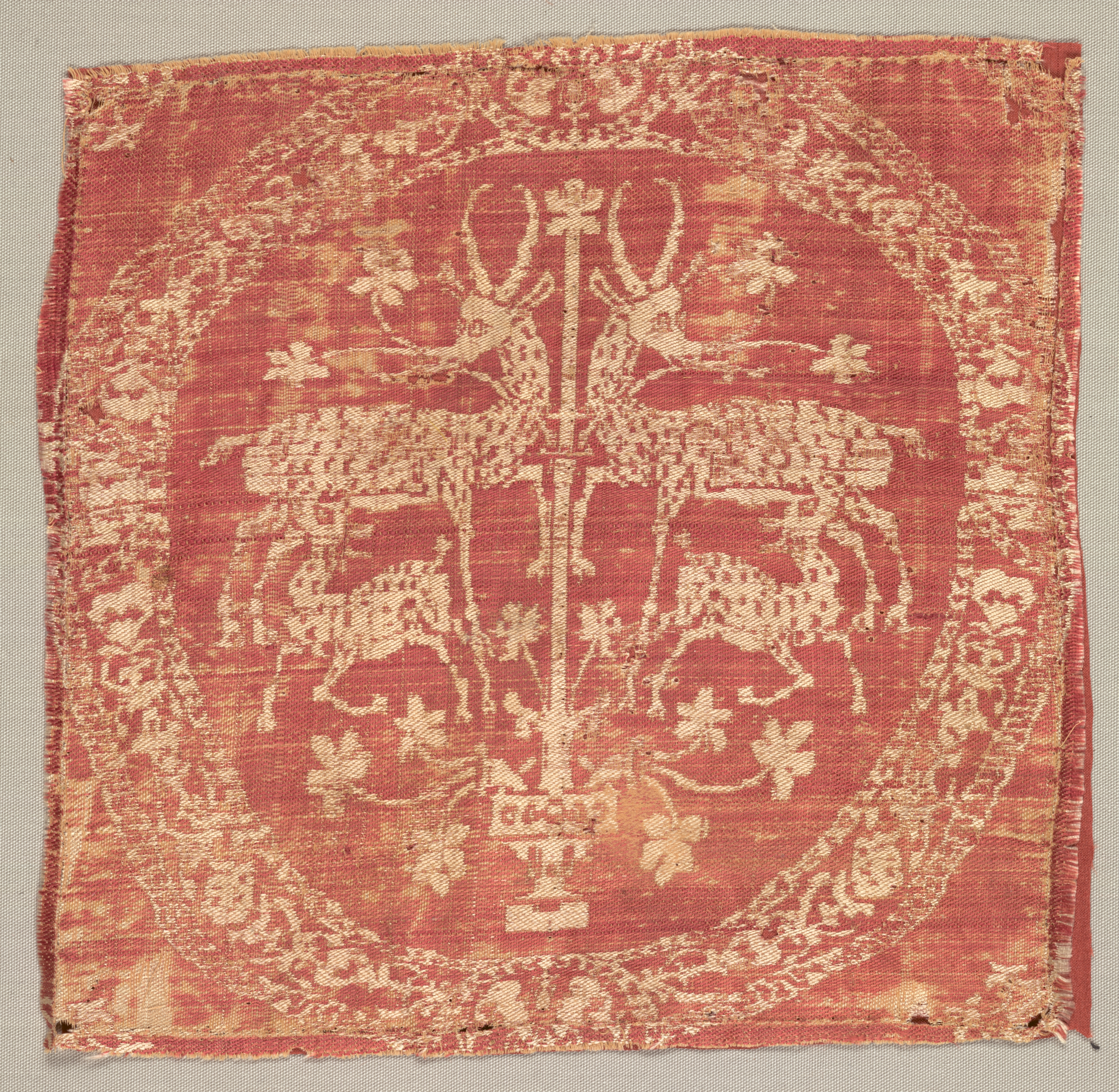
Deconstructing the Square Ornament: A Zoey Fashion Lab Analysis
At Zoey Fashion Lab, our mission is to reinterpret historical textiles through the lens of avant-garde design. The subject of this analysis—a square ornament from a tunic, originating in Egypt or Syria during the Umayyad (661–750) or Abbasid (750–1258) period—presents a compelling case study. Constructed from silk using a complementary weft-faced twill weave with inner warps, known as samite, this artifact embodies a sophisticated interplay of material, technique, and cultural symbolism. Our deconstruction focuses on how this ancient fragment can inspire a new DNA strand for contemporary fashion: one that merges historical precision with radical, avant-garde expression.
Technical Mastery: The Samite Weave as a Foundation for Avant-Garde Innovation
The technical brilliance of the square ornament lies in its samite weave, a structure that uses multiple weft threads to create a dense, patterned fabric. In this example, the complementary weft-faced twill technique involves two or more weft systems—one for the ground weave and one for the pattern—while inner warps provide stability and structure. This method allowed artisans to achieve intricate, polychrome designs that were both durable and luxurious. For Zoey Fashion Lab, this technical foundation offers a blueprint for avant-garde material exploration. The layering of wefts, for instance, can be reinterpreted as a metaphor for deconstructed layering in modern garments: think of sheer silks overlaid with metallic threads, or digital prints that mimic the complex interplay of warp and weft. The use of inner warps suggests a hidden architecture, a concept we can translate into structural boning or internal supports that shape avant-garde silhouettes—like exaggerated shoulders or asymmetrical drapes—without sacrificing fluidity.
Furthermore, the silk itself is a material of tension. In the Umayyad and Abbasid periods, silk was a symbol of wealth, trade, and cross-cultural exchange, often imported from China or produced locally in the Levant. For our avant-garde reinterpretation, silk becomes a canvas for material deconstruction: we might distress the fabric through laser cutting, chemical washing, or hand-tearing to create raw edges that contrast with its historical opulence. Alternatively, we could fuse silk with non-traditional materials like recycled plastics or conductive fibers, creating a dialogue between ancient luxury and contemporary sustainability. The square ornament’s precise geometric patterns—likely featuring stars, interlocking circles, or stylized vegetal motifs—can be abstracted into digital algorithms that generate asymmetrical, randomized patterns for 3D-printed textiles or laser-etched leathers, pushing the boundaries of what a “square ornament” can signify in a modern context.
Cultural and Symbolic Context: From Imperial Power to Avant-Garde Subversion
The square ornament’s origins in the Umayyad and Abbasid caliphates place it within a period of immense cultural and artistic flowering. These empires were centers of trade, science, and art, and their textiles often served as markers of political authority and religious identity. The square shape itself is significant: in Islamic art, squares often represent the four corners of the world, stability, and the earthly realm, while geometric patterns reflect the infinite nature of God. For Zoey Fashion Lab, this symbolism offers a rich vein for subversive reinterpretation. An avant-garde collection might take the square ornament as a starting point for disrupting traditional notions of order and symmetry. For example, we could deconstruct the square into fragmented, floating elements on a garment, suggesting a world in flux—a commentary on modern geopolitical instability or the fragmentation of identity in the digital age. The tunic, originally a unisex garment, can be reimagined as a gender-fluid piece, using the square ornament as a modular patch that can be attached, removed, or repositioned, challenging fixed ideas of body and clothing.
The Umayyad and Abbasid periods also saw the rise of tiraz workshops—state-run textile factories that produced luxury fabrics for the court. This institutional context inspires our avant-garde approach: we can treat the square ornament as a prototype for mass customization. By using digital fabrication techniques like CNC weaving or robotic embroidery, we can reproduce the ornament’s complexity while allowing for individual variation—each piece becomes a unique artifact, much like the original, but produced at scale. This blurs the line between historical craftsmanship and industrial production, a core tenet of avant-garde fashion. Additionally, the ornament’s likely use as a decorative patch on a tunic suggests a modularity we can expand: imagine a garment where multiple square ornaments—each with a different historical or symbolic reference—can be swapped in and out, creating a living archive of textile history on the body.
Avant-Garde Reinterpretation: The New DNA Strand
For Zoey Fashion Lab, the square ornament is not merely a historical artifact but a catalyst for a new design language. We propose a collection titled “Samite Fragments,” where the square ornament serves as a recurring motif, deconstructed and reconstructed through avant-garde techniques. The DNA strand we extract from this analysis can be summarized as follows:
- Material Alchemy: Combine silk with high-tech fibers (e.g., carbon fiber, biodegradable polymers) to create fabrics that are both luxurious and functional. Use the samite weave’s layering principle to develop double-faced textiles where the inside and outside tell different stories—one side historical, the other futuristic.
- Structural Deconstruction: Borrow the inner warp concept for architectural garments. Create internal “scaffolding” using boning, wire, or 3D-printed lattice that supports exaggerated forms—like a square-shaped bustle or a floating collar—while the outer fabric remains fluid. This echoes the tension between the ornament’s rigid geometry and the tunic’s flowing silhouette.
- Pattern Abstraction: Digitize the square ornament’s motifs and apply them through generative design algorithms. Output patterns that are asymmetrical, distorted, or fragmented, printed onto silk using reactive dyes or sublimation. This creates a visual language that honors the original while embracing chaos—a hallmark of avant-garde aesthetics.
- Modularity and Wearability: Design garments with detachable square panels, allowing the wearer to customize their look. Each panel could feature a different historical technique—from samite to brocade to digital print—creating a collage of textile history. This approach aligns with contemporary desires for sustainable, multifunctional fashion.
- Cultural Commentary: Use the ornament’s symbolism to critique modern power structures. For example, a deconstructed square on a jacket might represent the fragmentation of political authority, while a reconstructed, perfect square on a gown could evoke utopian ideals. The avant-garde thrives on such contradictions.
Conclusion: Bridging Centuries Through Deconstruction
The square ornament from an Umayyad or Abbasid tunic is more than a historical curiosity; it is a template for avant-garde innovation. At Zoey Fashion Lab, we see in its technical precision, cultural resonance, and geometric elegance a roadmap for creating fashion that is both rooted in tradition and radically forward-looking. By deconstructing its weave, reimagining its symbolism, and translating its structure into modern materials and methods, we can produce a new DNA strand for fashion—one that honors the past while breaking all the rules. The result is a collection that speaks to the timeless human desire for beauty, order, and subversion, embodied in silk and thread across centuries. This is the Zoey Fashion Lab approach: to look back with respect, deconstruct with precision, and create with audacity.