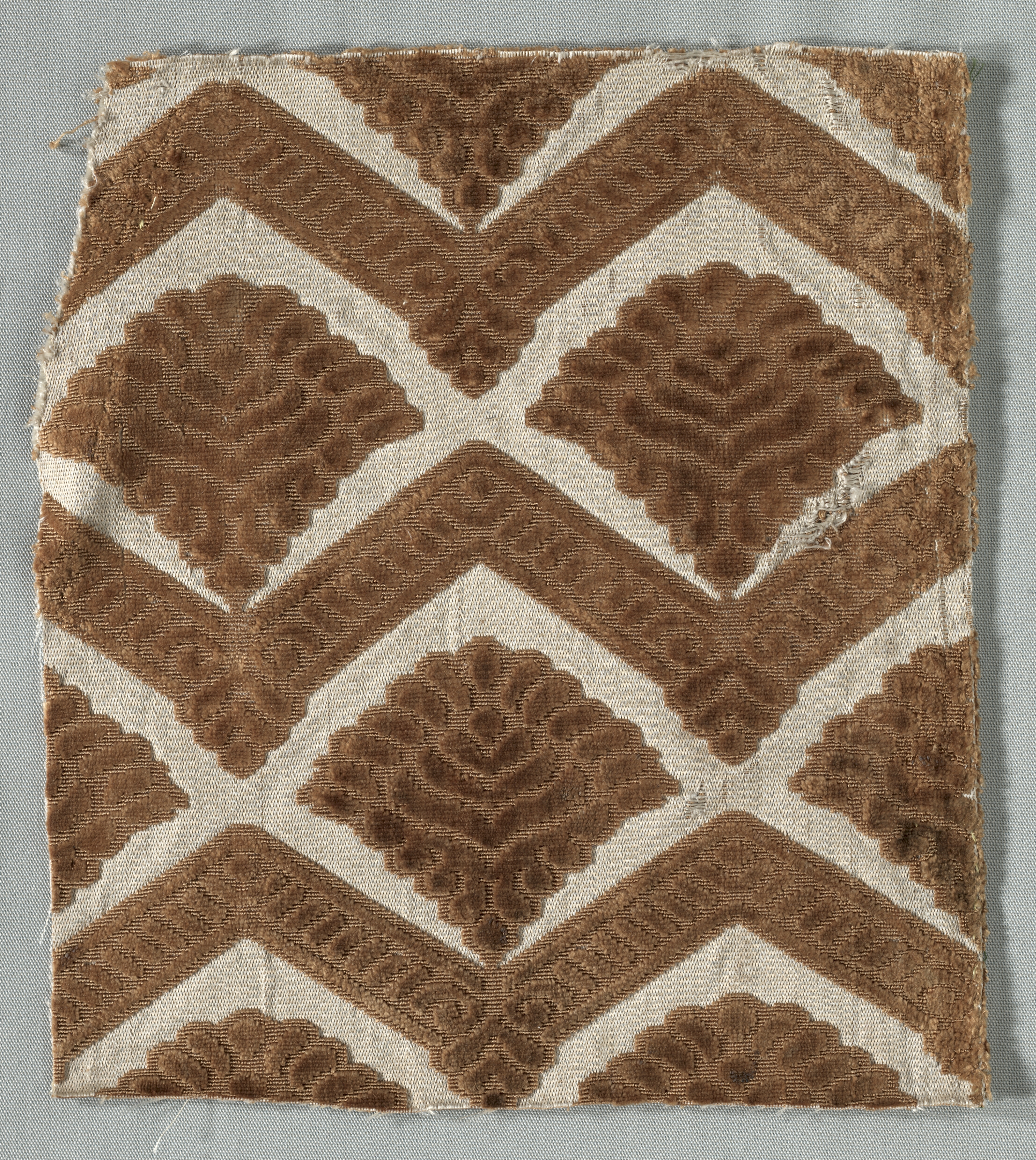
Deconstructing the Baroque: A Technical and Stylistic Analysis of a 17th-Century Italian Velvet Fragment
At Zoey Fashion Lab, our mission is to unearth the latent potential within historical textiles, transforming them into catalysts for avant-garde design. The subject of this analysis—a 17th-century Italian velvet fragment, composed of silk with both cut and uncut pile—represents a pinnacle of Baroque craftsmanship. This fragment is not merely a relic; it is a New DNA Strand—a genetic blueprint for radical, future-facing fashion. By deconstructing its technical, material, and aesthetic properties, we can extract principles that resonate with the ethos of avant-garde design: tension, texture, and temporal dislocation.
Technical Analysis: The Duality of Cut and Uncut Velvet
The fragment’s most defining technical feature is its use of both cut and uncut velvet (also known as ciselé velvet). In cut velvet, the loops of the pile are severed to create a soft, plush surface that absorbs light, resulting in deep, rich shadows. In uncut velvet, the loops remain intact, forming a more rigid, reflective texture that catches light in a linear, almost metallic sheen. This dual-pile technique creates a dynamic interplay between matte and gloss, softness and structure, depth and surface.
From an avant-garde perspective, this duality is a powerful tool for subverting expectations. The cut pile offers a tactile invitation—a luxurious softness that suggests comfort and tradition. In contrast, the uncut loops introduce an element of resistance, a deliberate roughness that disrupts the smooth narrative of luxury. For Zoey Fashion Lab, this suggests a design principle: the intentional juxtaposition of opposing textures can create a garment that is both sensuous and confrontational, familiar and alien. A contemporary application might involve laser-cutting specific areas of a velvet garment to create a controlled pattern of cut and uncut sections, generating a topographic map of light and shadow on the body.
Furthermore, the structural integrity of the uncut loops provides a natural armature for deconstruction. In an avant-garde context, these loops could be left exposed, frayed, or even chemically altered to create a distressed, post-industrial aesthetic. The fragment teaches us that the construction of a textile is as important as its surface—a lesson that aligns with the deconstructivist ethos of revealing the skeleton of a garment.
Material Analysis: Silk as a Conductor of History and Innovation
The use of silk as the base fiber is critical. Silk’s natural protein structure allows for exceptional dye absorption, which in the 17th century produced the deep crimsons, purples, and golds favored by the aristocracy. For Zoey Fashion Lab, however, silk is not just a symbol of opulence; it is a material with inherent contradictions. It is strong yet delicate, smooth yet capable of holding intricate textures. This paradox is central to avant-garde design, which thrives on ambiguity.
In the context of the New DNA Strand, silk becomes a medium for genetic manipulation. We can envision treating this historical silk with modern bio-fabrication techniques—embedding it with conductive threads, coating it with biodegradable polymers, or dyeing it with color-changing bacteria. The 17th-century velvet fragment, with its dense pile and rich history, becomes a substrate for hybridity. For instance, a gown could feature a panel of this historical silk, preserved in its original state, alongside a digitally printed, futuristic version of the same pattern. This creates a dialogue between past and future, handcraft and algorithm, organic and synthetic.
The weight and drape of the silk also inform garment construction. The fragment’s substantial pile suggests a fabric that holds its shape, making it ideal for sculptural, architectural silhouettes. Zoey Fashion Lab might use this velvet to create exaggerated shoulders, asymmetrical collars, or rigid, folded structures that defy the body’s natural form. The material’s historical association with courtly dress can be subverted by using it for streetwear-inspired designs—a velvet hoodie, perhaps, with the cut pile forming a Baroque pattern on the back, while the uncut loops create a ribbed, almost industrial texture on the sleeves.
Stylistic Analysis: The Avant-Garde as Temporal Collage
The fragment’s origin in 17th-century Italy places it within the Baroque period, characterized by drama, movement, and excess. For the avant-garde designer, this is not a style to be replicated but a vocabulary to be recontextualized. The fragment’s pattern—likely a floral or arabesque motif—represents a specific moment in European design history. In the hands of Zoey Fashion Lab, this pattern becomes a ghost, a trace of the past that haunts the present.
The New DNA Strand reference suggests a biological, evolutionary approach to design. Rather than merely borrowing the fragment’s pattern, we treat it as a genetic code that can be mutated, spliced, and recombined. An avant-garde collection might feature garments where the velvet pattern is digitally distorted, stretched, or fragmented across seams. The cut and uncut pile could be used to create a visual illusion of depth, as if the pattern is growing out of the fabric itself—a 3D, almost organic texture that blurs the line between textile and sculpture.
Furthermore, the fragment’s historical weight can be used to critique contemporary fashion’s obsession with novelty. By incorporating a 400-year-old textile into a modern design, the garment becomes a time capsule, forcing the viewer to confront the passage of time and the impermanence of style. This aligns with the avant-garde tradition of détournement—taking a familiar object and placing it in an unfamiliar context to create new meaning. A velvet fragment from a 17th-century Italian church vestment, for example, could be repurposed as the lining of a deconstructed bomber jacket, its sacred origins clashing with the secular, utilitarian garment.
Conclusion: From Fragment to Future
The 17th-century Italian velvet fragment is far more than a historical artifact. Its technical duality of cut and uncut pile, its material richness of silk, and its stylistic resonance with Baroque drama provide a rich foundation for avant-garde experimentation. At Zoey Fashion Lab, we see this fragment as a New DNA Strand—a genetic starting point for designs that are both reverent and rebellious, timeless and timely. By deconstructing its technical and aesthetic properties, we can create garments that challenge the boundaries of fashion, weaving history into the very fabric of the future.
In practice, this means embracing the fragment’s contradictions: softness versus rigidity, tradition versus innovation, luxury versus deconstruction. The result is a collection that speaks to the complexity of our time—a time when the past is never truly past, and the future is always being woven from the threads of history. For Zoey Fashion Lab, the velvet fragment is not a reference point; it is a living, breathing blueprint for the avant-garde.