Deconstructing the Kozuka: Architectural Metallurgy for SS26
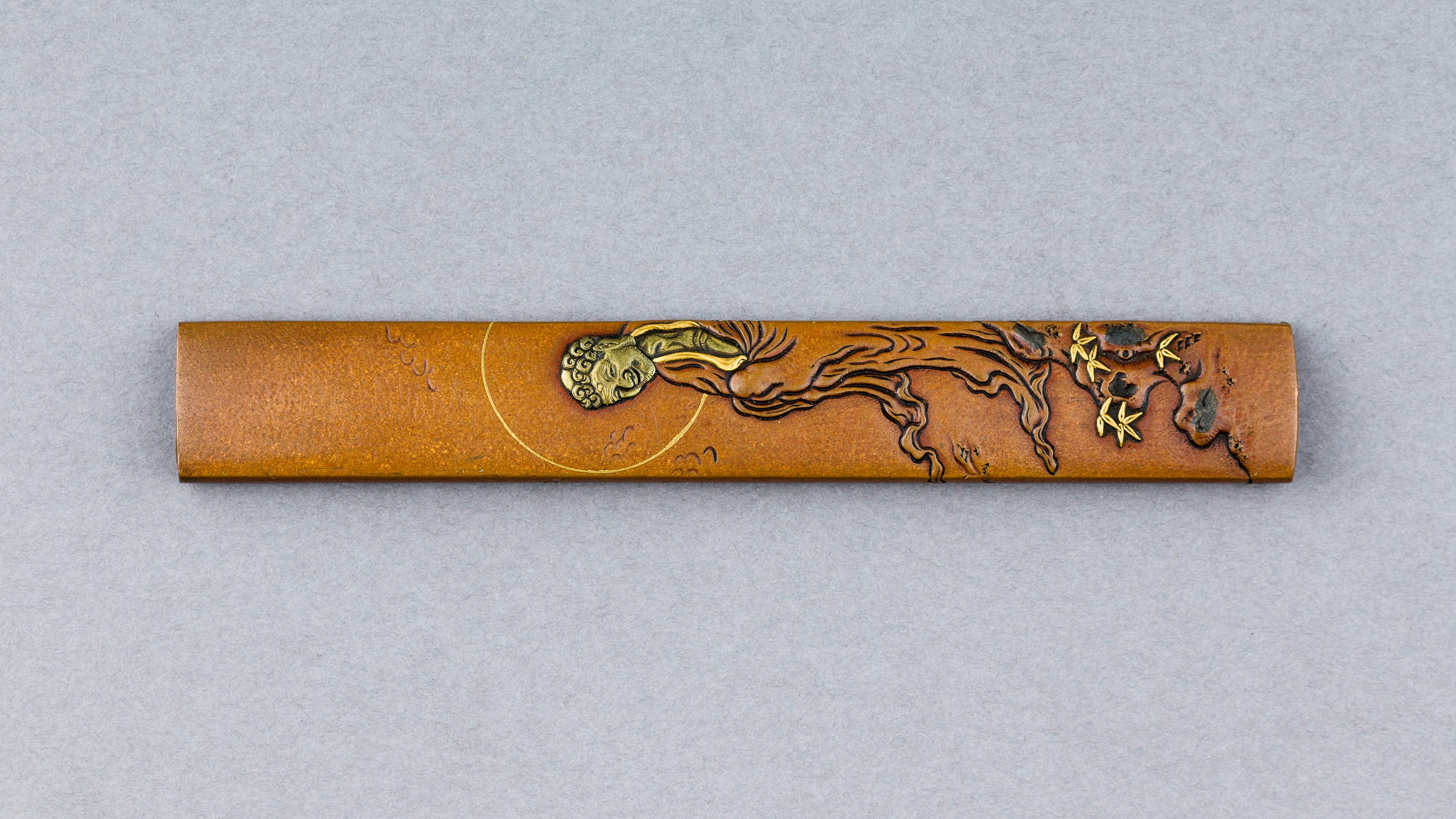
The avant-garde atelier of Zoey Fashion Laboratory has long sought to dissolve the boundaries between weaponry, adornment, and architecture. For the SS26 collection, we turn our gaze to the Kozuka—the Japanese knife handle, a diminutive yet potent artifact of the samurai era. Typically forged from a trinity of copper, gold, silver, and the nuanced alloy known as sentoku, the Kozuka is not merely a utilitarian object; it is a manifesto of restrained power, a study in structural innovation that predates modern minimalism by centuries. This analysis dissects the Kozuka’s material dialectic and its radical potential for futuristic silhouettes, proposing a collection where garments become wearable architecture—rigid yet fluid, ancient yet hyper-modern.
Material Alchemy: From Sentoku to Silhouette
The core of the Kozuka’s avant-garde appeal lies in its material composition. Sentoku, a copper alloy prized for its warm, bronze-like patina, is often inlaid with gold and silver to create intricate landscapes or mythical creatures. This is not decoration; it is a deliberate juxtaposition of base and precious, of earth and sky. For Zoey Fashion Laboratory, this translates directly into fabric engineering. We propose a new textile: a metallic mesh woven from copper-infused nylon threads, selectively electroplated with 24-karat gold and sterling silver. The result is a fabric that shifts in reflectivity and weight, mimicking the Kozuka’s surface—matte in one light, blindingly luminous in another.
This textile becomes the foundational structure for what we term “armored drapery.” The garment’s silhouette is not draped in the classical sense; it is forged. Consider a floor-length coat where the left panel is a solid, unbroken sheet of gold-plated mesh, while the right panel dissolves into a cascade of silver-threaded fringe. This asymmetry echoes the Kozuka’s typical design, where the handle’s front (omote) is lavishly decorated, while the back (ura) remains starkly minimal. The structural innovation lies in the laser-cut articulation of the panels, allowing the garment to remain fluid despite its metallic density. The silhouette becomes a living sculpture, its volume dictated by the wearer’s movement—a futuristic reimagining of the samurai’s armor as haute couture.
Futuristic Silhouettes: The Kozuka’s Unseen Geometry
Traditional Kozuka handles are typically curved to fit the palm, with a subtle taper that belies their ergonomic precision. For SS26, we abstract this geometry into a series of non-linear silhouettes. The key piece is the “Kozuka Gown”—a sheath dress that appears to be cut from a single, continuous plane of sentoku-colored silk-satin. However, upon closer inspection, the dress is bisected by a dramatic, diagonal seam that traces the exact curve of a Kozuka’s spine. This seam is not stitched; it is cold-fused using a proprietary polymer that bonds fabric without thread, creating a rigid, knife-like edge that stands away from the body.
This edge is the collection’s structural signature. It creates a silhouette that is simultaneously sharp and soft—a “blunted blade” effect. The shoulder line, for instance, is extended into a sharp, asymmetrical point on one side, while the opposite shoulder is completely bare, supported only by a single gold chain that mimics the Kozuka’s kurikata (the cord attachment hole). The result is a garment that defies gravity, its volume held in tension by a single metallic point. This is not fashion; it is wearable engineering, where every line references the knife handle’s function as a tool of precision and restraint.
Structural Innovation: The Sentoku Corset and Kinetic Panels
Perhaps the most radical proposition for SS26 is the Sentoku Corset. Unlike traditional corsets that compress the torso, this piece expands outward, using a lattice of copper-alloy rods (inspired by the Kozuka’s metal layers) to create an exoskeleton. The rods are hinged at the waist, allowing the upper torso to articulate independently of the hips. The corset’s front panel is a single, polished piece of sentoku (simulated via 3D-printed resin with metallic powder), while the back is composed of silver and gold scales that overlap like the Kozuka’s inlay. This structural dichotomy—rigid front, kinetic back—allows the garment to transform from a static sculpture into a dynamic second skin as the wearer moves.
The innovation extends to the sleeve architecture. Drawing from the Kozuka’s handle, which often features a subtle groove for the thumb, we design sleeves that are not tubes but “blade sheaths”. Each sleeve is constructed from two separate panels: a rigid, gold-plated outer shell that follows the arm’s contour, and an inner, silver-mesh lining that is free-floating and flexible. The two panels are connected only at the shoulder and wrist, creating a void between them. This void allows air to circulate, while the outer shell casts a sharp, architectural shadow. The silhouette is futuristic in its austerity—a clean line that evokes the Kozuka’s precision, yet subverts it through its radical deconstruction of the sleeve itself.
Conclusion: The Kozuka as a Blueprint for Tomorrow
The Kozuka is not a relic; it is a blueprint. Its marriage of precious metals with functional alloy, its balance of ornament and restraint, and its geometric precision offer a lexicon for the avant-garde. For Zoey Fashion Laboratory’s SS26 collection, this knife handle becomes a catalyst for a new aesthetic: one where garments are not worn but wielded. The silhouettes are sharp yet organic, metallic yet fluid, ancient yet unequivocally futuristic. Through material alchemy and structural innovation, we transform a weapon of the past into an armor for the future—a testament to the enduring power of deconstructive thought in the realm of high fashion.