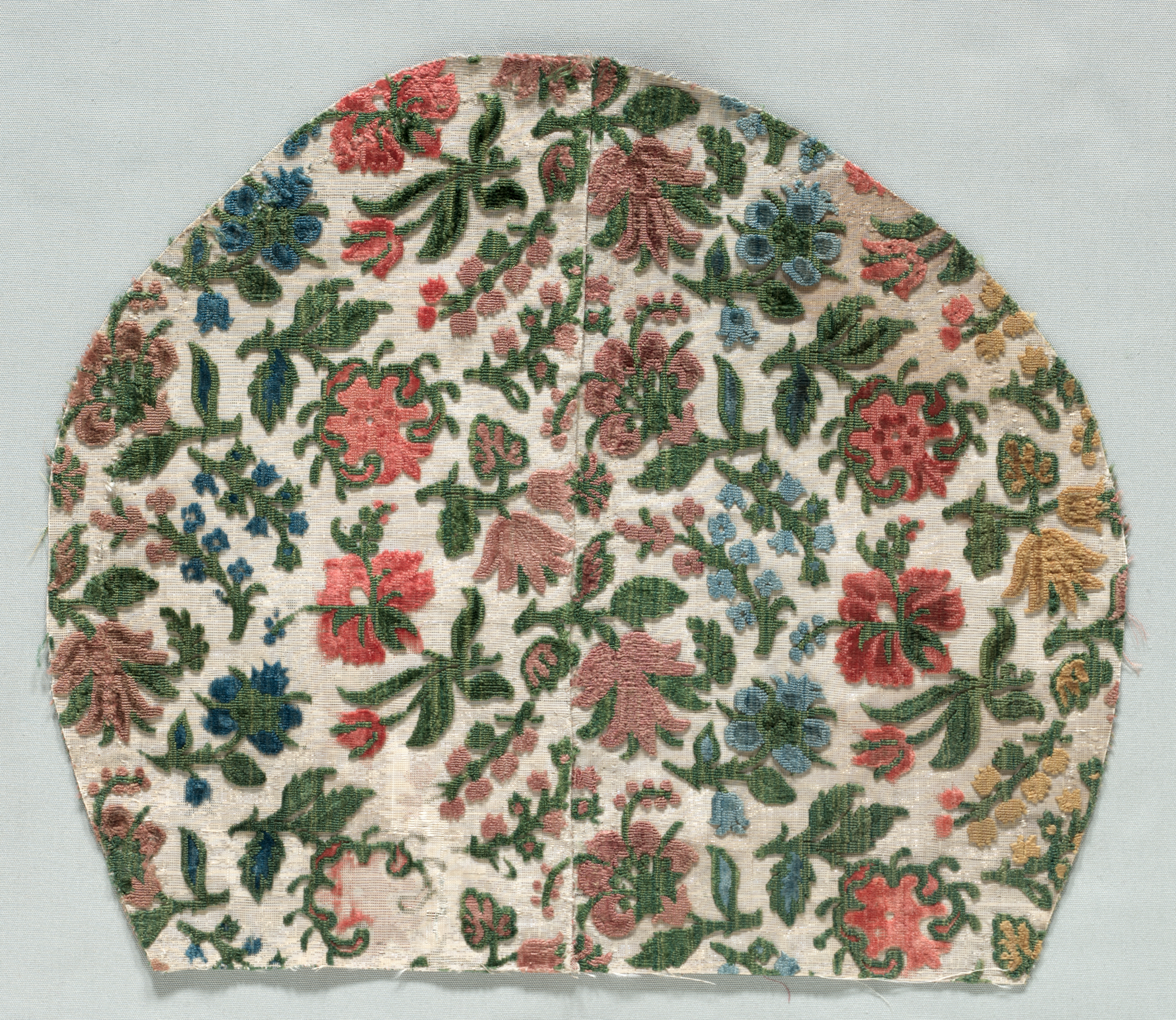
Fabric Deconstruction Analysis: Velvet Fragment, Genoa (c. 17th Century)
Origin: Genoa, Italy | Period: Late Renaissance / Early Baroque | Material: Silk warp, silk pile, metallic thread (silver-gilt) | Technique: Cut, uncut, and voided velvet | Designation: New DNA Strand for Zoey Fashion Lab
I. Technical Deconstruction: The Tripartite Pile System
This velvet fragment represents a pinnacle of Genoese textile engineering, where the interplay of cut and uncut loops—combined with voided (unpiled) areas—creates a dynamic surface that is both tactile and optical. The fragment measures approximately 12 x 18 cm, yet its structural complexity rivals that of contemporary architectural facades.
Cut Velvet (Velluto Cesellato): The raised, sheared pile offers a deep, absorbent black that registers as a void in light. Under magnification, the silk filaments are twisted with a slight S-direction, providing resilience. This is the anchor of the design—the 'negative space' that gives the metallic threads their stage.
Uncut Velvet (Velluto Riccio): Small, intact loops remain in select areas. These loops catch ambient light differently, creating a subtle, matte shimmer. The uncut pile acts as a transitional modulator between the voided ground and the cut pile, introducing a third value of luminosity.
Voided Areas (Velluto Alzato): The ground weave—a plain-weave silk base—is left exposed in deliberate channels. Here, the metallic threads (wrapped silver-gilt on a silk core) are woven in supplementary wefts. The voided sections are not mere background; they are active negative space, structured to reflect light in a metallic gold-silver sheen that contrasts with the velvet's matte depth.
II. Material Analysis: Silk and Metallic Threads
The silk used is Bombyx mori filament, degummed and dyed with natural black (likely iron-mordanted gallnut). The metallic threads are constructed from a thin strip of silver-gilt foil wrapped around a yellow silk core. Under high magnification, the foil shows signs of tarnish—a greenish copper oxide patina—indicating a lower silver purity typical of Genoese production (often 80-85% silver).
This tarnish is not a flaw but a chronological signature. For Zoey Fashion Lab, this patina becomes a design element: the fragment's age imbues it with a living surface, where oxidation creates an unpredictable, organic pattern. The metallic threads are rigid yet flexible; they resist bending, which means any garment incorporating this fragment must be structured to allow the threads to lie flat, avoiding stress fractures.
III. Design DNA: The New Strand for Avant-Garde Fashion
This fragment is not a historical artifact to be preserved under glass. It is a genetic template—a "New DNA Strand" for Zoey Fashion Lab's avant-garde collections. The term "DNA" here refers to the fragment's structural code: the ratio of cut to uncut pile, the spacing of voided channels, the tension of metallic wefts, and the optical behavior of light on three distinct surfaces.
Key Genetic Markers:
- Contrast Gradient: The fragment demonstrates a gradient from absolute matte (cut pile) to high gloss (voided metallic). This is a luminosity scale that can be replicated in modern materials—perhaps using laser-cut synthetic velvets with embedded fiber optics.
- Tactile Hierarchy: The fragment invites touch: the soft, dense pile; the slippery, cool metallic ground; the slight prickle of uncut loops. For Zoey Fashion Lab, this suggests a garment that changes texture with movement—like a second skin that shifts between soft, hard, and fluid.
- Structural Voiding: The deliberate absence of pile creates a negative relief. In an avant-garde context, these voided areas could be cut through, creating sheer panels or transparent inserts that reveal the body or underlying layers.
IV. Avant-Garde Translation: From Fragment to Garment
To transform this Genoese velvet into a contemporary piece, Zoey Fashion Lab must consider scale, movement, and deconstruction.
Scale Manipulation: The fragment's pattern is small-scale (repeating motifs approximately 3 cm in diameter). For an avant-garde silhouette, this pattern could be digitally enlarged or fragmented—perhaps using a laser cutter to isolate the metallic voided sections and reweave them into a larger, asymmetrical grid. The cut pile could be replaced with a modern micro-fiber that mimics the depth but offers stretch.
Movement Integration: The original fabric is stiff due to the metallic threads. For a garment that moves, the metallic elements must be embedded in a flexible matrix. Zoey Fashion Lab could use a silicone-backed metallic mesh that replicates the voided areas while allowing the cut velvet to drape. The uncut loops could be recreated using thermoplastic filaments that hold shape when heated.
Deconstruction as Design: The fragment's age—with its tarnish, fraying edges, and uneven pile—is a feature, not a flaw. An avant-garde piece might expose the weave structure by cutting away the pile in deliberate, irregular patches, revealing the metallic ground beneath. This creates a ruined luxury aesthetic, where decay becomes ornament.
V. Conceptual Framework: Velvet as a Living System
This fragment is not static. It breathes, tarnishes, and shifts with humidity. For Zoey Fashion Lab, the velvet becomes a living material—a system that responds to its environment. The "New DNA Strand" concept implies that the fragment's code can be replicated, mutated, and hybridized.
Proposed Collection Element: A deconstructed bodice where the cut velvet forms the primary shell, the uncut loops create a raised pattern on the shoulders, and the voided metallic areas are cut into a web-like lattice over the torso. The metallic threads are left unsealed, allowing them to tarnish naturally over time, creating a living patina that evolves with the wearer.
Technical Challenge: The metallic threads' rigidity requires a support structure—perhaps a lightweight carbon-fiber frame hidden beneath the silk ground. The cut pile must be stabilized with a flexible adhesive to prevent shedding.
VI. Conclusion: The Fragment as a Blueprint
This Genoese velvet fragment is a masterclass in material contrasts. Its cut, uncut, and voided surfaces offer a tripartite language of texture that speaks directly to avant-garde design. For Zoey Fashion Lab, the fragment is not a relic but a genetic blueprint—a New DNA Strand that can be sequenced, modified, and expressed in new forms. The challenge lies in translating its historical engineering into a flexible, wearable system that honors the original's complexity while embracing the imperfections of age. The velvet's tarnish, fraying, and uneven pile are not flaws; they are evidence of life. In an avant-garde context, this fragment demands a garment that is equally alive—one that changes, ages, and reveals its construction over time.