Deconstructing the Sacred: The Mandala of Kasuga Shrine as Blueprint for SS26 Avant-Garde Couture
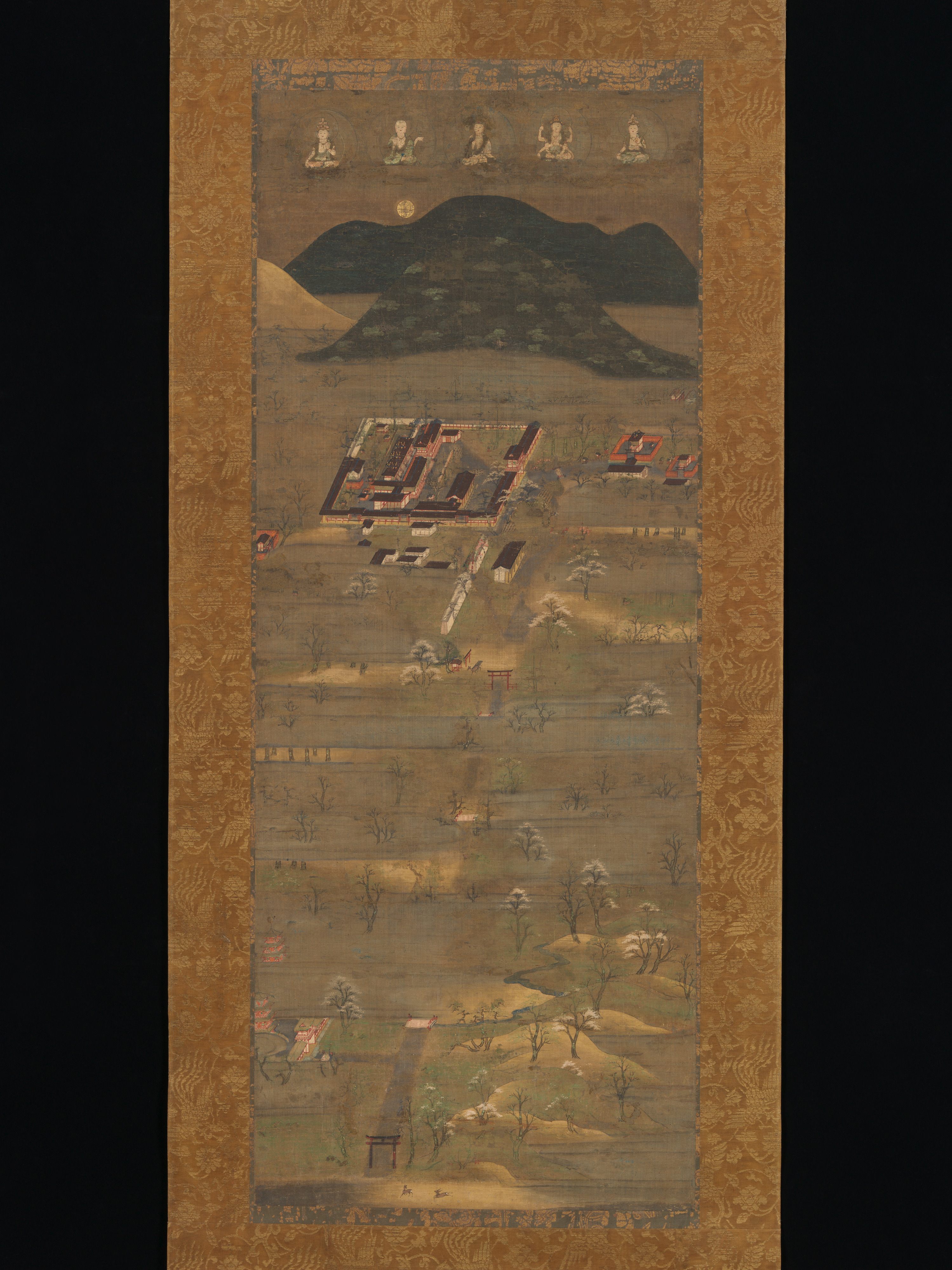
The Mandala of Kasuga Shrine, a hanging scroll executed in ink, color, and gold on silk, is not merely a religious artifact; it is a cartography of transcendence. For Zoey Fashion Laboratory, this 14th-century Japanese masterpiece offers a radical departure from conventional inspiration. Its geometric purity, symbolic layering, and material opulence serve as a precise architectural lexicon for the SS26 collection. This analysis deconstructs the mandala’s formal elements—its radial composition, hierarchical space, and gold-leaf luminosity—into a series of structural innovations that redefine the futuristic silhouette. The result is a garment system that fuses sacred geometry with deconstructive aesthetics, producing a high-concept wardrobe for the post-human epoch.
Radial Symmetry and the Silhouette of Ascension
The mandala’s core is a centralized, radiating structure. The Kasuga Shrine mandala organizes its deities, shrines, and natural elements around a vertical axis, creating a vortex of spiritual energy. In the SS26 collection, this radial logic is translated into asymmetrical, spiraling volumes that wrap the body. Imagine a coat constructed from a single, continuous panel of silk organza, its hemline cut in a logarithmic spiral that mimics the mandala’s concentric circles. The garment does not rest flat; it rises, twisting upward from the left hip to the right shoulder, creating a dynamic, gravitational defiance. This is not a dress but a wearable mandala—a three-dimensional diagram of movement.
The structural innovation lies in the negative space. The mandala’s blank silk backgrounds are not voids; they are active fields that allow the painted elements to breathe. Similarly, the SS26 silhouette employs strategic cutouts and floating panels. A tailored jacket, for instance, features a void at the sternum, echoing the mandala’s central emptiness where the sacred resides. This absence is not a lack but a portal. The fabric—a hybrid of recycled metallic threads and raw silk—is suspended on carbon-fiber armatures, creating a tension between rigidity and flow. The silhouette is both armor and aura, a futuristic exoskeleton that channels the mandala’s hierarchical order—from the earthly base to the celestial apex.
Gold on Silk: Luminosity as Structural Material
The gold application on the Kasuga mandala is not decorative; it is structural. The gold leaf defines the boundaries of shrines, halos, and sacred mountains, acting as a luminous skeleton. For Zoey, gold becomes a textile engineering tool. We propose a new fabric technology: electro-luminescent threads woven into a base of black silk. These threads are programmed to activate in gradients, mimicking the mandala’s gold highlights. When the wearer moves, the garment emits a soft, directional glow, transforming the body into a living mandala. This is not light applied to fabric; it is light as fabric—a structural component that defines form.
The color palette is equally radical. The mandala’s muted earth tones—ochre, indigo, vermillion—are reimagined as bio-luminescent pigments that shift under different light spectra. A coat in deep indigo appears black in daylight but reveals a constellation of gold micro-dots at dusk, echoing the mandala’s hidden intricacies. The silk itself is reconstructed through laser-cutting into fractal patterns, each cut line following the scroll’s ink strokes. This is deconstruction as creation: the garment’s surface is a palimpsest of the original, where every tear and seam references the mandala’s painted layers.
Hierarchical Space and the Deconstructive Silhouette
The Kasuga mandala operates on a strict spatial hierarchy: the sacred shrine at the top, the earthly realm at the bottom, and the intermediary space of deities. This vertical stratification is reimagined in the SS26 collection as modular garment architecture. A single ensemble can be disassembled into three distinct layers, each representing a mandala tier. The outermost layer—a translucent, gold-flecked cape—symbolizes the celestial. The middle layer—a structured bodice with woven copper wire—embodies the divine intermediary. The innermost layer—a raw, unbleached silk shift—references the earthly. The wearer can rearrange these layers, creating a personal cosmology of dress. This is not fashion; it is wearable ritual.
The deconstructive aesthetic is pushed further through intentional asymmetry. The mandala’s perfect symmetry is disrupted by the hand-painted strokes of the artist—a human imperfection within a divine order. Zoey’s collection celebrates this tension. A jacket’s left sleeve is elongated into a train, while the right sleeve is cropped to the elbow. The seams are left raw, the stitching exposed, as if the garment is still in the process of being created. This is not unfinished; it is structural honesty. The gold threads are not hidden but traced along the seams, turning the garment’s construction into a visual narrative of the mandala’s creation.
Futuristic Silhouettes: The Body as Shrine
The ultimate innovation is the body-shrine silhouette. The mandala’s primary function is to house the sacred; the SS26 garment becomes a portable sanctuary. A key piece is the “Kasuga Cage”—a lattice of recycled aluminum and silk panels that form a geometric exoskeleton around the torso. The cage is not restrictive; it is a framework for movement, allowing the body to exist within a defined space. The silk panels are printed with a digital reconstruction of the mandala’s ink strokes, but the pattern is algorithmically distorted to create a parallax effect—shifting as the wearer turns. This is a garment that sees, that responds, that becomes a living artifact.
The footwear continues the theme: platform sandals with laser-cut soles that echo the mandala’s concentric rings. Each step prints a temporary, gold-dusted mandala on the ground, a fleeting ritual of movement. The headpieces are minimal—a single, curved gold band that traces the hairline, a nod to the mandala’s circular framing. The entire collection is a system of wearable geometry, where every line, every void, every glow is a direct translation of the Kasuga Shrine mandala’s sacred code.
Conclusion: The Sacred in the Secular
The Mandala of Kasuga Shrine, when stripped of its religious context, reveals a universal language of structure, light, and hierarchy. For Zoey Fashion Laboratory, this language is the foundation for an avant-garde couture that is both ancient and futuristic. The SS26 collection does not mimic the mandala; it re-embodies it. Through radial silhouettes, electro-luminescent textiles, and modular deconstruction, the collection transforms the body into a shrine—a vessel for the sacred within the profane world of fashion. This is not a trend; it is a paradigm shift. The garment is no longer a covering but a cosmological diagram, a wearable mandala that invites the wearer to ascend, to radiate, to become.