Deconstructing the Sicán Beaker: An Avant-Garde Analysis of Gold, Narrative, and Material Dissonance
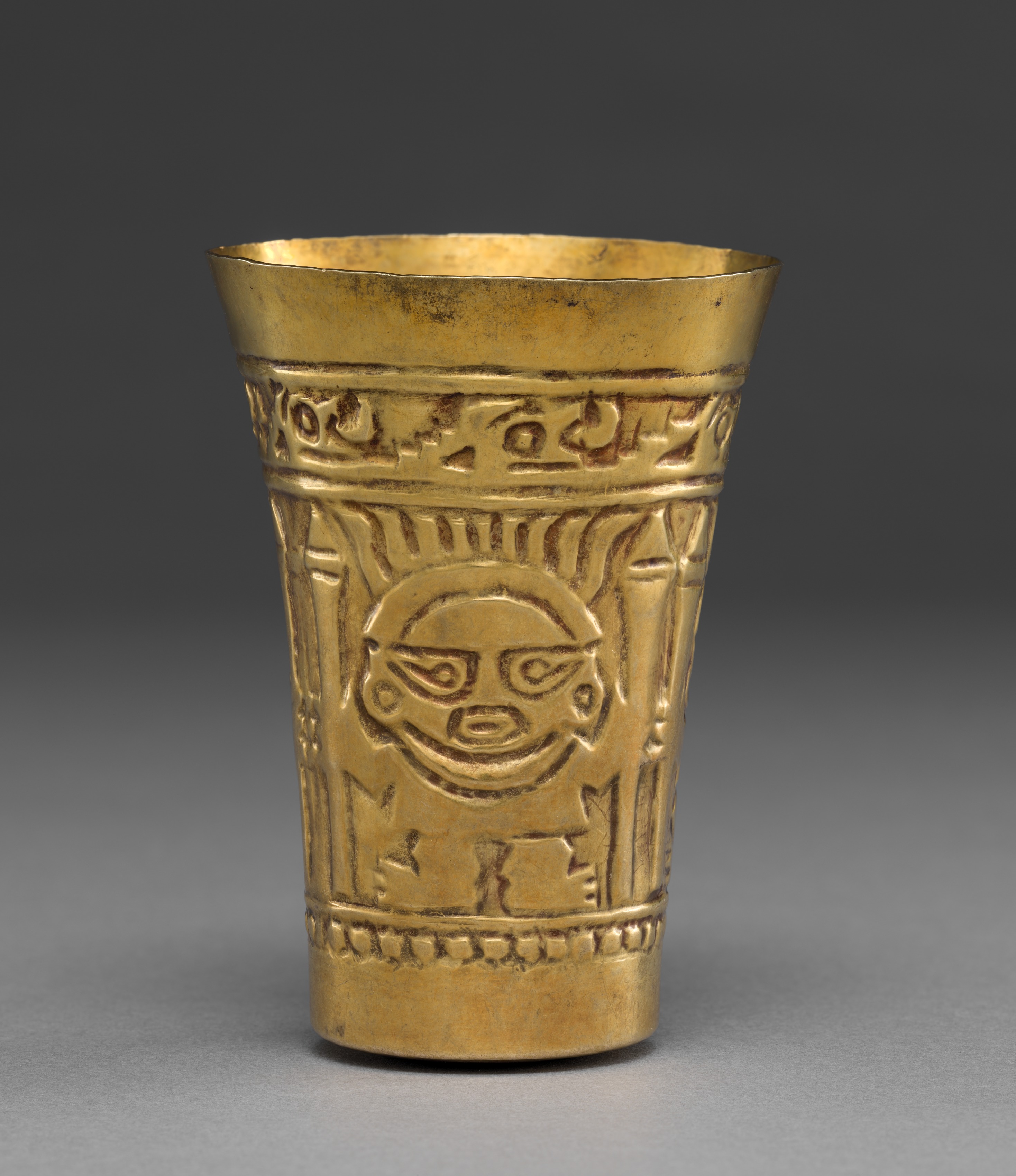
At Zoey Fashion Lab, our core methodology is Fabric Deconstruction—the systematic unraveling of historical artifacts to extract their latent structural, textural, and narrative codes. We then reassemble these codes into avant-garde fashion concepts that challenge contemporary materiality. The subject of this analysis, a Beaker with Frontal Figures from the Lambayeque (Sicán) culture of the Central Andes (10th–12th century), crafted from hammered gold, presents a profound paradox. It is simultaneously a vessel of ritual consumption and a frozen tableau of hierarchical power. The reference point, Archive Resonance: 一面是光洁银镜上以黄金镶嵌的纷繁棕叶纹,另一面是冰冷石棺板上以浮雕诉说的生命叙事, introduces a critical duality—the polished, reflective surface versus the cold, narrative stone. This analysis will deconstruct the Sicán beaker through this lens, proposing how its gold, its frontal figures, and its hammered construction can be translated into a disruptive, avant-garde fashion language.
I. The Material Paradox: Gold as Reflective Surface and Narrative Stone
The beaker is not merely a gold object; it is a statement of material dissonance. The reference text’s juxtaposition of a “smooth silver mirror” with gold palm-leaf patterns and a “cold stone sarcophagus” with relief narratives is key. The Sicán gold, while inherently precious, was hammered to a specific surface quality. The hammering process—repeated strikes that thin and shape the metal—creates a textured, slightly irregular field. This is not the flawless, liquid reflection of a modern mirror. Instead, it is a hammered mirror: a surface that catches light in fragmented, angular ways, distorting the viewer’s reflection while simultaneously projecting the beaker’s own iconography.
For the Avant-garde Fashion Lab, this translates into a textile concept: “Hammered Gold Lamé with Narrative Imperfections.” We propose a fabric that mimics the beaker’s surface—a metallic lamé base that is not smooth but deliberately puckered, seamed, and pleated to create light-catching facets. The “palm-leaf patterns” of the reference are reinterpreted as laser-cut, gold-foil appliqués that are sewn onto the fabric at irregular intervals, suggesting the “纷繁棕叶纹” (lush palm leaf patterns) that break the mirror’s surface. Simultaneously, the “stone sarcophagus” narrative is embedded through heavy, matte-black embroidery that outlines the frontal figures. The thread is a blend of carbon fiber and matte silk, creating a relief that feels cold and heavy against the shimmering gold. The garment’s surface becomes a battlefield between the reflective, living gold and the cold, narrative stone—a direct translation of the beaker’s dual nature.
II. The Frontal Figures: Power, Stasis, and the Deconstruction of Gaze
The beaker’s iconography is dominated by frontal figures, a hallmark of Sicán art. These figures, likely elite rulers or deities, are presented in a rigid, symmetrical, and hieratic pose. Their gaze is direct, confrontational, and eternal. This is not a naturalistic representation; it is a performative construction of power. The figures’ bodies are stylized: large, circular eyes, a trapezoidal headdress, and hands placed on the chest or holding ceremonial objects. The hammered gold technique reinforces this stasis—the metal cannot bend into soft, organic curves; it must be struck into angular, geometric forms.
In our deconstruction, we ask: What if the frontal figure becomes a garment’s silhouette? The avant-garde fashion concept is a “Frontal Figure Armor”—a gown or jacket that is entirely constructed to be viewed from the front, with the back left deliberately raw, unfinished, or transparent. The front panel is a rigid, sculpted bodice made from hammered brass or gold-toned resin, cast in a mold that replicates the beaker’s figure. The eyes of the figure are not painted but are hollowed-out voids—negative spaces through which the wearer’s own skin or a contrasting fabric is visible. This deconstructs the gaze: the wearer is not merely displaying the figure; the figure is wearing the wearer, its empty eyes consuming the body behind it.
The headdress, a key signifier of power, becomes a detachable, wearable sculpture—a headpiece made of layered gold discs that clatter with movement, referencing the “纷繁棕叶纹” (lush patterns) but in a kinetic, three-dimensional form. The hands of the figure, placed on the chest, are reinterpreted as exaggerated, oversized sleeves that cross over the torso, creating a restrictive, ceremonial posture. The garment forces the wearer into a state of controlled stasis, mirroring the beaker’s frozen narrative. This is fashion as ritual object, not as everyday wear.
III. The Hammered Construction: Deconstructing the Making Process
The technical specification—“gold, hammered”—is not merely a material note; it is a blueprint for construction. Hammering gold is an additive and subtractive process: the metal is thinned, stretched, and shaped through repeated, percussive strikes. Each strike leaves a mark. The final object is a palimpsest of these actions, a record of its own making. The beaker’s surface is not smooth; it is a field of tiny, undulating facets that catch light differently depending on the angle. This is a fabric of force.
For Zoey Fashion Lab, this translates into a construction technique: “Percussive Seaming and Metalized Pleating.” We propose a garment made not from woven fabric but from individual, hammered metal panels that are then linked together with visible, oversized rivets or stitches. The seams are not hidden; they are emphasized as structural lines of force. The garment’s surface is a patchwork of these panels, each one hammered by hand or machine to a different degree, creating a topography of light and shadow. The pleats are not soft folds but sharp, angular creases—like the facets of a hammered gold beaker—that are heat-set or welded into place.
The reference’s “冰冷石棺板上以浮雕诉说的生命叙事” (life narrative told in relief on a cold stone sarcophagus) inspires a layering of textures. The base layer of the garment is a cold, matte-black neoprene—the “stone sarcophagus”—onto which the hammered gold panels are attached. The narrative of the frontal figures is then embossed or debossed into the neoprene itself, creating a relief that is felt as much as seen. The gold panels are not sewn flat; they are cantilevered or suspended from the neoprene base, creating air gaps and shadows. This mimics the beaker’s three-dimensionality—the gold is not a flat image but a sculpted surface that projects outward into space.
IV. Avant-Garde Synthesis: The Beaker as Wearable Archive
The final avant-garde garment is not a replica of the beaker; it is a deconstruction of its core principles: material paradox (reflective gold vs. narrative stone), frontal power (the hieratic figure as silhouette), and percussive construction (hammered metal as fabric). The garment is a wearable archive that resonates with the Archive Resonance reference. It is a mirror that does not reflect the viewer’s face but instead reflects the fractured history of its own making. It is a stone sarcophagus that does not contain a corpse but instead contains the living body of the wearer, who becomes a contemporary Sicán figure—frozen, powerful, and confrontational.
Zoey Fashion Lab proposes a collection titled “Hammered Mirror: Sicán Fragments.” The key piece is a “Frontal Figure Gown” with a hammered gold bodice, a matte-black neoprene skirt embossed with abstracted palm-leaf patterns, and a detachable headdress of layered gold discs. The garment’s seams are exposed and riveted. The back is left open, revealing a sheer, gold-threaded mesh that shows the wearer’s spine—a literal deconstruction of the frontal figure’s stasis. The garment is heavy, restrictive, and ceremonial. It is not fashion for the street; it is fashion for the ritual of the archive, a wearable object that forces the wearer and the viewer to confront the tension between the polished surface and the narrative depth, between the living gold and the cold stone.
In conclusion, the Sicán beaker, through the lens of avant-garde deconstruction, is not a historical artifact to be preserved behind glass. It is a generative system—a set of material, structural, and iconographic codes that can be extracted, translated, and reassembled into garments that challenge our understanding of luxury, power, and the body. The hammered gold becomes a fabric of force; the frontal figure becomes a silhouette of stasis; the narrative becomes a relief on the skin. This is the work of the Chief Fabric Deconstructionist: to see the future in the past, and to wear it.