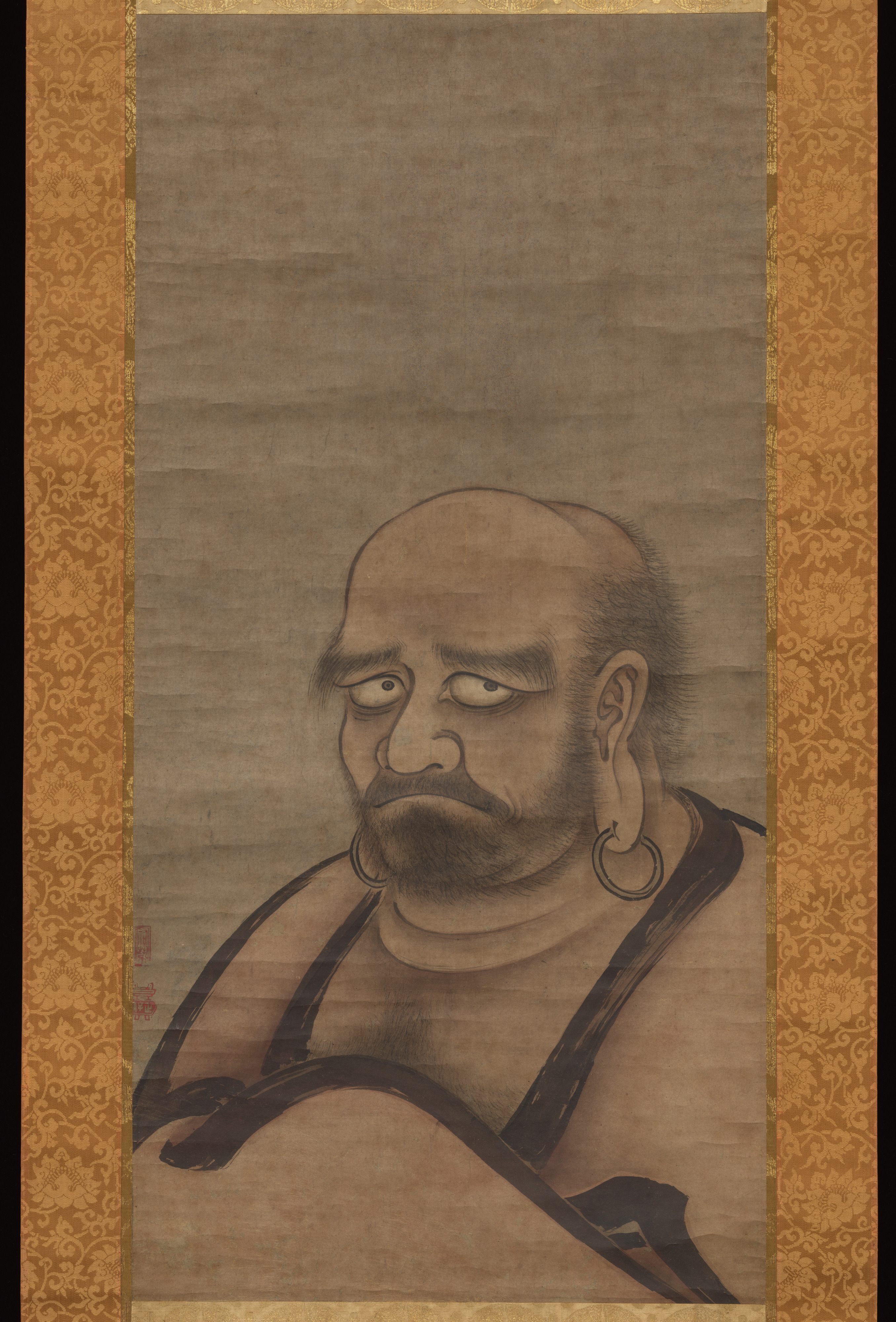
Bodhidharma in Red Robes: A Deconstructive Blueprint for SS26
Introduction: The Zen of Anti-Structure
The iconic Japanese hanging scroll, *Bodhidharma in Red Robes*, presents a paradox that resonates deeply with the avant-garde ethos of Zoey Fashion Laboratory. At first glance, the figure is a study in monastic simplicity—a single, unadorned red robe enveloping the seated patriarch. Yet, within this apparent austerity lies a radical architectural proposition. Bodhidharma’s silhouette is not merely a garment; it is a volume, a negative space, a statement of pure form. For SS26, we must deconstruct this visual mantra, extracting its latent futurism through a lens of structural innovation. This analysis transcends historical reverence, instead treating the scroll as a prototype for a new kind of garment architecture—one that prioritizes silhouette as narrative and fabric as structural skin.
Silhouette as Sacred Geometry
The red robe in the scroll is not draped; it is built. The folds are not random but deliberate, creating a series of intersecting planes that mimic the facets of a gemstone. For SS26, this translates into a monolithic, almost architectural silhouette that defies the natural human form. The shoulders are broadened into a sharp, angular yoke, while the fabric descends in a series of rigid, pleated volumes that create a bell-like base. This is not a garment that moves with the body; it is a garment that defines the space around the body. We propose a series of modular, inflatable panels integrated into the fabric, allowing the wearer to adjust the volume of the robe in real-time—a living sculpture that responds to environment and intent. The color, a deep, unwavering vermilion, is not merely pigment but a chromatic anchor, grounding the radical silhouette in a tradition of spiritual authority.
Deconstructing the Monastic Form: From Robe to Armature
The traditional Japanese hanging scroll presents the robe as a seamless, continuous surface. Our avant-garde study must deconstruct this monolithic surface into a series of interlocking, wearable components. The robe becomes an exoskeletal armature, with each fold and crease engineered as a load-bearing element. We envision a garment constructed from laser-cut, bonded leather and recycled carbon fiber, mimicking the crisp, angular folds of the painted fabric. The seams are not hidden but celebrated, becoming structural ribs that articulate the form. The traditional obi (sash) is reimagined as a tensioning system, a series of adjustable straps and buckles that allow the wearer to alter the garment’s geometry—from a closed, meditative cocoon to an open, confrontational stance. This is functional deconstruction, where every cut and seam serves both aesthetic and structural purpose.
Material Innovation: The Red as a Structural Membrane
The vermilion red of Bodhidharma’s robe is not just a color; it is a material statement. For SS26, we must translate this into a textile that is both rigid and fluid. We propose a double-faced fabric: one side a matte, almost chalky, pigmented silicone that mimics the texture of the painted paper; the other a high-gloss, metallic micro-fiber that catches light like a lacquered surface. This duality allows the garment to transform from a matte, spiritual presence to a reflective, futuristic armor. The fabric is treated with a thermochromic finish, so that body heat causes subtle shifts in hue—from a deep, blood-red to a fiery, almost neon orange. This is not mere decoration; it is a dynamic narrative of the wearer’s internal state, a living canvas that echoes the meditative stillness of the scroll while embracing kinetic modernity.
Futuristic Silhouette: The Meditative Monolith
The ultimate innovation for SS26 lies in the reinvention of the seated silhouette. Bodhidharma is depicted in a state of deep meditation, his form compressed into a compact, almost geometric shape. Our garment architecture must translate this static compression into a dynamic, wearable volume. We propose a transformable, origami-like structure that can be collapsed into a compact, backpack-like unit or expanded into a full, floor-length robe. The pleating system is engineered with memory-wire filaments, allowing the garment to hold its shape when expanded but fold flat when not in use. The sleeves are not sleeves but articulated wing-like appendages, built from a lattice of carbon fiber and transparent polymer, that can be folded against the body or extended outward to create a dramatic, 360-degree silhouette. This is not a garment for walking; it is a garment for occupying space, for commanding attention without movement.
Structural Innovation: The Negative Space as Design Element
The scroll’s composition is defined by the negative space around Bodhidharma’s figure—the vast, empty background that amplifies his presence. Our SS26 collection must integrate this concept directly into the garment architecture. We propose cutouts and voids that are not arbitrary but strategically placed to create optical illusions. A large, circular aperture at the chest reveals a secondary layer of fabric—a floating, holographic mesh that shifts color as the wearer moves. The back of the garment features a vertical slit that exposes the spine, framed by a lattice of 3D-printed, bone-like structures. These voids are not weaknesses; they are architectural openings that allow the garment to breathe, to interact with light, and to reveal the body beneath as a conceptual element. The garment becomes a sculptural frame for the human form, with absence as important as presence.
Conclusion: The SS26 Manifesto
*Bodhidharma in Red Robes* is not a historical artifact; it is a blueprint for a new kind of fashion—one that prioritizes structural integrity, volumetric innovation, and chromatic authority. For SS26, Zoey Fashion Laboratory will translate this Zen patriarch into a wearable manifesto. The collection will feature monolithic, inflatable silhouettes, deconstructed armatures, and thermochromic, double-faced textiles. It will be a study in sacred geometry, where every fold and seam is a deliberate architectural choice. The garment is not a second skin; it is a portable environment, a meditation cell, a statement of presence. This is the future of couture: silence as volume, stillness as movement, and red as the color of infinite possibility. The SS26 collection will not simply be worn; it will be inhabited. It will be a living sculpture, a testament to the power of deconstructive aesthetics and the relentless pursuit of structural innovation. The Bodhidharma scroll has spoken; now, we must build.