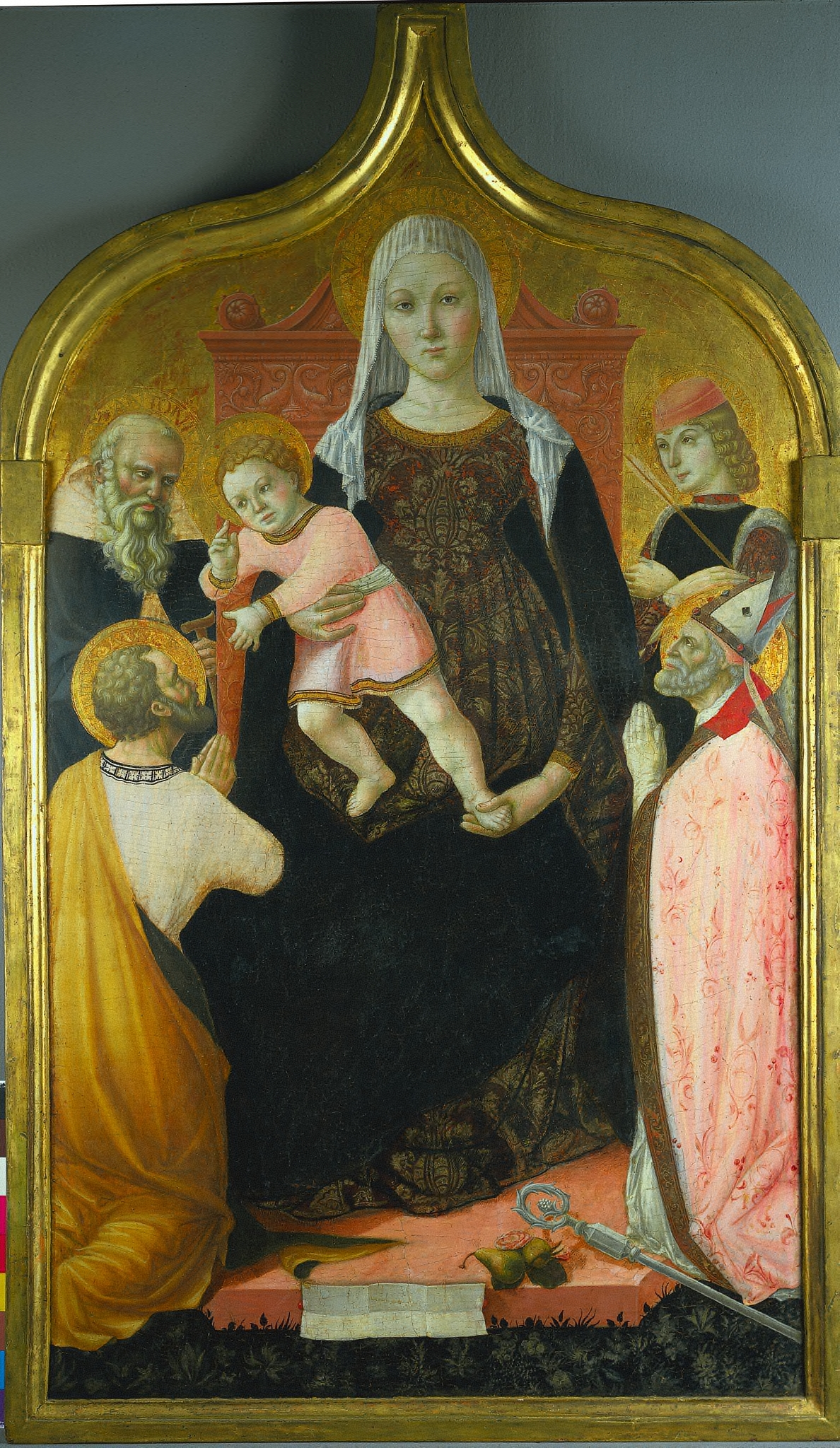
Technical Deconstruction & Material Synthesis: A 15th-Century Polyptych Re-sequenced
The assigned artifact, a 15th-century Italian tempera and gold ground panel, presents not a singular narrative but a complex genetic sequence of devotion, hierarchy, and material symbolism. Our analysis at Zoey Fashion Lab does not view it as a static relic but as a dormant codex. The reference "New DNA Strand" is our directive: to isolate, sequence, and recombine its constituent elements into an avant-garde sartorial proposition. The saints—Anthony Abbott, Mark, Severino, and Sebastian—are not merely figures; they are archetypal data clusters of texture, form, and symbolic resistance.
Strand Isolation: Decoding the Material Genome
The primary substrate is a paradox: the rigid, structured wood panel versus the ethereal, light-capturing gold ground. This is our foundational fabric dialectic. In avant-garde terms, this translates to a structural philosophy of architectural rigidity juxtaposed with luminous fluidity. Imagine engineered outerwear with severe, clean lines—inspired by the panel's strict compartmentalization—crafted from a technical fabric that has been micro-laminated with a discontinuous, hand-applied gold foil. The gold is not a uniform sheet; it is a deconstructed halo, appearing only at seams, under collars, or as a reverse-side lining, catching light unpredictably, much like the original gold leaf's interaction with candlelight.
The tempera medium itself is key. Its matte, chalk-like opacity sits atop the reflective gold, creating a tangible, almost tactile color field. This informs our textile development: matte, densely woven natural fibers (linen, hemp) are fused or quilted to substrates of recycled metallic lamé. The paint's craquelure is not a flaw but a blueprint for surface treatment—laser-etching on leather to create a fine, web-like pattern, or heat-transfer processes that generate deliberate, crystalline fractures in synthetic coatings.
Archetype Translation: The Saints as Silhouette and Texture
Each saint represents a distinct "data packet" for aesthetic extraction and recombination.
Saint Anthony Abbott: The hermit saint embodies textural austerity and monastic drape. His rough hair shirt is translated not as literal sackcloth but as the essence of textured, irregular, and sustainable fabric. Think heavyweight, undyed, organic cotton manipulated with shibori techniques to create a permanent, 3D topographic texture. His long beard and staff inform silhouette: asymmetric, elongated draping from a single, structured shoulder, mimicking the verticality of his figure and staff.
Saint Mark: The evangelist brings the codex and the lion—symbols of authoritative knowledge and primal strength. This strand informs intelligent, structured pieces. The codex translates to garments with modular, page-like panels that can be reconfigured. The lion's mane suggests bold, shaggy fur alternatives (crafted from recycled yarns or innovative plant-based fibers) used as explosive collars or cuffs, bursting from the severe lines of a tailored coat.
Saint Severino: Often a bishop saint, he contributes the liturgical splendor—the ornate cope, the jeweled mitre. This is not about literal religious regalia but about ceremonial fabrication. We interpret this as intricate, Byzantine-inspired jacquard weaves integrated into minimalist forms, or as "jewels" formed from resin-encapsulated fragments of deconstructed electronic waste, speaking to modern idolatry.
Saint Sebastian: The martyr is the most potent avant-garde archetype. He represents the vulnerable body punctuated by external forces. His bound torso and arrows are a masterclass in deconstruction. This translates to garments that explore controlled exposure, strategic binding, and piercing. Imagine a sleek, body-conscious foundation garment—a modern corset or bodysuit—"pierced" not by arrows but by trailing straps, industrial hooks, or transparent vinyl inserts that create the illusion of penetration and suspension. The binding ropes become intricate macramé harnesses integrated into the garment's architecture.
The Avant-Garde Recombinant: Zoey Fashion Lab's Proposition
The final collection, codenamed "QUATTRO SANCTI," is not a costume drama. It is a synthesis of these decoded strands into a coherent, disruptive fashion language.
Core Silhouette: A hybrid of Anthony's monastic drape and Mark's authoritative structure. Asymmetric, floor-length coats with a rigid, panel-like back, dissolving into fluid, draped fronts. Trousers are severely wide-leg, echoing priestly robes, but cut from technical matte fabrics.
Surface Narrative: Each piece tells a layered story. A Severino-inspired jacquard bomber jacket is partially over-painted with matte, tempera-like pigments, then laser-etched with Sebastian's arrow-pierce patterns. A dress combines the hair-shirt texture on one side with a smooth, gold-foil laminated panel on the other, bifurcated by a vertical "staff" seam.
Philosophical Driver: The original panel was an object of veneration, a focus for spiritual energy. Our recombinant collection seeks to be an object of considered confrontation. It venerates the past not through imitation, but through radical, respectful disassembly. It asks the wearer to embody contradictions: strength and vulnerability, austerity and opulence, structure and decay.
The 15th-century master combined egg, pigment, and gold to create a window to the divine. Zoey Fashion Lab recombines texture, silhouette, and symbolic memory to create a window to a complex, fragmented, and fiercely individual present. The "New DNA Strand" is not a copy; it is a mutation—deliberate, elegant, and born from a deep, analytical reverence for the source code of history.