Deconstructing the Avant-Garde: The Cloth of Gold as a Proto-Modernist Artifact
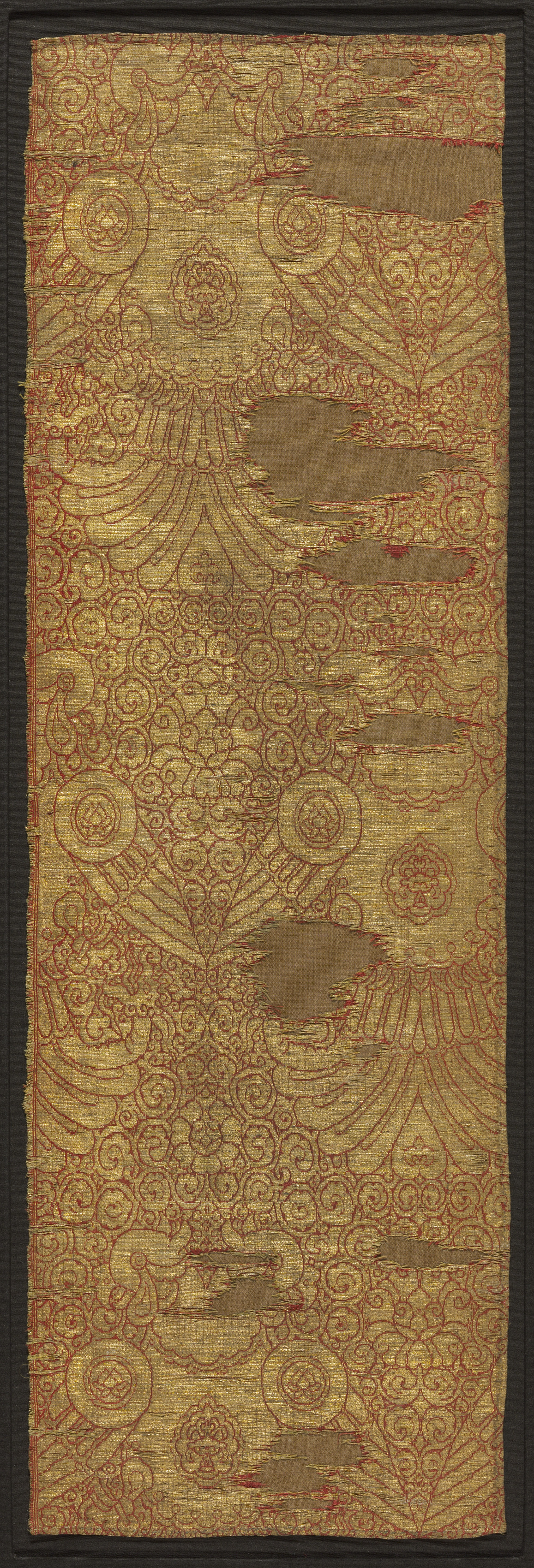
At Zoey Fashion Lab, we do not merely observe historical textiles; we interrogate them as living documents of material culture. The Cloth of Gold: Displayed Falcons, a Central Asian lampas woven from silk and gold thread (circa 16th-17th century), presents a paradox that is central to our avant-garde ethos. On the surface, it is a relic of imperial power and courtly splendor. Yet, when subjected to our methodology of fabric deconstruction, this textile reveals itself as a radical proto-modernist statement—a precursor to the abstraction, spatial disruption, and material fetishism that define contemporary avant-garde fashion. This analysis will dissect the cloth’s technical, iconographic, and cultural layers, demonstrating how its inherent contradictions resonate with the disruptive strategies of today’s experimental design.
Technical Subversion: The Lampas Weave as a System of Controlled Chaos
The technical foundation of this cloth—the lampas weave—is a masterclass in structural tension. Lampas is a compound weave that employs two or more warp and weft systems, allowing for a pattern to float on a ground weave. In this specimen, a silk ground provides a matte, absorbent base, while a supplementary weft of gilded silver thread (gold thread) creates a reflective, rigid surface. From an avant-garde perspective, this is not simply ornamentation; it is a deliberate material conflict. The gold thread does not bend; it fractures light. It imposes its own logic on the pliable silk, creating a surface that is simultaneously tactile and optical, soft and armored.
This dualism is a foundational principle of avant-garde deconstruction. Think of Rei Kawakubo’s “Lumps and Bumps” collection (Spring/Summer 1997), where garments were distorted by internal padding. The lampas weave achieves a similar effect through structural layering: the gold thread acts as an exoskeleton, forcing the silk into geometric submission. The pattern of the Displayed Falcons—with its symmetrical, heraldic birds—is rendered not through dye but through the physical presence of metal. The falcon’s wing, for example, is not painted; it is woven into being by the gold thread’s refusal to blend. This is a textile that declares its own construction, a quality that avant-garde designers like Martin Margiela have championed through exposed seams and unfinished hems. The cloth is honest about its artifice.
Iconographic Deconstruction: The Falcon as a Symbol of Displacement
The Displayed Falcons motif—a heraldic pose with wings spread and head turned—is a potent symbol in Central Asian and Persianate art, often representing sovereignty, swiftness, and the celestial realm. However, within the context of Zoey Fashion Lab’s deconstructive lens, we read this iconography not as a celebration of power but as a visual rupture. The falcon is a predator, but it is also a creature of the sky, untethered from the earth. In this cloth, it is frozen in a pattern, repeated across a grid. This repetition creates a tension between the bird’s symbolic freedom and its material captivity.
This is where the Archive Resonance becomes critical. The provided reference speaks of “器物与绘画” (objects and paintings) as witnesses to cultural collision. The Cloth of Gold is a product of the Silk Road, a network of exchange that was never harmonious—it was a site of conflict, appropriation, and hybridity. The falcon motif, while distinctly Central Asian, may have been adapted from Chinese or Persian prototypes. The gold thread itself, likely sourced from European or Middle Eastern bullion, speaks to a globalized economy of luxury. For the avant-garde, this cultural layering is a resource for displacement. Just as designers like Iris van Herpen use 3D printing to distort the human silhouette, this textile uses gold to distort the naturalism of the falcon. The bird becomes a cyborg symbol—part organic, part metallic, part ritual, part commodity.
Material Subversion: Gold as a Weapon Against Tradition
Gold thread in historical textiles is traditionally associated with permanence, value, and divine light. It is the material of coronation robes and religious vestments. Yet, within an avant-garde framework, gold can be weaponized against these very associations. Consider the work of Alexander McQueen, who used gold lamé in his “Plato’s Atlantis” collection (Spring/Summer 2010) not to signify royalty but to evoke a post-human, alien skin. The Cloth of Gold achieves a similar effect through its material fragility. Despite its opulence, gold thread is brittle. It tarnishes. It cannot be washed. It is a material of controlled decay.
This fragility is a key deconstructive element. The cloth’s survival for over 400 years is a testament to its care, but also to its inherent vulnerability. The avant-garde designer does not see this as a flaw; they see it as a feature. The gold thread’s tendency to catch light and cast shadows creates a kinetic surface that changes with the viewer’s position. This is a precursor to the opto-kinetic textiles used by contemporary designers like Hussein Chalayan, who embed LEDs and micro-motors into fabric. The Cloth of Gold is a static performance—a textile that demands to be seen in motion, even if it cannot move itself.
Cultural Resonance: The Avant-Garde as a Return to the Archive
The Archive Resonance reference—the notion that objects and paintings witness cultural collision—is the philosophical core of this analysis. The Cloth of Gold is not a passive artifact; it is an active agent in the ongoing dialogue between tradition and transgression. The 16th-17th century was an era of globalization and anxiety, much like our own. The Silk Road was a network of exchange, but also of plague, war, and religious schism. The cloth’s gold thread was a currency of power, but it was also a marker of difference—a sign that the wearer could afford to import materials from distant lands.
For the avant-garde, this historical context is a blueprint for disruption. The cloth’s combination of silk (organic, feminine, soft) and gold (inorganic, masculine, hard) is a gender and material binary that contemporary designers actively deconstruct. The work of Comme des Garçons, for example, often uses metallic threads to create armored silhouettes that challenge traditional notions of femininity. The Cloth of Gold does the same: it is a textile that armors the body while also advertising its own luxury. It is both a shield and a display.
Conclusion: The Cloth of Gold as a Proto-Avant-Garde Manifesto
In the hands of Zoey Fashion Lab, the Cloth of Gold: Displayed Falcons is not a museum piece to be preserved; it is a design brief for the future. Its technical complexity—the lampas weave’s controlled chaos—teaches us that structure can be a form of rebellion. Its iconography—the falcon as a displaced, metallic predator—shows us that symbols can be recontextualized to critique power. Its materiality—the brittle, luminous gold—reminds us that luxury is a form of fragility.
This textile is a proto-avant-garde manifesto, written in silk and gold, centuries before the term “avant-garde” existed. It anticipates the deconstructive strategies of the 20th and 21st centuries: the exposure of construction, the fetishization of material, the collision of cultures, and the rejection of stability. At Zoey Fashion Lab, we do not look to the past for nostalgia. We look to the past for weapons. The Cloth of Gold is one such weapon—a luminous, fractured, and deeply resonant artifact that proves that the avant-garde has always been woven into the fabric of human creativity.