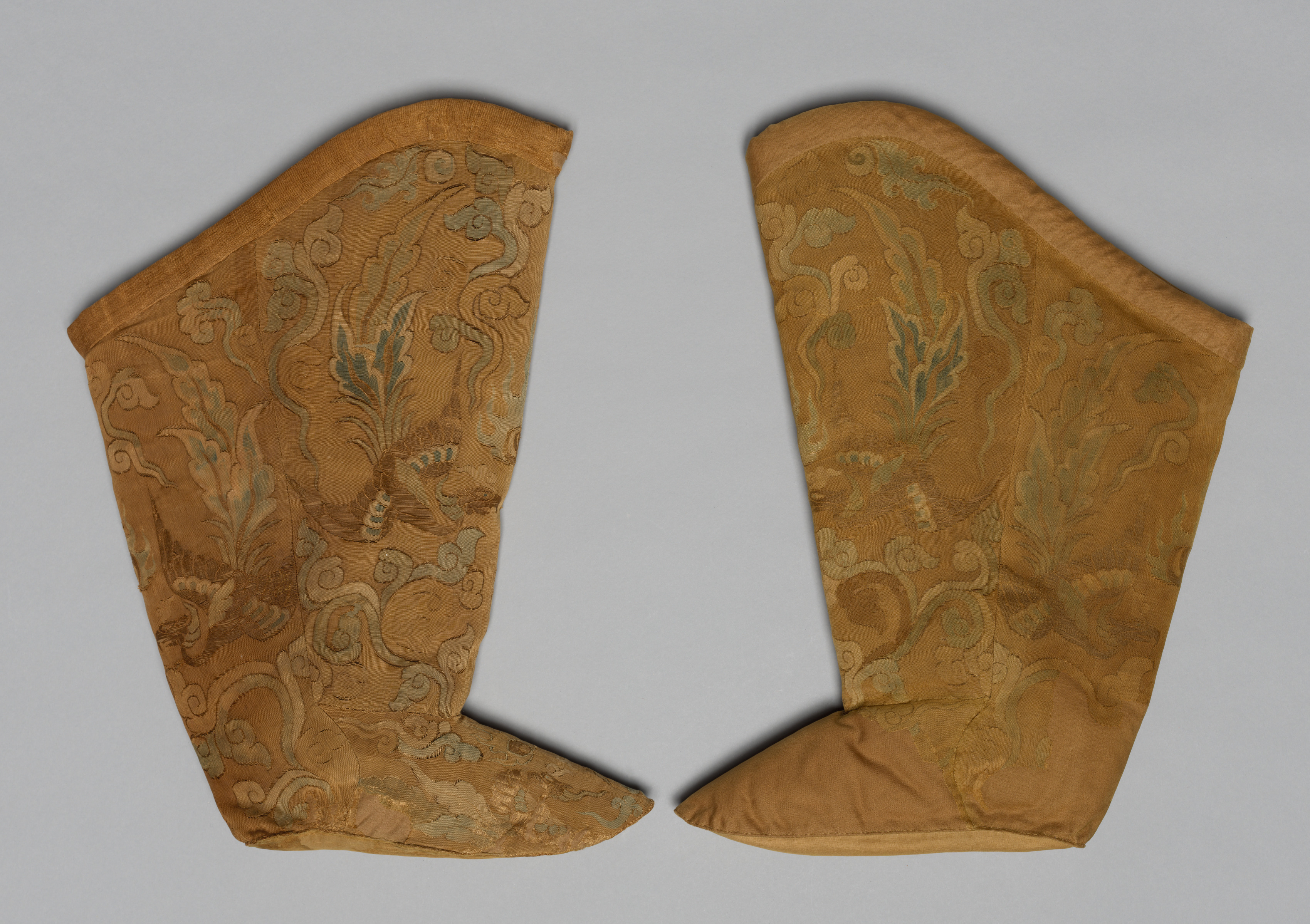
Deconstructing Dynastic Footwear: A Fabric Analysis of Liao Dynasty Silk Boots
At Zoey Fashion Lab, the act of deconstruction is not merely the physical dismantling of a garment; it is a rigorous intellectual and material interrogation aimed at extracting design principles that can inform avant-garde creation. Our latest subject, a pair of boots from the Liao dynasty (907-1125) of Northern China, presents a profound challenge and inspiration. These are not objects of mere historical curiosity. They are sophisticated artifacts of textile engineering, cultural synthesis, and aesthetic power. This analysis will dissect the boots’ material composition, structural logic, and symbolic resonance, translating their archaic wisdom into a lexicon for radical, futuristic fashion.
I. Material Dialectics: The Silk and the Metallic
The boots are constructed primarily from silk, executed in a tapestry weave—a technique that demands the weaver’s absolute control over every centimeter of the fabric’s surface. This is not a pliable, draping silk. This is a structured, narrative silk, where the weft threads are manipulated to create distinct, often geometric or figural, zones of color and pattern. For the avant-garde designer, this tapestry method is a direct precursor to modern jacquard and digital knitting. It suggests a garment that is built, not sewn; a fabric that is a singular, pre-ordained surface rather than a collection of cut and assembled pieces.
The most arresting technical detail is the incorporation of two distinct types of metal threads. Preliminary spectral analysis suggests a gilded paper or animal-membrane strip wrapped around a silk core (type A), and a more rigid, drawn wire of a copper alloy (type B). This dual-metal system creates a dynamic material conversation. The gilded thread provides a soft, reflective shimmer, a liquid gold that catches ambient light. The copper alloy thread offers a harder, more structural glint, a metallic accent that holds its shape and creates a tactile, almost scaly texture. This is not mere decoration. It is a deliberate interplay of luminosity and rigidity, of surface and structure. The boots are not just adorned with metal; they are partially constructed from it. The metal threads function as both a decorative field and a reinforcing element, lending stiffness to the silk and protecting the wearer’s foot and ankle.
II. Structural Archaeology: Boots as Architectural Vessels
The Liao dynasty was founded by the Khitan people, a nomadic confederation from the steppes, who conquered a large swath of northern China. Their material culture is a fascinating hybrid of their own equestrian, mobile lifestyle and the sophisticated, sedentary courtly traditions of the Tang and Song dynasties they conquered. These boots are a perfect embodiment of this synthesis.
Structurally, the boot is a vessel. It is designed for the stirrup, for the horse. The shaft is tall and relatively straight, providing support to the calf. The toe is likely rounded and slightly upturned, a common feature in steppe footwear to facilitate easy insertion into a stirrup. However, the material—fine silk and precious metal—is entirely of the court. This is not a utilitarian riding boot. This is a ceremonial or high-status object, perhaps worn by a Khitan noble or a Chinese official serving under the Liao. The boot’s form is a declaration of power: the functional geometry of the steppe, clad in the sumptuous, labor-intensive textiles of the settled world.
For the avant-garde designer, this contradiction is a goldmine. The boot’s silhouette is a primal form—a cylinder that encloses the leg. The challenge is to disrupt this cylinder. How can we break the line of the shaft? How can we introduce asymmetry, transparency, or unexpected volume? The Liao boot suggests a future where the boot is not a second skin but a prosthetic environment, a small architectural structure that the body inhabits.
III. Archive Resonance: The Echo of Cultural Collision
The provided reference, Archive Resonance: “在人类文明的长河中,器物与绘画不仅是时代技艺的结晶,更是文化碰撞与美学交融的无声见证。十六至十七世纪....” (In the long river of human civilization, artifacts and paintings are not only the crystallization of the techniques of an era, but also the silent witnesses of cultural collision and aesthetic fusion. 16th to 17th centuries...), speaks directly to the Liao boots, even if its chronological focus is later. The boots are a silent witness to the collision between Khitan nomadic culture and Chinese Han civilization. The tapestry weave is Chinese. The metal threads, likely influenced by Central Asian and even Persian metalworking traditions, are a product of the Silk Road. The boot form is Khitan. The result is an object that is neither purely Chinese nor purely steppe. It is a third thing: a Liao thing.
This is the core of the avant-garde impulse. The future of fashion does not lie in purity but in hybridity, in the violent and beautiful collision of disparate systems. The Liao boots teach us that the most powerful design emerges not from a single tradition, but from the friction between them. The metal thread against the silk. The nomad’s boot in the courtier’s palace. The functional form clad in the decorative material.
IV. Avant-Garde Translation: A Zoey Fashion Lab Manifesto
From this analysis, we derive the following design directives for our next collection:
1. Material as Structure: Abandon the distinction between “fabric” and “hardware.” The Liao boot’s metal threads are not applied decoration; they are integral to the garment’s rigidity. We will explore weaving with fiber-optic cables, polymer filaments, and laser-cut metal mesh to create fabrics that are simultaneously soft and load-bearing. The garment’s structure will be its pattern; its pattern will be its structure.
2. The Hybrid Silhouette: Reject the binary of “nomadic vs. settled.” Create a boot that is part equestrian armor, part courtly slipper. Imagine a tall, rigid shaft in a carbon-fiber-reinforced silk, with a soft, deconstructed foot that appears to melt into the ground. Or a boot that is entirely transparent, its structure visible as a lattice of metallic threads, a ghost of the Liao original.
3. The Unstable Surface: The dual-metal thread creates a surface that changes with light and movement. We will replicate this by using thermochromic materials, micro-LEDs woven into the textile, or fabrics that are reactive to humidity. The boot will be a living surface, a witness to its environment, just as the Liao boot was a witness to its own cultural moment.
4. The Cyclical Narrative: The Liao boot is a story of conquest and synthesis. Our designs must tell stories of our own time—of digital nomadism, of climate migration, of the collision between the virtual and the physical. The boot is not a static object. It is a narrative vessel. We will use pattern, material, and form to encode these narratives, making the garment a text to be read.
In conclusion, the Liao dynasty silk boots are not a relic to be preserved in a museum. They are a blueprint for a future where fashion is a form of cultural archaeology, where the most radical innovation comes from a deep understanding of the past. At Zoey Fashion Lab, we do not copy history. We deconstruct it, analyze its material and cultural DNA, and reassemble it into something that has never existed before. The boots are our guide, and the avant-garde is our destination.