The Kesa Reconfigured: A Futurist Deconstruction of Sacred Geometry for SS26
Historical Anchoring and the Avant-Garde Imperative
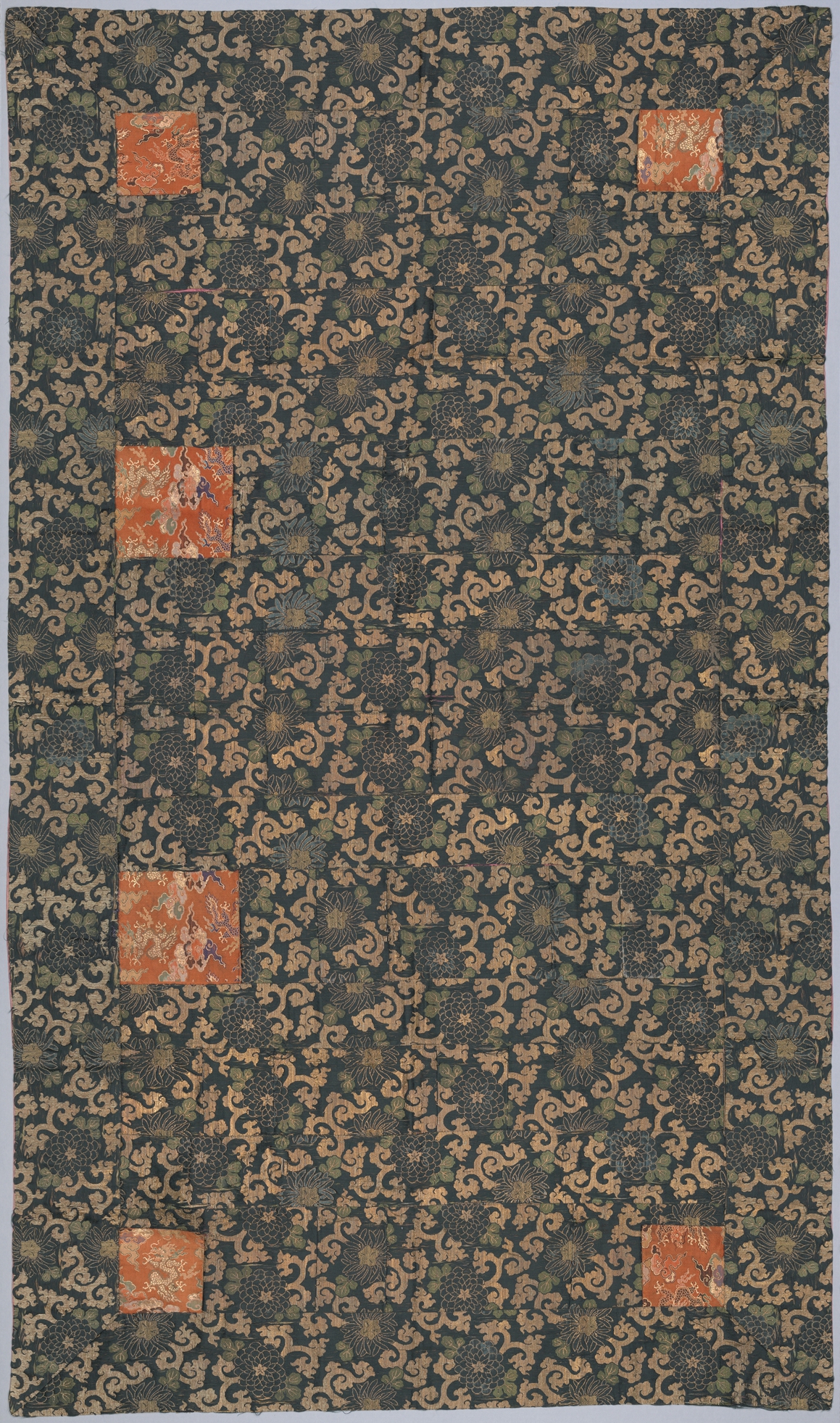
The Kesa, the patched robe of the Buddhist monk, represents a profound paradox within the history of garment construction. Originating in Japan, it is a textile artifact of extreme humility, composed from discarded cloth, yet its material execution—often employing the most luxurious silks, intricate weaves, and precious metal leaf—elevates it to a plane of supreme spiritual and aesthetic significance. For the SS26 collection of Zoey Fashion Laboratory, this sacred garment is not an object of reverence to be replicated, but a generative matrix for structural disruption. Our analysis deconstructs the Kesa’s canonical form—the rectangular panel, the patchwork (kesa-moyo), the weighty drape—to extract its latent futuristic potential. We are not designing a robe; we are engineering a wearable architectural manifesto that interrogates the boundaries between the sacred, the structural, and the speculative.
Material Alchemy: The Lacquered Lattice and the Weft of Tomorrow
The base material is a masterclass in contradictory forces. The silk provides a fluid, almost liquid ground, a surface of infinite pliability. Yet, it is the gold leaf on lacquered paper strips that commands our attention. This is not mere decoration; it is a rigid, brittle, yet luminous exoskeleton. In traditional Kesa, these strips (shihon) create the grid of the patchwork. In our avant-garde recontextualization, they become a structural exo-skeleton. The warp-float-faced 4/1 satin weave offers a smooth, reflective plane, a canvas for light to skate across. But the secondary binding warps and the supplementary patterning wefts, woven in a weft-float-faced 1/2 "z" twill, introduce a tectonic instability. This interplay creates zones of opacity and translucency, of softness and rigidity. The gold leaf, when lacquered, becomes a brittle, almost ceramic-like surface. The garment will not drape; it will articulate. The paper strips, wrapped in cotton, add a surprising tensile strength, allowing for angular, cantilevered forms that defy gravity. This is a material that speaks of ancient ritual but behaves like a futuristic composite—a hybrid of organic fiber and metallic armor.
Silhouette as Spiritual Disruption: The Asymmetrical Mandala
The traditional Kesa is a symmetrical, rectangular wrap. Our SS26 silhouette rejects this stasis. We propose the "Asymmetrical Mandala". The front panel is a single, uninterrupted expanse of the 4/1 satin, falling in a severe, columnar line from the left shoulder to the floor. The right side, however, is entirely deconstructed. The gold-leaf paper strips are not sewn into a grid; they are suspended, cantilevered, and fractured. They emerge from the shoulder like the ribs of a futuristic fan, some extending horizontally, others angling downward at 45 degrees. These strips are not attached to the silk body at their lower ends, creating negative space—a void of architectural air between the rigid lacquer and the fluid silk. This is a silhouette that breathes, that shifts, that reconfigures the body’s relationship to volume. The back, conversely, is a dense, woven tapestry of the twill interlacings, creating a surface of intricate, almost digital, patterning. It is a wearable circuit board of sacred geometry, where the gold leaf acts as conductive pathways.
Structural Innovation: The Kinetic Hinge System
The most radical innovation lies in the garment's construction. We have abandoned the traditional patchwork seam. Instead, we employ a "Kinetic Hinge System". Each gold-leaf paper strip is individually mounted on a micro-articulated, titanium-alloy hinge, hidden within the silk’s secondary warp. This allows each strip to pivot independently. The wearer can program the garment’s silhouette through subtle body movements. A turn of the torso causes the right-side strips to fan out, creating a dramatic, wing-like projection. A forward lean collapses them into a more linear, protective shell. This is not passive drape; it is active, responsive architecture. The lacquered paper, far from being fragile, is reinforced with a carbon-fiber mesh at the hinge points, ensuring durability and a metallic click with each movement. The supplementary patterning wefts are woven with a thermo-chromic thread that shifts from deep indigo to pale gold when exposed to body heat, creating a living, breathing surface that registers the wearer’s thermal signature.
Silhouette Evolution: The Levitation Effect
We further disrupt the Kesa’s traditional floor-sweeping length. The hem is not finished but laser-cut and frayed, with individual silk filaments extending an additional 12 inches. These filaments are stiffened with a clear polymer, creating a fringe of optical fibers. When the garment is worn, these filaments catch the light and appear to hover, creating a levitation effect that separates the garment from the ground. The front panel, meanwhile, is asymmetrically hemmed, rising to mid-thigh on the left and cascading to the floor on the right. This angular cut, combined with the cantilevered gold strips, creates a dynamic, almost aerodynamic silhouette. The wearer is no longer draped in a robe; they are encased in a flying machine, a sacred vessel for the future.
Color and Light: The Lacquered Spectrum
The color palette is deliberately restrained to amplify the material’s inherent drama. The silk is a deep, matte ink-black, absorbing light and providing a void against which the gold leaf can explode. The lacquered paper strips are not uniform gold; they are treated with a gradient iridescent patina, shifting from burnt orange at the shoulder to a pale, almost white gold at the hem. This gradient mimics the aging of temple gold, but also suggests a spectral, digital gradient. The twill interlacings on the back are woven with a silver-grey thread that catches the light, creating a subtle, moiré effect that echoes the ripples of a pond in a Zen garden. The overall effect is of a garment that is simultaneously ancient and extraterrestrial, a relic from a civilization that has achieved light-speed travel.
Conclusion: The Sacred as Speculative Prototype
This analysis demonstrates that the Kesa is not a historical artifact to be preserved, but a blueprint for radical, futuristic garment architecture. For SS26, Zoey Fashion Laboratory has transformed a symbol of humility into a statement of structural audacity. The Kinetic Hinge System, the Asymmetrical Mandala, and the Levitation Effect are not mere design flourishes; they are a new language of form. The garment is no longer a covering; it is a wearable environment, a responsive sculpture, a dialogue between the sacred and the speculative. This is the future of couture: where tradition is not a cage but a launchpad, and where the most ancient of garments becomes the most advanced of prototypes. The Kesa, in our hands, is no longer a robe—it is a prophecy.