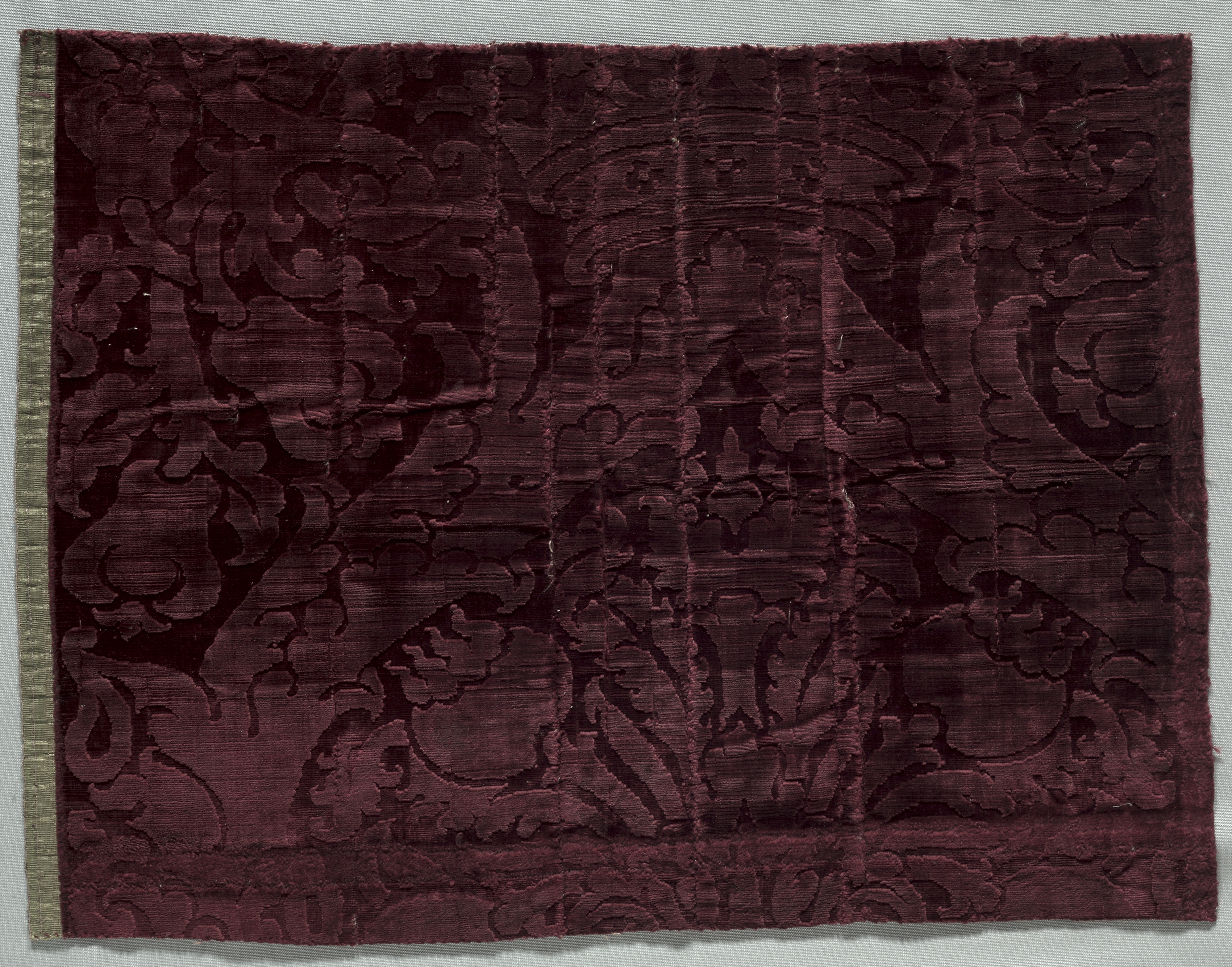
Deconstructing the Velvet Fragment: A 16th-Century Italian Textile as a New DNA Strand for Avant-Garde Design
As the Chief Fabric Deconstructionist for Zoey Fashion Lab, my role is to dissect historical textiles not merely as artifacts, but as living blueprints—genetic codes waiting to be re-sequenced for contemporary expression. The subject of this analysis is a fragment of 16th-century Italian velvet, a material that, on the surface, speaks of Renaissance opulence, ecclesiastical power, and aristocratic luxury. However, beneath its plush surface and intricate weaves lies a New DNA Strand—a molecular structure of design principles, technical innovations, and cultural tensions that can be radically re-engineered for an avant-garde aesthetic. This analysis will decode that DNA, exploring the fragment’s materiality, its historical context, and its potential for transformation within Zoey Fashion Lab’s disruptive design philosophy.
I. The Material Genome: Decoding the 16th-Century Velvet Structure
Velvet, in its purest 16th-century Italian form, is a triumph of complex weaving. It is not a single fabric but a composite structure: a ground weave (typically silk) and a pile warp that is cut to create the signature soft, dense surface. The fragment in question likely employs a cut and uncut pile technique, where loops are either sheared or left intact to create contrasting textures and light-reflecting properties. This is the first strand of our new DNA—a binary system of texture: smooth versus rough, matte versus lustrous.
From a deconstructionist viewpoint, the velvet’s pile is not just a surface; it is a field of potential energy. Each cut loop represents a decision, a moment of transformation. For the avant-garde, this can be reinterpreted as a tactile topography. Instead of uniform pile, we can engineer gradient densities—areas of high pile that mimic fur or moss, juxtaposed with shaved, almost bald sections that reveal the underlying skeleton of the weave. This creates a garment that is not static but dynamic, changing its appearance based on light, movement, and touch. The historical velvet’s reliance on silk for both ground and pile can be subverted by introducing recycled metallic threads or bio-based polymers into the pile structure, creating a hybrid material that honors the original’s texture while rejecting its resource-intensive origins.
II. Historical Context as a Design Constraint: From Sacred to Subversive
Sixteenth-century Italian velvet was not merely decorative; it was a carrier of status and ideology. Worn by clergy, nobility, and wealthy merchants, its deep colors—crimson, gold, black—were derived from expensive dyes like cochineal and kermes. The patterns, often featuring pomegranates, thistles, or geometric arabesques, were symbols of eternity, fertility, or divine order. This is the cultural genome of the fragment: a language of power and permanence.
For Zoey Fashion Lab, this historical weight is not a burden but a site of resistance. The avant-garde thrives on deconstructing hierarchies. We can treat the original pattern as a ghost image—a faint, almost subliminal trace that is then overlaid with digital glitch effects, laser-cut holes, or hand-stitched anarchic symbols. The velvet’s traditional association with the sacred can be inverted by introducing deconstructive cuts that mimic wounds or tears, referencing the body’s vulnerability rather than its adornment. The color palette, once limited to natural dyes, can be expanded into neon acid tones or chromatic shifts achieved through photochromic or thermochromic treatments, transforming the fabric from a static historical object into a reactive, living surface.
III. Technical Re-Engineering: The New DNA Strand in Action
The “New DNA Strand” concept for this velvet fragment is not about replication but mutation. We will extract three core technical principles from the original and re-sequence them for an avant-garde context.
1. The Pile as a Sensory Interface: In the 16th century, velvet’s pile was purely tactile. Today, we can embed conductive yarns within the pile structure, creating a fabric that responds to touch, pressure, or proximity. Imagine a velvet jacket where the pile changes color or emits a soft light when the wearer is touched. This transforms the historical fabric from a passive surface into an interactive, communicative medium. The pile becomes a sensory organ, blurring the line between garment and technology.
2. The Ground Weave as a Structural Skeleton: The original velvet’s ground weave is a tightly woven silk that provides stability. For the avant-garde, this can be reimagined as a transparent or mesh-like base. Using laser-cutting or chemical etching, we can selectively remove sections of the ground weave, leaving only the pile floating. This creates a lace-like effect that is both fragile and strong, referencing the original’s opulence while embracing decay and impermanence. The ground weave can also be replaced with biodegradable cellulose fibers, making the entire garment compostable—a direct critique of the fashion industry’s wastefulness.
3. The Pattern as a Code of Repetition and Rupture: The original velvet’s patterns are highly repetitive, creating a sense of rhythm and order. The New DNA Strand will introduce algorithmic disruption. Using generative design software, we can create a pattern that starts as a faithful reproduction of a 16th-century motif but gradually degrades into abstract, glitch-like forms. This can be achieved through digital jacquard weaving, where each thread is individually controlled, allowing for infinite variation within a single garment. The result is a narrative of entropy—a velvet fragment that tells the story of its own decay and rebirth.
IV. Avant-Garde Synthesis: The Velvet Fragment as a Wearable Artifact
The final output of this deconstruction is not a replica but a provocation. Zoey Fashion Lab’s avant-garde interpretation of the 16th-century Italian velvet fragment will be a garment that exists in a state of permanent transition. It will be asymmetrical, with one side retaining the original’s lush pile and deep crimson, while the other side is shaved, bleached, and overlaid with conductive circuits. The pattern will be a hybrid of Renaissance pomegranates and digital pixelation, suggesting a collision of epochs.
This garment will be unwearable in a traditional sense, but that is precisely its point. It is a conceptual object that challenges the viewer to reconsider the boundaries between history and futurism, luxury and decay, the sacred and the profane. The velvet fragment is no longer a relic; it is a living laboratory for material experimentation. Its New DNA Strand is a manifesto: that the past is not a prison but a source code to be hacked, rewritten, and re-released into the world as something entirely unprecedented.
In conclusion, the 16th-century Italian velvet fragment, when viewed through the lens of deconstruction and avant-garde design, becomes far more than a historical curiosity. It is a template for transformation. By extracting its material, cultural, and technical DNA, Zoey Fashion Lab can generate a new lineage of textiles that are reactive, subversive, and profoundly contemporary. The velvet’s softness, once a symbol of comfort, becomes a canvas for critique. Its patterns, once static, become dynamic systems. This is the work of the Chief Fabric Deconstructionist: to see the future hidden within the folds of the past.