Deconstructing the Brescia Helmet: A Zoey Fashion Lab Analysis
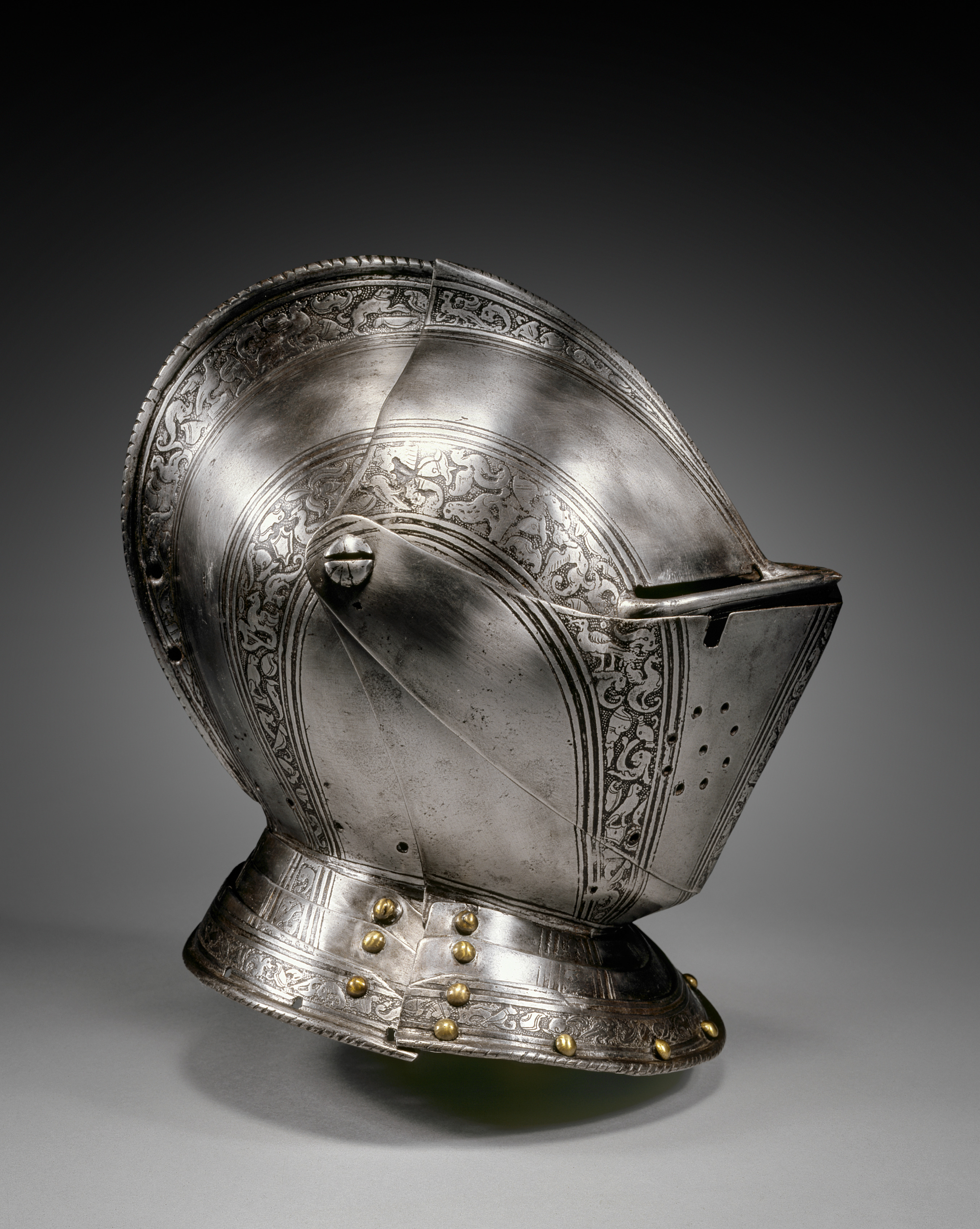
At Zoey Fashion Lab, we approach historical artifacts not as static relics but as dynamic blueprints for avant-garde design. Our latest subject of deconstruction is a close helmet attributed to North Italy, likely Brescia, dating from the 16th century. Crafted from steel with etched decorative bands and roundels, this piece represents a pinnacle of Renaissance armor craftsmanship. However, for our lab, it serves as a New DNA Strand—a genetic code to be extracted, mutated, and recombined into contemporary fashion that challenges conventional silhouettes, materials, and narratives.
Materiality and Surface: The Etched Steel as Textile
The helmet’s primary material—steel—is traditionally associated with rigidity and protection. Yet, the etched decorative bands and roundels transform this functional metal into a narrative surface. The etching technique, likely acid- or tool-based, creates a low-relief pattern that mimics textile embroidery or damask weaving. This is a critical point for deconstruction: steel behaves as a textile. The bands, with their repeating geometric or floral motifs, function like woven stripes; the roundels echo medallion prints found in brocade or velvet.
For our avant-garde application, we propose a material transposition: laser-cut stainless steel mesh layered over high-tensile polymer membranes. The etched bands become conductive thread patterns embedded into the mesh, allowing for color-shifting or light-emitting elements controlled by movement. The roundels, originally decorative, are reimagined as 3D-printed magnetic closures that can be detached and reconfigured, turning the garment into a modular system. This approach honors the original’s surface complexity while introducing kinetic, interactive properties—a hallmark of Zoey’s avant-garde ethos.
Structural Silhouette: The Close Helmet as Wearable Architecture
The close helmet’s defining feature is its enveloping form: a seamless, domed skull piece that extends to cover the face, neck, and shoulders. This creates a monolithic, almost architectural silhouette—a sphere of protection that eliminates human vulnerability. In the 16th century, this was about warfare; in our context, it becomes a statement on digital armor and emotional fortification.
Our deconstruction extracts the helmet’s negative space. The visor, with its horizontal slits for vision, is reinterpreted as a deconstructed hood—a series of overlapping, laser-cut leather strips that can be raised or lowered. The neck guard, or gorget, becomes a detachable collar made from carbon-fiber-reinforced silicone, flexible yet unyielding. The helmet’s dome is fragmented into articulated panels that slide and lock, allowing the wearer to adjust the degree of enclosure. This modularity transforms the helmet from a fixed object into a responsive second skin, reflecting the avant-garde principle of fluidity between protection and expression.
Etched Decorative Bands: Pattern as Code
The etched bands are not merely ornamental; they are a visual language of status and craftsmanship. In Brescia, these patterns often incorporated classical motifs—acanthus leaves, grotesques, and mythological figures—communicating the wearer’s education and wealth. For Zoey, we decode this as pattern as data. The bands become algorithmically generated prints that change based on the wearer’s biometrics—heart rate, temperature, or ambient sound.
We propose a digital embroidery technique using thermochromic threads that shift color in response to body heat. The roundels, originally static, are replaced with micro-LED displays that cycle through abstract patterns, referencing the original etchings but moving in real-time. This creates a garment that is both historical and futuristic—a living archive that responds to its environment. The bands are also conductive pathways for haptic feedback, allowing the garment to “touch” the wearer in response to external stimuli, merging protection with sensory augmentation.
Roundels: The Modular Interface
The roundels on the Brescia helmet were likely riveted or screwed into place, serving as both decoration and structural reinforcement. In our deconstruction, they become modular attachment points. Each roundel is reimagined as a magnetic docking station for interchangeable accessories: a retractable veil made from metallic organza, a scent diffuser inspired by period pomanders, or a miniature camera for live-streaming the wearer’s perspective. This transforms the helmet from a static object into a wearable platform for communication and performance.
The roundels’ etched interiors are replicated using holographic foil stamping on recycled PET fabric, creating a shimmering, iridescent effect that changes with light. This material choice aligns with Zoey’s commitment to sustainability, while the holographic quality references the original’s reflective steel surface. The roundels are also detachable and washable, allowing the garment to be reconfigured for different contexts—from a runway show to a digital avatar.
New DNA Strand: Avant-Garde Synthesis
The term New DNA Strand is central to Zoey’s methodology. We do not simply copy historical forms; we extract their genetic code—material, structure, pattern, and symbolism—and recombine them with contemporary technologies and ideologies. For the Brescia helmet, the DNA strand includes:
- Material Gene: Steel → conductive mesh + polymer membrane
- Structural Gene: Monolithic dome → articulated, modular panels
- Pattern Gene: Etched bands → thermochromic digital embroidery
- Interface Gene: Riveted roundels → magnetic modular docking stations
This synthesis yields a garment that is armor for the digital age—protecting not from swords but from information overload, social scrutiny, and identity fragmentation. The wearer becomes a cyborg knight, navigating a landscape of data and spectacle. The helmet’s original function—to conceal and protect—is preserved, but its expression is inverted: it now reveals through interaction, pattern, and transformation.
Conclusion: The Helmet as Future Archive
The Brescia close helmet, with its etched bands and roundels, is a testament to the Renaissance belief that objects could embody both function and beauty. At Zoey Fashion Lab, we believe the same of avant-garde fashion. By deconstructing this artifact, we unlock a new vocabulary of form—one that speaks to our era’s anxieties and aspirations. The helmet becomes a wearable time capsule, connecting 16th-century craftsmanship to 21st-century technology. Through our analysis, we offer not a replica but a reincarnation: a garment that is at once historical, futuristic, and deeply personal. This is the essence of Zoey’s avant-garde mission—to find the new in the old, and to armor the future with the past.