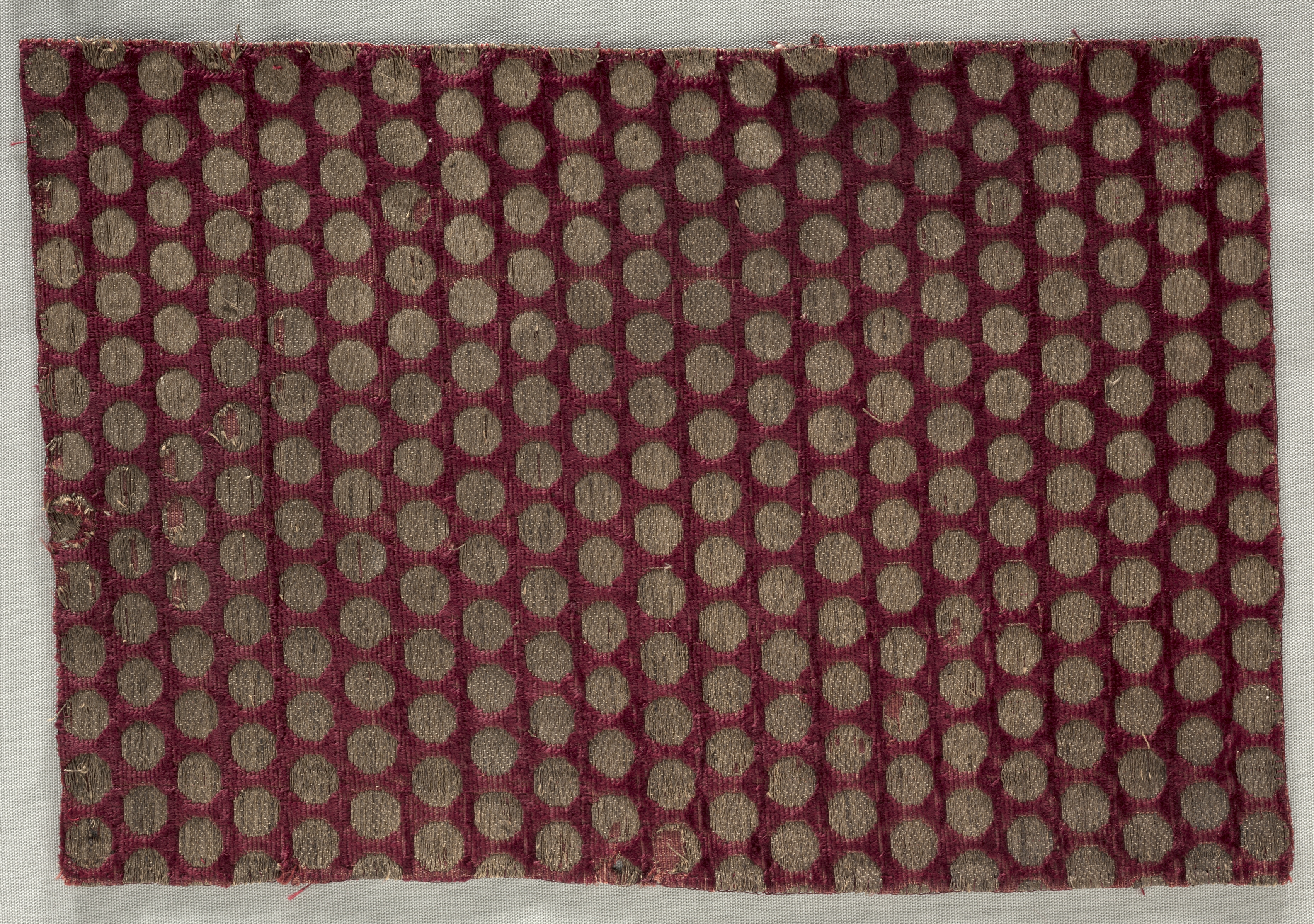
Deconstructing the Ilkhanid Velvet: A Technical and Aesthetic Analysis for Zoey Fashion Lab
As Chief Fabric Deconstructionist for Zoey Fashion Lab, I present a comprehensive analysis of a singular textile artifact: a fragment of velvet woven with gold discs, originating from Iran, likely Tabriz, during the Ilkhanid period (circa 1256–1353). This piece, constructed from silk and gilt-metal thread through the complex technique of brocaded velvet, represents a pivotal moment in the history of luxury textiles. Its technical sophistication and symbolic resonance offer profound material for avant-garde design. This analysis will dissect its construction, historical context, and aesthetic potential, framing it as a new DNA strand for Zoey Fashion Lab’s experimental collections.
Technical Deconstruction: The Brocaded Velvet Process
The foundation of this textile is velvet, a pile weave created by introducing an extra set of warp threads—typically silk—that are looped and cut to form a dense, soft surface. In this Ilkhanid example, the ground weave is a plain or twill structure, likely in a deep crimson or midnight blue, though the original color may have faded to a muted aubergine or charcoal. The pile, standing approximately 2-3 millimeters high, provides a tactile depth that absorbs and reflects light unevenly, creating a living, shifting surface.
The gold discs are not appliquéd or embroidered; they are brocaded. Brocading involves weaving supplementary weft threads—here, gilt-metal—that float on the surface to create patterns. The gold discs were executed by introducing a weft of gilt-metal thread, typically a thin strip of gold leaf wrapped around a silk or linen core. This thread was woven in a discontinuous manner, meaning it only appears where the discs are located, leaving the velvet pile untouched elsewhere. The result is a crisp, metallic motif that contrasts sharply with the soft, matte pile. The discs themselves are likely circular, ranging from 5 to 15 millimeters in diameter, and may be arranged in staggered rows or isolated clusters, evoking celestial bodies or coinage.
The technical mastery required for this brocaded velvet is extraordinary. The weaver had to coordinate the lifting of warp threads for the ground weave, the insertion of the velvet pile warp, and the placement of the supplementary gilt weft—all on a drawloom operated by a drawboy. The precision of the gold discs suggests a highly skilled artisan, likely working in a state-sponsored workshop in Tabriz, a major center of Ilkhanid silk production. The use of gilt-metal thread indicates access to significant wealth, as gold was a precious commodity traded along the Silk Road. This fabric was not merely decorative; it was a statement of political and economic power.
Historical and Cultural Context: The Ilkhanid Synthesis
The Ilkhanid period, following the Mongol conquest of Persia, was a time of cultural fusion. The Ilkhanate rulers, originally Buddhist or shamanistic, gradually adopted Islam, and their courts became crucibles of Persian, Chinese, and Central Asian artistic traditions. This velvet fragment embodies that synthesis. The velvet technique itself likely originated in China, where silk pile weaves were known as kesi or later zhuanghua. However, the Persian weavers refined it, introducing the brocaded gold that recalls Sasanian and early Islamic metalwork. The gold discs may reference Chinese coin motifs, Islamic geometric patterns, or even Mongol tamga symbols, but their precise meaning remains elusive—a deliberate ambiguity that enhances their avant-garde appeal.
Tabriz, as a capital under the Ilkhanate, was a hub of trade and production. The city’s bazaars supplied courts across Eurasia, and its textiles were exported to Europe, where they were treasured as relics or used for ecclesiastical vestments. This velvet fragment, therefore, is not just a Persian artifact but a node in a global network of exchange. Its gold discs, shimmering like distant stars, evoke the Silk Road’s luminous pathways—a metaphor Zoey Fashion Lab can exploit for collections exploring connectivity and diaspora.
Avant-Garde Potential: The New DNA Strand
For Zoey Fashion Lab, this Ilkhanid velvet is not a historical curiosity but a new DNA strand—a genetic code for deconstructing and recombining luxury, texture, and symbolism. The avant-garde sensibility demands that we strip the fabric of its original function and reimagine it as a conceptual material. Here, the velvet’s soft, absorbent pile becomes a ground for disruption, while the gold discs act as nodes of resistance—hard, reflective, and alien.
Texture and Tactility: The contrast between velvet’s plushness and the rigid, metallic discs is inherently avant-garde. Zoey Fashion Lab can amplify this by laser-cutting the velvet to expose the gold threads, creating a topographic map of the original pattern. Alternatively, the discs can be isolated and re-embroidered onto sheer organza or neoprene, transforming them into floating, planetary motifs. The velvet’s pile can be selectively crushed or burned to create distressed zones, echoing the ravages of time and trade.
Color and Light: The original colors—likely deep reds, blues, or greens—can be inverted or saturated. Consider a collection where the velvet is dyed in toxic neon shades (chartreuse, magenta) while the gold discs are replaced with iridescent Mylar or recycled circuit-board components. This subverts the fabric’s historical luxury, introducing a cyberpunk or bio-hacker aesthetic. The gold discs, once symbols of imperial wealth, become emblems of digital currency or surveillance.
Structural Deconstruction: The brocaded technique suggests a modular approach. Zoey Fashion Lab can treat the velvet as a base layer, with the gold discs as removable or interchangeable components. Imagine a garment where the discs are attached via magnetic snaps or conductive thread, allowing the wearer to reconfigure the pattern. This interactive quality aligns with avant-garde fashion’s interest in performance and user agency.
Symbolic Recontextualization: The gold discs, originally celestial or coin-like, can be reinterpreted as QR codes, barcodes, or data points. Print a matrix of discs onto a velvet bodysuit, each disc containing a fragment of the Ilkhanid poem or a Silk Road map. This turns the garment into a wearable archive, a new DNA strand encoding history for a future audience. Alternatively, the discs can be cast in resin or 3D-printed in bioplastic, referencing ecological concerns—the gold of the past replaced by the plastics of the present.
Conclusion: Weaving the Past into the Future
This Ilkhanid velvet with gold discs is a masterwork of technical and aesthetic achievement. Its brocaded construction, silk pile, and gilt-metal threads speak to a sophisticated understanding of materiality and symbolism. For Zoey Fashion Lab, it offers a rich lexicon of textures, motifs, and historical narratives that can be deconstructed and reimagined through an avant-garde lens. By treating this fabric as a new DNA strand, we can weave its legacy into collections that challenge notions of luxury, temporality, and cultural exchange. The gold discs, once fixed in a rigid pattern, now become mutable, floating, and alive—ready to be re-encoded for the future of fashion.