Deconstructing the Body Guard: An Avant-Garde Analysis for Zoey Fashion Lab
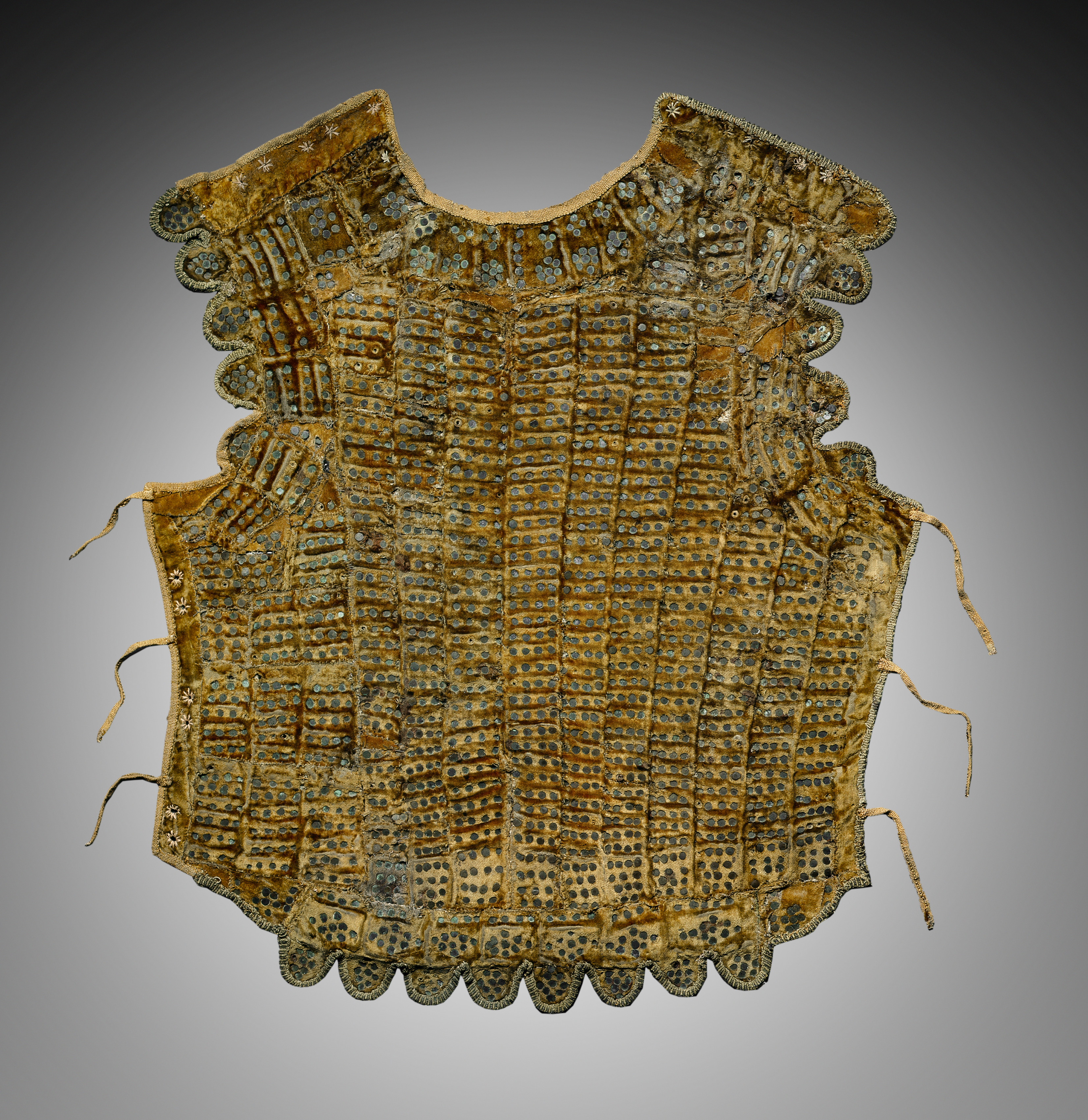
The garment under scrutiny—a Body Guard (Brigandine), tentatively attributed to early 16th-century Italy—presents a paradox of protection and vulnerability. Composed of linen, gold velvet, steel, and brass, it is a relic of martial necessity. Yet, for Zoey Fashion Lab, this artifact is not a historical endpoint but a genetic starting point. In the context of our avant-garde mandate, this Brigandine becomes a New DNA Strand: a code to be spliced, mutated, and re-expressed. This analysis deconstructs its material and structural lexicon to extract the raw syntax for a future-forward silhouette.
Material Dissonance: The Alchemy of Soft and Hard
The Brigandine’s genius lies in its material juxtaposition. The linen base and gold velvet overlay speak to the wearer’s status—a soft, luminous shell for the battlefield. The steel plates, riveted with brass, lie beneath, a hidden skeleton of defense. For Zoey Fashion Lab, this is not a binary of inner/outer but a dialogue of translucency and opacity. The linen, once a humble underlayer, can be reimagined as a sheer, deconstructed weave—a ghost of the original. The gold velvet, a symbol of imperial wealth, must be disrupted: consider laser-cut patterns that mimic the rivet holes of the brass, allowing the steel beneath to peek through as a metallic grid. The brass itself, historically functional, becomes an ornamental exoskeleton—not hidden, but exposed as a structural web over the velvet. This creates a tension between the garment’s historical purpose (concealment of armor) and its avant-garde reinterpretation (revelation of structure).
Structural Syntax: From Rigid Shell to Fluid Architecture
The Brigandine’s construction is a modular grid: small steel plates (typically 1-2 inches square) are riveted to the fabric, creating a semi-flexible armor. This modularity is the core DNA for our new strand. In the original, the plates are hidden; in our avant-garde version, the grid must be reversed and exaggerated. Imagine a garment where the steel plates are not concealed but become the primary surface—polished to a mirror finish, then partially obscured by a top layer of gold velvet that is strategically torn, burned, or chemically distressed. The brass rivets, instead of being flush, are elongated into spikes or loops, transforming the garment from a shield into a sculptural trap. The linen backing, rather than being a base, could be detached and allowed to hang freely, creating a second skin that sways with movement, contrasting the rigid steel above. This structural inversion echoes the avant-garde principle of function becoming form: the armor is no longer for combat but for visual confrontation.
Historical Context as Provocation
This Brigandine, likely worn by a condottiero or merchant prince, was a statement of controlled aggression. The gold velvet signaled wealth; the steel, readiness. For Zoey Fashion Lab, we must interrogate this power dynamic. In the 21st century, what does it mean to wear armor? It is no longer about literal warfare but about psychological protection—against surveillance, against the gaze, against the ephemeral nature of fashion itself. Our reinterpretation should challenge the wearer’s relationship with vulnerability. Consider a Brigandine where the steel plates are replaced with brass mesh—flexible yet impenetrable to touch. The gold velvet is replaced with a metallic organza that shifts color in light, creating a moiré effect that disorients the viewer. The linen, traditionally breathable, becomes a smart textile embedded with fiber optics, pulsing with data or responding to the wearer’s heartbeat. This is not armor for the battlefield but for the digital age—a suit of light and information.
The New DNA Strand: Deconstruction as Creation
The concept of a New DNA Strand implies a genetic recombination. We are not merely copying the Brigandine; we are isolating its core genes—modularity, material contrast, hidden structure—and recombining them with alien elements. For Zoey Fashion Lab, this means:
- Gene 1: Modular Plate System → Replaced with 3D-printed polymer tiles that snap together magnetically. Each tile can be a different color, texture, or function (e.g., one tile holds a pocket, another acts as a screen). The wearer can reconfigure the armor daily.
- Gene 2: Gold Velvet → Mutated into hand-painted liquid latex over a gold leaf base, creating a cracked, iridescent surface that mimics the patina of aged metal. This material is both precious and disposable, echoing the Brigandine’s original status as a luxury item.
- Gene 3: Brass Rivets → Transformed into kinetic joints—small brass bearings that allow the polymer tiles to slide and rotate, creating a garment that breathes and moves like a second skeleton. The sound of brass on brass becomes a sonic signature.
- Gene 4: Linen Backing → Replaced with recycled carbon fiber mesh, a material that is both lightweight and stronger than steel. This mesh is left raw, its industrial grid exposed as a commentary on sustainability and the future of protective wear.
Silhouette and Movement: The Avant-Garde Body
The original Brigandine was fitted to the torso, allowing for arm movement while protecting the core. Our avant-garde version explodes this silhouette. The shoulders are exaggerated with overlapping polymer tiles that fan out like gills. The waist is cinched with a brass corset that is not hidden but displayed, the rivets forming a spinal ridge. The hem is asymmetrical, with one side ending at the hip, the other trailing into a train of carbon fiber mesh and liquid latex. This asymmetry echoes the Brigandine’s original purpose—protection was not uniform but prioritized vital organs. Here, the imbalance becomes a visual statement: the garment protects the wearer’s identity, not their body.
Movement is critical. The kinetic joints allow the tiles to shimmer and shift with each step, creating a ripple effect like water over steel. The carbon fiber mesh, when the wearer turns, catches light and reveals the gold leaf beneath. This is not static armor; it is a living exoskeleton that responds to the environment. The avant-garde element lies in the unpredictability—the garment is never the same twice, as the tiles can be rearranged, the latex can crack further, and the brass bearings wear down over time, creating a unique patina for each owner.
Conclusion: The Brigandine as a Blueprint for the Future
The early 16th-century Italian Brigandine is not a relic to be preserved but a catalyst for creation. Zoey Fashion Lab’s deconstruction reveals that its true value lies not in its historical accuracy but in its structural DNA. By splicing its genes—modularity, material contrast, hidden strength—with futuristic materials and kinetic design, we produce a garment that is both a tribute and a rebellion. This new Body Guard is not for war but for self-definition. It is armor against the mundane, a shield of individuality in a world of mass production. The gold velvet may be gone, but the spirit of opulence remains, transmuted into light and data. The steel is now polymer, but the will to protect persists—now protecting the wearer’s essence, not their flesh. This is the avant-garde imperative: to honor the past by destroying and rebuilding it, strand by strand, until a new species of fashion emerges.