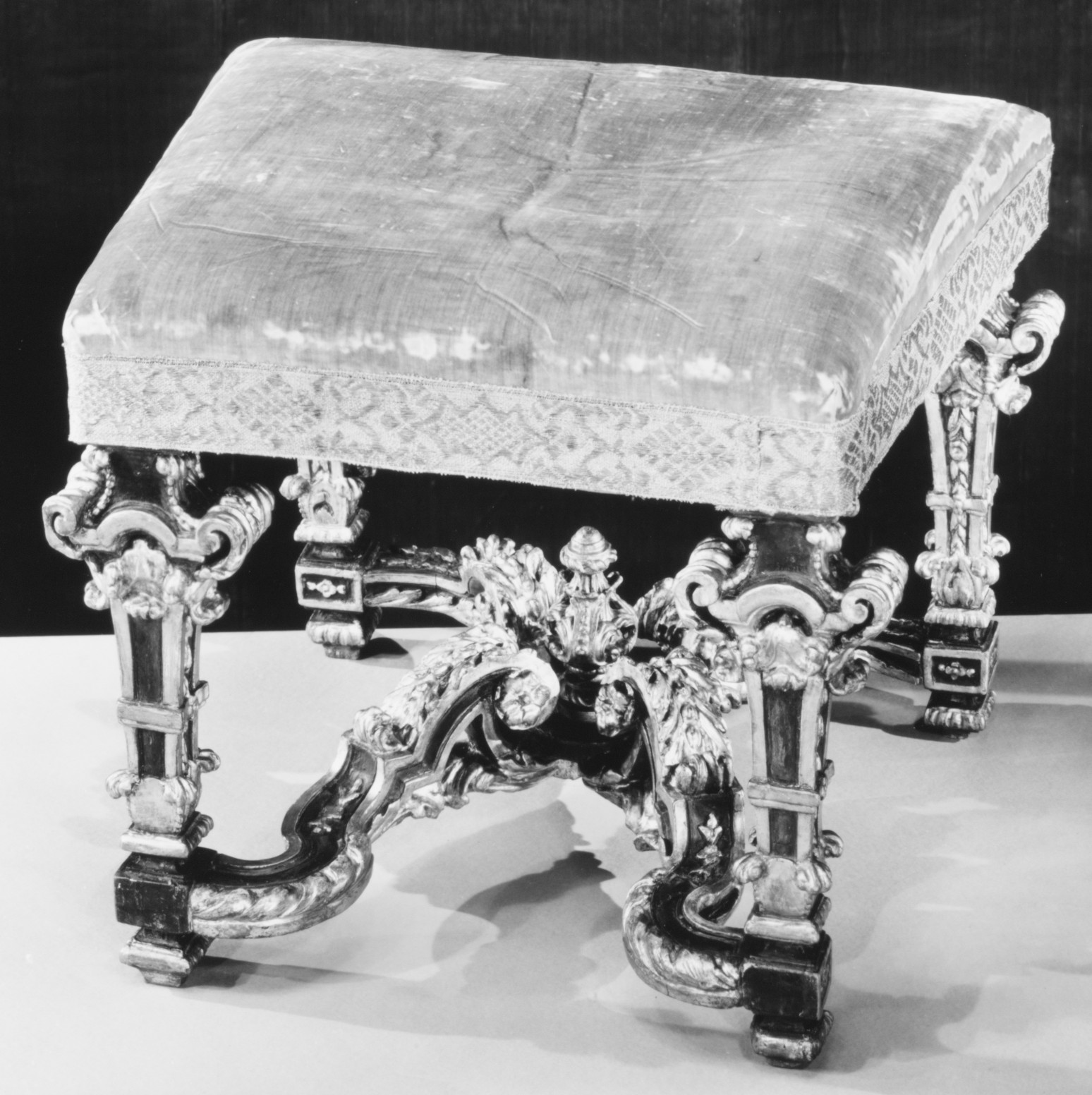
Deconstructing the Vertical Axis: The Harpsichord Stool as a Proto-Futurist Silhouette for SS26
At Zoey Fashion Laboratory, we operate at the precipice where objecthood and garment architecture collide. In our ongoing Global Frontier series, we excavate the latent avant-garde potential within historical artifacts, stripping them of their original context to reveal a new, radical syntax. The subject of this definitive analysis is a seemingly prosaic piece: a stool for a harpsichord, part of a larger set. Yet, within its painted and gilded elm and birch frame, and its incongruous green silk velvet upholstery—a textile not original to its structure—we discover a blueprint for the SS26 collection. This is not a study in furniture restoration; it is a manifesto for futuristic silhouettes and structural innovation.
The Dissolution of Function: From Sitting to Suspension
The stool’s primary function—to support the seated body at a fixed height—is its most obvious, and therefore least interesting, attribute. For SS26, we deconstruct this vertical axis. The stool’s four legs, crafted from painted and gilded elm, are not merely load-bearing elements; they are vertical struts that anchor a potential energy field. In our preliminary sketches, these legs are reimagined as elongated, cantilevered supports for a jacket’s shoulder harness, or as the articulated joints of a high-waisted, asymmetrical skirt. The gilding, a layer of precious metal applied to the birch, becomes a luminiferous accent—a metallic thread woven into a sheer, architectural mesh that reflects light and redefines the wearer’s spatial presence. The stool’s seat, originally a static plane, is reinterpreted as a floating chassis. The green silk velvet, a later addition, is a deliberate, almost violent intervention. Its non-originality is its strength. We treat it as a displaced membrane, a piece of skin that does not belong, creating a tension between the rigid, gilded frame and the soft, organic pile. This juxtaposition of the hard and the soft, the painted and the natural, is the core of our structural innovation.
Gilding the Grid: A New Structural Lexicon
The painted and gilded elm and birch are not simply materials; they are a system of constraints. The paint—likely a dark, almost charcoal base—provides a matte, grounding field, while the gilded accents trace a delicate, geometric pattern. For SS26, we translate this into a laser-cut, structural grid for a futuristic silhouette. Imagine a bodice constructed from multiple, interlocking panels of elm veneer, each painted matte black, with gilded brass rivets at the junctions. This is not a costume; it is a wearable exoskeleton. The grid’s geometry—inspired by the stool’s turned legs and carved details—is both rigid and fluid. It allows for a controlled range of motion, like the articulated armor of a cyborg, while the gilded elements catch the light like a digital circuit. The green silk velvet, meanwhile, is repurposed as a lining for the exoskeleton, a soft, tactile interior that contrasts with the hard exterior. This is a garment that speaks to the duality of the modern frontier: the organic and the synthetic, the historical and the hyper-future. The stool’s verticality is preserved, but its function is inverted. Instead of supporting a seated figure, the exoskeleton elevates the wearer, creating a silhouette that is elongated, powerful, and almost alien.
The Green Velvet Intervention: Subverting the Original
The green silk velvet is the most provocative element of this artifact. As a later addition, it represents a rupture in the object’s timeline. In the context of avant-garde couture, we embrace this rupture as a design principle. For SS26, we propose a series of interventionist techniques where the velvet is not simply applied, but integrated into the structural logic of the garment. Consider a tailored jacket where the sleeves are constructed from gilded birch panels, but the back is a single, sweeping piece of green silk velvet, draped asymmetrically. The velvet is not a lining; it is a second skin that flows over the rigid structure, creating a dynamic tension between the static and the kinetic. The color—a deep, almost forest green—evokes a digital bioluminescence, a nod to the Global Frontier’s fusion of nature and technology. We also explore the velvet’s pile by using it as a textural counterpoint in a skirt’s train. The stool’s original seat, now a portable cushion, is reimagined as a detachable, velvet-covered hip pad that can be worn as a standalone accessory or integrated into a larger silhouette. This is the essence of our deconstructive method: the stool is not a relic; it is a kit of parts for a new, futuristic language.
Futuristic Silhouettes: The Vertical Expanse
The most profound impact of the harpsichord stool on SS26 is its vertical orientation. Unlike a chair, which encourages a seated, grounded posture, the stool demands a state of elevated readiness. The wearer is always on the verge of standing, of moving, of performing. Our silhouettes for SS26 are therefore characterized by extreme verticality. We propose a columnar dress that tapers from a wide, gilded shoulder yoke to a narrow, ankle-length hem, echoing the stool’s turned legs. The green velvet is used as a vertical stripe running down the center front, breaking the monochrome of the painted elm. Alternatively, we envision a harness-like top with multiple straps of gilded birch, worn over a flowing, asymmetrical skirt of velvet. The stool’s legs become the structural ribs of a cage crinoline, but one that is worn externally, as a sculptural piece. The silhouette is not about volume; it is about linear tension. The gilding acts as a light-conducting element, drawing the eye upward and outward, while the velvet anchors the look with a sense of organic weight. This is a silhouette that defies gravity, a futuristic armor for the global citizen.
Conclusion: The Object as a Portal
The stool for the harpsichord, in its original context, was a tool for music—a passive support for an active performer. In our avant-garde analysis, it becomes a portal to a new design paradigm. The painted and gilded elm and birch teach us about structure, constraint, and the power of the grid. The green silk velvet teaches us about intervention, displacement, and the beauty of the non-original. For SS26, we are not creating garments that look like furniture; we are creating garments that embody the stool’s latent energy: its verticality, its tension, its potential for movement. The result is a collection that is both a tribute to the Global Frontier and a radical departure from it—a definitive statement on the futuristic silhouette and structural innovation that only Zoey Fashion Laboratory can deliver.