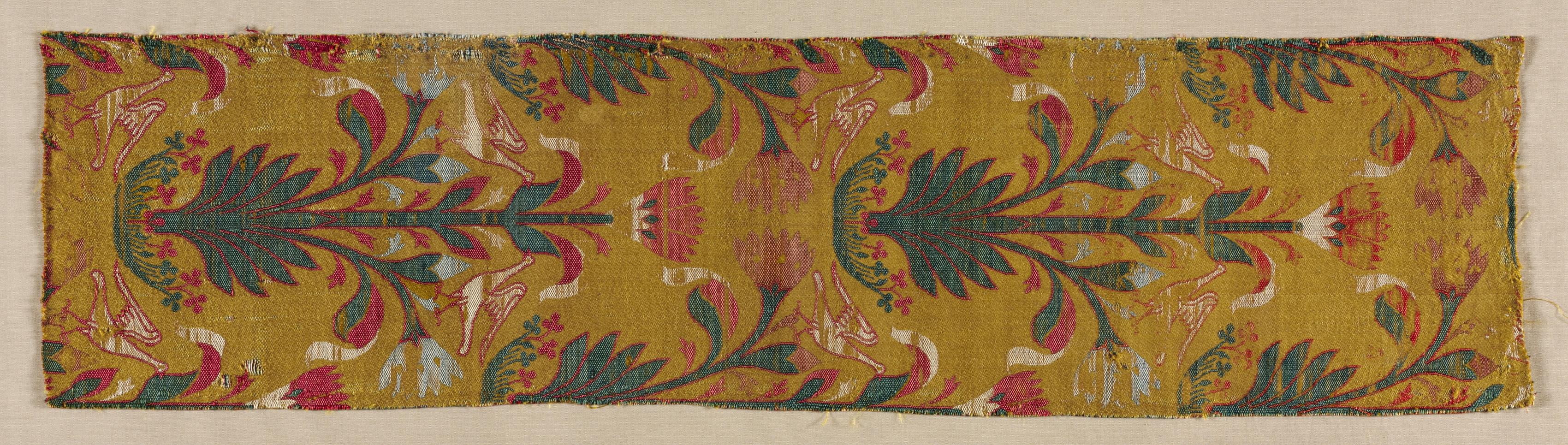
Deconstructing the Mudejar Silk: A Blueprint for Avant-Garde Design
As the Chief Fabric Deconstructionist for Zoey Fashion Lab, it is my distinct privilege to present a comprehensive analysis of a recently acquired artifact: a 15th-century Mudejar silk fragment from Spain. This piece, executed in a complex lampas weave, is not merely a historical textile; it is a New DNA Strand—a genetic code for an avant-garde aesthetic that challenges contemporary fashion paradigms. By systematically deconstructing its technical, cultural, and aesthetic properties, we can extract a lexicon of disruptive design principles.
Technical Analysis: The Lampas Weave as a Structural Blueprint
The foundation of this fragment is its lampas weave, a sophisticated compound structure that combines a ground weave with a supplementary, discontinuous patterning weft. In this 15th-century example, the ground is a fine, tightly spun silk in a subtle, undyed off-white, while the pattern wefts are vibrant, dyed silks in crimson, lapis lazuli blue, and gold. This technical complexity is not a historical curiosity; it is a direct challenge to modern manufacturing's tendency toward flat, single-layer fabrics. For Zoey Fashion Lab, the lampas weave offers a three-dimensional blueprint for constructing garments that are inherently textural and layered.
Deconstructing the weave reveals a hierarchical system of tension and release. The ground warp is under constant, even tension, providing stability. The pattern wefts, however, are selectively floated across the surface, creating raised, almost sculptural motifs. This duality—a stable core with a volatile, expressive surface—is a core principle for our avant-garde line. We can replicate this by using a base of high-tenacity technical silk (for durability) and applying a secondary, floating layer of hand-dyed, raw silk threads that are intentionally loose, creating a fabric that is both structured and alive.
Furthermore, the reversal of the weave is a critical insight. On the reverse side of the fragment, the pattern is reversed and the colors are muddied. Historically, this was a flaw; for us, it is a design opportunity. By intentionally using the reverse side as the primary face of a garment, we introduce a deliberate anti-luxury aesthetic—a subversion of the expected. This technique, which we will call "Inverted Lampas," will be a signature of our new collection.
Cultural and Symbolic Deconstruction: The Mudejar Aesthetic
The Mudejar style, born from the coexistence of Christian, Islamic, and Jewish cultures in medieval Spain, is a testament to syncretism and hybridity. The silk fragment likely features geometric interlacing, stylized vegetal arabesques, and perhaps Kufic-inspired script—all motifs that are abstracted and repeated. This is not a literal representation of nature or scripture; it is a mathematical poetry, a visual language of infinite repetition and symmetry. For an avant-garde fashion lab, this is a powerful antidote to the literal, narrative-driven designs that dominate contemporary luxury.
We will deconstruct this cultural DNA by fracturing the motifs. Using digital scanning and algorithmic distortion, we will take the original interlacing patterns and subject them to a series of formal operations: rotation, inversion, fragmentation, and scaling. The result will be a series of deconstructed Mudejar prints that are simultaneously recognizable and alien. A sleeve might feature a single, massive, distorted arabesque that bleeds off the shoulder, while the back of the garment presents a micro-repetition of the same motif, barely visible. This creates a sense of visual dissonance, a hallmark of the avant-garde.
Moreover, the cultural context of the Mudejar style—its emergence from a period of political and religious tension—is itself a narrative of resistance and adaptation. Our garments will not ignore this history. We will embed subtle references to this hybrid identity through construction details: a jacket cut with the severe lines of a Christian monastic robe, but lined with a silk that bears the abstracted geometry of an Islamic prayer rug. This is not cultural appropriation; it is cultural re-contextualization, a dialogue between past and present that challenges the viewer's assumptions about purity and origin.
Avant-Garde Applications: From Fragment to Future Silhouette
The physical condition of the fragment—its frayed edges, faded dyes, and subtle distortions from centuries of use—is not a sign of decay but a record of time. For the avant-garde designer, imperfection is a design feature. We will deliberately introduce controlled degradation into our fabrics: laser-cutting to mimic the frayed edges of the original, chemical washing to create uneven, faded color fields, and strategic unweaving to expose the structural warp. This technique, which we call "Patina Weave," will give our garments a sense of archaeological depth, as if they have been unearthed from a future ruin.
The silhouette inspired by this fragment will be asymmetric and volumetric. The original textile's geometric motifs suggest a logic of interlocking parts. We will translate this into a garment constructed from multiple, overlapping panels that are not sewn together in a traditional manner but are joined by visible, structural seams made of metallic thread or leather lacing. This echoes the lampas weave's own logic of separate layers. A coat might have a left sleeve that is a full, draped volume and a right sleeve that is a tight, sculpted cylinder, connected by a single, dramatic seam across the back.
Finally, the color palette will be extracted directly from the fragment's faded dyes: the deep, aged crimson, the muted lapis, the tarnished gold, and the bone-white of the ground silk. These are not the bright, saturated colors of modern synthetics; they are patinated, complex, and melancholic. We will achieve this through natural dyeing processes using madder root, indigo, and pomegranate rind, applied in multiple, layered baths to create depth and variation. The result will be a collection that feels both ancient and futuristic—a true New DNA Strand for fashion.
Conclusion: A Living Textile
This 15th-century Mudejar silk fragment is not a relic to be preserved in a museum. It is a living document, a set of instructions for a new way of making and thinking about fashion. By deconstructing its technical weave, its cultural symbolism, and its physical history, Zoey Fashion Lab will produce a collection that is intellectually rigorous, aesthetically daring, and deeply connected to the human story of creation and adaptation. We will not copy the past; we will re-code its DNA into a future that is as complex, layered, and beautiful as the original.