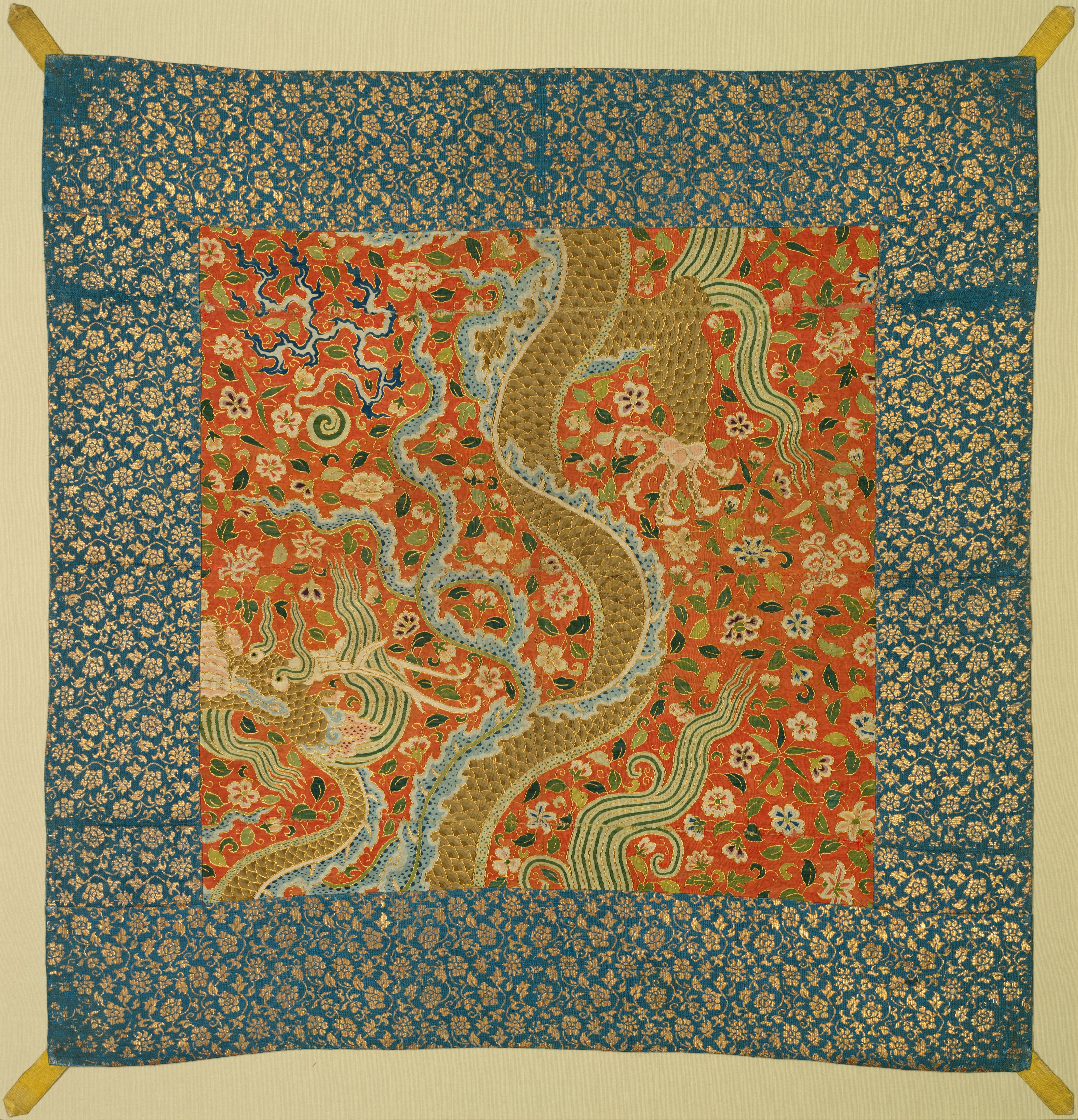
Deconstructing the Canopy: A Tapestry of Time and Textile Rebellion
At Zoey Fashion Lab, we do not merely observe historical artifacts; we interrogate them. We dissect their materiality, challenge their chronology, and re-suture their fragments into a new, avant-garde lexicon. The "Canopy with Dragon among Flowers," a composite relic of the Southern Song and Ming dynasties, presents a uniquely fertile ground for such deconstruction. This object is not a monolithic whole but a dialogue across centuries—a conversation between two distinct imperial aesthetics, woven together in silk and gold. Our analysis will strip this canopy of its conventional reverence, exposing the radical potential latent within its very structure: a proto-avant-garde manifesto of temporal and textile rebellion.
I. The Center: Southern Song (1127-1270) – A Study in Restrained Power
The central panel, a masterpiece of kesi (tapestry weave), embodies the Southern Song dynasty’s refined sensibility. This is not the bombastic, overt power of later imperial courts. Instead, it is a power of suggestion, of controlled energy. The dragon, a symbol of imperial authority, is rendered not through aggressive scale or violent posture, but through sinuous, fluid lines. Its form is almost calligraphic, a brushstroke of gold thread against a field of deep, resonant silk. The flowers—most likely peonies, symbols of wealth and honor—are not chaotic but orchestrated, their petals and leaves forming a rhythmic, almost abstract pattern. The kesi technique itself is crucial here. Each color area is woven separately, creating sharp, clean boundaries and a tapestry-like texture that feels both painterly and tactile. This is a fabric of immense discipline, a testament to the Song dynasty’s philosophical embrace of li (principle) and the beauty of understatement. The gold thread is not a gaudy flash but a subtle, luminous accent, guiding the eye along the dragon’s spine and the flower’s stamens. This center is a quiet, confident statement of a civilization at its peak of aesthetic introspection.
II. The Border: Ming Dynasty (1368-1644) – An Explosion of Ornament
Contrast this with the border, a Ming dynasty addition executed in lampas weave. Here, the aesthetic language shifts dramatically. The Ming period was one of expansion, consolidation, and a taste for the grand and the explicit. The border is not a quiet whisper but a resounding declaration. The lampas weave, with its complex structure of a ground weave and a pattern weave, allows for a denser, more intricate, and more saturated design. The gold thread is used more liberally, creating a shimmering, almost metallic field that frames the central panel. The dragon and flowers, while thematically similar, are rendered with a different energy. The dragon is more muscular, its claws more pronounced, its expression more fierce. The flowers are larger, more stylized, and repeated in a rhythmic, almost hypnotic pattern. The border is a frame that does not simply contain; it asserts. It is a testament to the Ming dynasty’s confidence, its love of opulence, and its desire to leave an unmistakable mark on whatever it touched. This is not a subtle dialogue; it is a forceful re-contextualization.
III. The Avant-Garde Reading: Temporal Collision and Textural Dissonance
The true genius of this canopy, and the basis for our avant-garde analysis, lies in the temporal collision it enacts. The Southern Song center and the Ming border are not harmonious. They are in a state of productive tension. The restrained, painterly quality of the kesi is literally enclosed by the dense, ornamental luxury of the lampas. This is not a seamless whole; it is a palimpsest, a layering of two distinct design philosophies. For the avant-garde designer, this is a goldmine. We see this not as a flaw but as a deliberate act of textural dissonance. The smooth, almost matte surface of the Song center is abruptly confronted by the raised, shimmering, and more rigid texture of the Ming border. The eye is forced to oscillate between these two modes of seeing, two ways of understanding power and beauty. This is a proto-deconstructivist gesture, a premonition of the fragmented, collage-like aesthetics of the 20th and 21st centuries. The canopy is not a finished object; it is a process, a record of its own making and remaking.
IV. Re-Suturing for the Modern Silhouette: The Zoey Lab Protocol
At Zoey Fashion Lab, we do not preserve; we re-suture. Our protocol for this canopy involves a radical act of extraction and recombination. We will deconstruct the canopy into its constituent parts: the Song center and the Ming border. These will not be treated as a unified artwork but as two distinct, independent textile arguments. The Southern Song kesi will be isolated and used as the foundation for a deconstructed kimono jacket. Its restrained dragon and flowers will be partially obscured by a series of sheer, organza overlays, printed with a digital scan of the Ming border’s pattern. This creates a ghostly, layered effect, a visual echo of the historical layering. The Ming lampas border will be cut into geometric panels and used to construct a structured, asymmetrical skirt. The dense gold weave will be paired with matte black neoprene, creating a stark contrast between historical opulence and modern utility. The dragon motifs from the border will be isolated and applied as 3D-printed, gold-lacquered appliqués on the skirt’s surface, literally lifting the pattern from its woven context. The result is a wearable, avant-garde ensemble that does not imitate the canopy but performs its history. It is a garment that speaks of time, of power, of the audacity to cut and re-stitch the past into a new, defiant form.
V. Conclusion: The Canopy as a Manifesto
The "Canopy with Dragon among Flowers" is more than a rare artifact. It is a manifesto in silk and gold. It demonstrates that the most radical acts are not always the loudest; sometimes, they are the quiet, centuries-long conversations between a center and its border. For Zoey Fashion Lab, this object validates our core philosophy: that the avant-garde is not a break from history but a critical re-engagement with it. By deconstructing this canopy, we honor its material complexity while refusing to be bound by its original narrative. We see in its temporal seams and textural clashes the blueprint for a new kind of fashion—one that is intellectually rigorous, aesthetically daring, and unafraid to cut, paste, and re-suture the very fabric of time itself. This is our Archive Resonance: not a passive echo, but a generative, disruptive force that propels the past into a future it could never have imagined.