Material Deconstruction: The Metallurgical Logic of 17th-Century Brass Stirrups
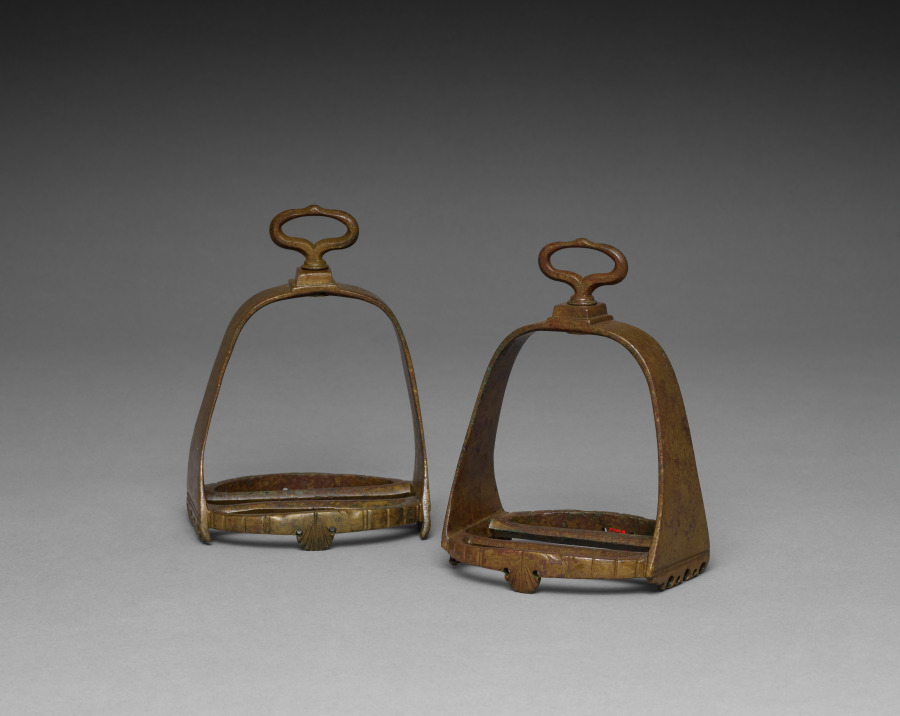
The assigned artifact—a pair of 17th-century English stirrups, fabricated in brass—presents a foundational case study in applied material intelligence. Our analysis begins not with the equestrian function, but with the inherent properties of the period-specific brass alloy. This was not a pure metal but a dynamic composite, typically a variable ratio of copper and zinc, often with trace elements of tin or lead. This formulation created a material with a critical duality: it possessed greater malleability and lower melting points than iron, allowing for intricate casting and hammered detailing, yet it achieved a tensile strength and corrosion resistance far superior to pure copper. The stirrup’s form-factor—a load-bearing, safety-critical interface between human and animal—demanded this exact compromise. The brass yielded slightly under impact, absorbing shock, while its structural integrity prevented catastrophic failure. This is a proto-engineering principle: the strategic implementation of a composite material to solve for multiple, conflicting performance criteria—weight, strength, durability, and manufacturability.
Structural Translation: From Equestrian Anchor to Axial Silhouette
The stirrup’s primary structural logic is one of suspended support and kinetic coupling. It is not a static platform but a dynamic pivot point, a rigid frame that facilitates controlled motion. Its arched top (the tread) and the dependent loop (for the leather) create a topology of tension and compression. This geometry translates directly into a human-centric silhouette architecture. For the Zoey Fashion Lab 2026 collection, this informs the concept of the “Exoskeletal Suspension System.” Imagine garments built not on traditional draping, but on a framework of slender, brass-derived alloy ribs. These ribs would emanate from key kinetic pivot points—the shoulders, the scapulae, the hips—creating a lightweight, external skeleton that defines silhouette while enabling a new range of structured, amplified movement. The stirrup’s form becomes the blueprint for articulated joint-capsules at the elbows and knees, fabricated in 3D-printed metal-polymer composites that mimic the historic brass's balance of give and rigidity.
The New DNA Strand: Correlating Historical Alloy to Futuristic Composite
The correlation directive, “New DNA Strand,” is precisely the core of this translation. The 17th-century brass alloy is our genetic template. Its DNA sequence—copper (conductive, antimicrobial), zinc (resilient, sacrificial), trace elements (for localized property modification)—is sequenced into a 2026 material genome.
Material Genome Expression for 2026
We propose the development of a proprietary material system, “Votive Brass™,” a bio-metallic composite. Its expression is threefold:
1. Structural Expression: Votive Brass™ will be engineered as a woven metal-filament yarn, where ultra-fine strands of copper-zinc alloy are sheathed in enzymatically treated, high-tenacity bio-polymer. This yields textiles with inherent boning, capable of holding radical, gravity-defying shapes—a bell sleeve that extends horizontally, a collar that spirals upward—without secondary structures. The fabric itself is the architecture.
2. Surface & Patina Expression: Historic brass acquires a narrative through patina—verdigris and tarnish that speak to environmental interaction. Our Votive Brass™ will be programmed with a reactive nano-coating that develops a personalized patina based on the wearer’s biometric data (skin pH, cortisol levels) and environmental exposure (urban pollutants, UV index). The garment’s surface becomes a living data visualization, its evolving hue and texture a direct correlate to the 17th-century artifact’s dialogue with time and use.
3. Functional Expression: The stirrup was an interface. Our derived material will be a smart interface. The copper component allows for the seamless integration of passive conductive pathways. A dress’s hem, structured with Votive Brass™ filaments, can act as a capacitive touch surface for device interaction. The antimicrobial properties inherent to copper are amplified, creating garments that actively manage microbiome balance.
Silhouette Manifesto: The Kinetic Cage and The Suspended Volume
This material logic births two dominant silhouette families for the 2026 collection.
Family One: The Kinetic Cage. This applies the stirrup’s load-bearing loop directly to the body. Dresses and tops are constructed from interlinked, lightweight alloy rings inspired by the stirrup’s arch, creating a flexible, mail-like exoskeleton. These cages are worn over minimalist biomechanical garments, creating a visible, functional infrastructure. The silhouette is transparently structural, celebrating points of connection and pivot, making the support system the aesthetic.
Family Two: The Suspended Volume. Here, we interpret the stirrup’s function—supporting a foot in space—as a principle for managing fabric mass. Voluminous, fluid textiles (engineered silks, liquid synthetics) are not supported by the body’s shoulders or hips alone. Instead, they are hung from external frames—minimalist brass-derived rods or curved plates that rise from the garment’s back or waist. This creates the illusion of floating fabric, a volume suspended in space by an elegant, visible armature, directly referencing the stirrup’s suspension of the rider. Trousers may feature a subtle, external brass-inspired tendon running from hip to ankle, guiding drape and articulating movement.
Conclusion: The Archetype as Innovation Platform
For Zoey Fashion Lab, this 17th-century stirrup is far more than a historical artifact; it is a validated blueprint for material-structural synergy. By deconstructing its metallurgical logic—the strategic compromise of its composite brass—we extract principles of dynamic support, kinetic interface, and environmental dialogue. Translating this into the Votive Brass™ material genome allows us to build a 2026 collection that is profoundly avant-garde yet rooted in empirical logic. The silhouettes are not arbitrary fantasies but direct three-dimensional extrapolations of force, suspension, and interaction. We move beyond retro-futurism to a model of deep-time innovation, where the material intelligence of the past is sequenced, amplified, and expressed as the worn architecture of the future. The result is a collection that performs both aesthetically and functionally, where every seam, curve, and surface tells the story of its 400-year-old DNA, radically re-expressed for a new world.