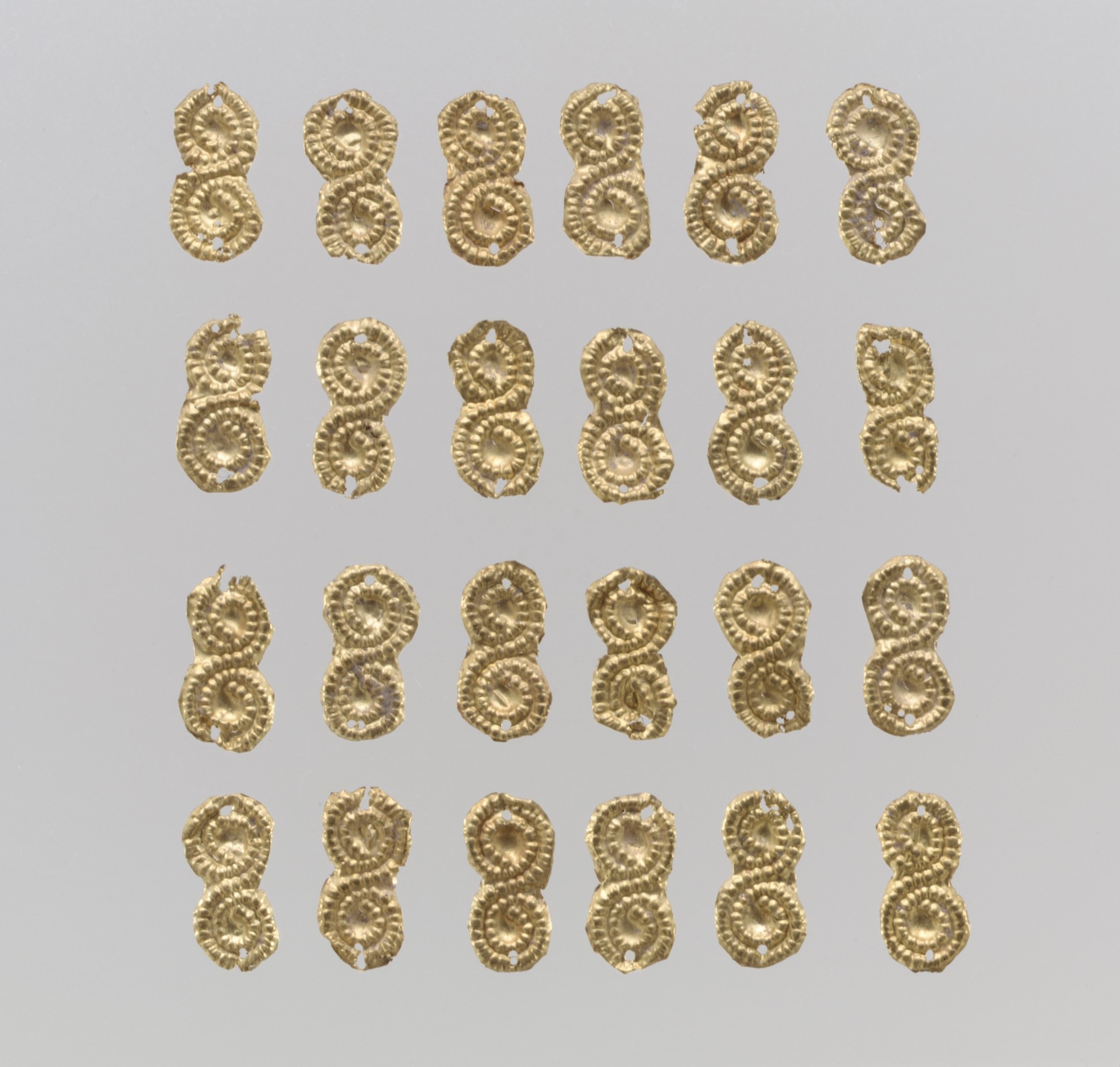
Gold Sheet Appliqués: The Alchemy of Surface and Structure in SS26
In the relentless pursuit of garment architecture that transcends mere adornment, Zoey Fashion Laboratory confronts a paradox: how to imbue a material as historically inert as gold sheet appliqué with the kinetic, futuristic energy demanded by SS26. The answer lies not in the preciousness of the metal, but in its potential for structural subversion. Drawing from an enigmatic archive node—a fragment referencing a silver mirror inlaid with intricate palm-leaf patterns on one side, and a sarcophagus lid narrating life through bas-relief on the other—we deconstruct the aesthetic correlation between reflective surface and narrative depth. This analysis posits that gold sheet appliqués, when liberated from their traditional role as ornament, become a medium for deconstructive silhouettes and futuristic volume, redefining the SS26 collection as a dialogue between fragility and monumentality.
The Archive Node: Mirror and Sarcophagus as Design Dialectic
The cited archive node—“一面是光洁银镜上以黄金镶嵌的纷繁棕叶纹,另一面是冰冷石棺板上以浮雕诉说的生命叙事”—offers a critical framework. The silver mirror, pristine and reflective, represents the surface as interface: a plane of immediate perception, where gold palm leaves are embedded like data points on a screen. Conversely, the cold stone sarcophagus embodies depth through compression: its bas-reliefs tell a story through layered, tactile protrusions. For SS26, gold sheet appliqués must oscillate between these two states. They cannot merely shimmer; they must fold, fracture, and float to create a third dimension. The appliqué becomes a bridge between the ephemeral reflection of the mirror and the eternal narrative of the stone, translating this tension into structural innovation.
Structural Innovation I: The Fractured Gold Grid
Traditional gold appliqué relies on flat adhesion—a surface treatment that prioritizes opulence over architecture. Our SS26 methodology rejects passivity. Instead, we introduce the Fractured Gold Grid: a technique where thin gold sheets are laser-cut into geometric shards—triangles, trapezoids, and irregular polygons—then anchored at single points onto a base of micro-perforated, high-tenacity nylon mesh. This creates a kinetic armor that moves with the body while retaining the rigidity of a structural exoskeleton. The shards, when juxtaposed, generate a moiré effect that mimics the palm-leaf pattern’s organic rhythm, yet their sharp edges evoke the cold precision of the sarcophagus’s carved lines. For a futuristic silhouette, this grid is draped asymmetrically across the torso, forming a single-sleeve, cantilevered shoulder that extends into a voluminous, cape-like back panel. The gold shards catch light from oblique angles, creating a visual dissonance between the garment’s static appearance and its actual fluidity.
Structural Innovation II: The Biomorphic Relief Panel
Drawing directly from the sarcophagus’s bas-relief, we develop the Biomorphic Relief Panel: a modular component where gold sheet appliqués are embossed, then attached to a flexible, 3D-printed lattice of recycled polymer. The lattice acts as a skeleton, allowing the gold to rise and fall in controlled, organic waves. This technique is applied to the hip and pelvic region, creating a sculptural, almost architectural bustle that reimagines historical silhouettes for a post-human aesthetic. The gold panels are arranged in overlapping scales, each one slightly rotated to catch light differently, producing a chimeric surface that shifts between reflective and matte. The result is a silhouette that amplifies the lower body into a monumental, almost geological form—a direct nod to the stone slab’s weight and narrative density. This is not a garment; it is a wearable relic of a future civilization, where gold is not a symbol of wealth but of structural memory.
Deconstructive Aesthetics: The Unraveled Gold Vein
Deconstruction in SS26 is not about tearing fabric; it is about unraveling the material’s identity. We introduce the Unraveled Gold Vein: a process where gold sheet is chemically treated to become brittle, then hand-cracked into fissures that resemble geological fault lines. These cracked sheets are then suspended between layers of transparent, heat-bonded silicone, creating a frozen moment of fragmentation. The appliqué is applied to the front panel of a high-neck, sleeveless tunic, where the cracks form a map of the archive node’s palm-leaf pattern—but reversed, as if the mirror had shattered. The silicone layer allows the gold to float away from the body, creating a negative space that challenges the viewer’s perception of surface and depth. This technique is paired with a deconstructed sleeve that is detached from the shoulder and reattached via a single, gold-plated chain, further emphasizing the tension between connection and disconnection.
Futuristic Silhouettes: The Asymmetric Volume Cascade
The overarching silhouette for SS26 is the Asymmetric Volume Cascade, a form that channels the archive node’s duality. The left side of the body is encased in a sleek, body-hugging base of matte black liquid jersey, punctuated by sparse, point-appliqué gold shards that mimic the mirror’s reflective quality. The right side, however, explodes into cascading layers of gold sheet appliqués mounted on articulated, carbon-fiber ribs. These ribs, inspired by the structural logic of the sarcophagus’s bas-relief, allow the gold to fan out like a peacock’s tail, but with the rigid geometry of a broken mosaic. The cascade begins at the hip and spirals upward, wrapping around the shoulder before dropping into a train that drags on the ground—a literal narrative trail that echoes the stone slab’s storytelling. This silhouette is both armor and drapery, a fusion of the immovable and the fluid.
Material Alchemy: From Malleability to Monumentality
Gold sheet, in its pure form, is malleable and ductile—properties often associated with softness and luxury. For SS26, we invert these properties through thermal and chemical manipulation. The gold is alloyed with a trace amount of titanium to increase its tensile strength, then heat-treated to create a micro-crystalline surface that diffuses light irregularly. This process, which we term “lithic gilding,” transforms the appliqué from a reflective surface into a textured, almost stone-like material. The gold no longer shines; it glows from within, like embers trapped in obsidian. When applied to the neckline of a high-collared, sleeveless vest, this lithic gold creates a collar of compressed time, a frozen moment of transformation that bridges the mirror’s instant reflection and the sarcophagus’s eternal narrative.
Conclusion: The Gold as Structural Memory
In SS26, gold sheet appliqués transcend their historical role as markers of wealth and status. Through the lens of the archive node—the mirror and the sarcophagus—they become carriers of structural memory. The Fractured Gold Grid, the Biomorphic Relief Panel, and the Unraveled Gold Vein are not mere techniques; they are architectural strategies that redefine the garment’s relationship with the body. The Asymmetric Volume Cascade is not a silhouette; it is a narrative form that speaks of time, fragility, and monumentality. Zoey Fashion Laboratory’s SS26 collection does not simply adorn the wearer; it encases them in a dialogue between surface and depth, between the fleeting reflection of a silver mirror and the enduring story of a stone slab. Gold, in this context, is no longer a material—it is a fossilized gesture, a testament to the avant-garde’s ability to transform the precious into the profound.