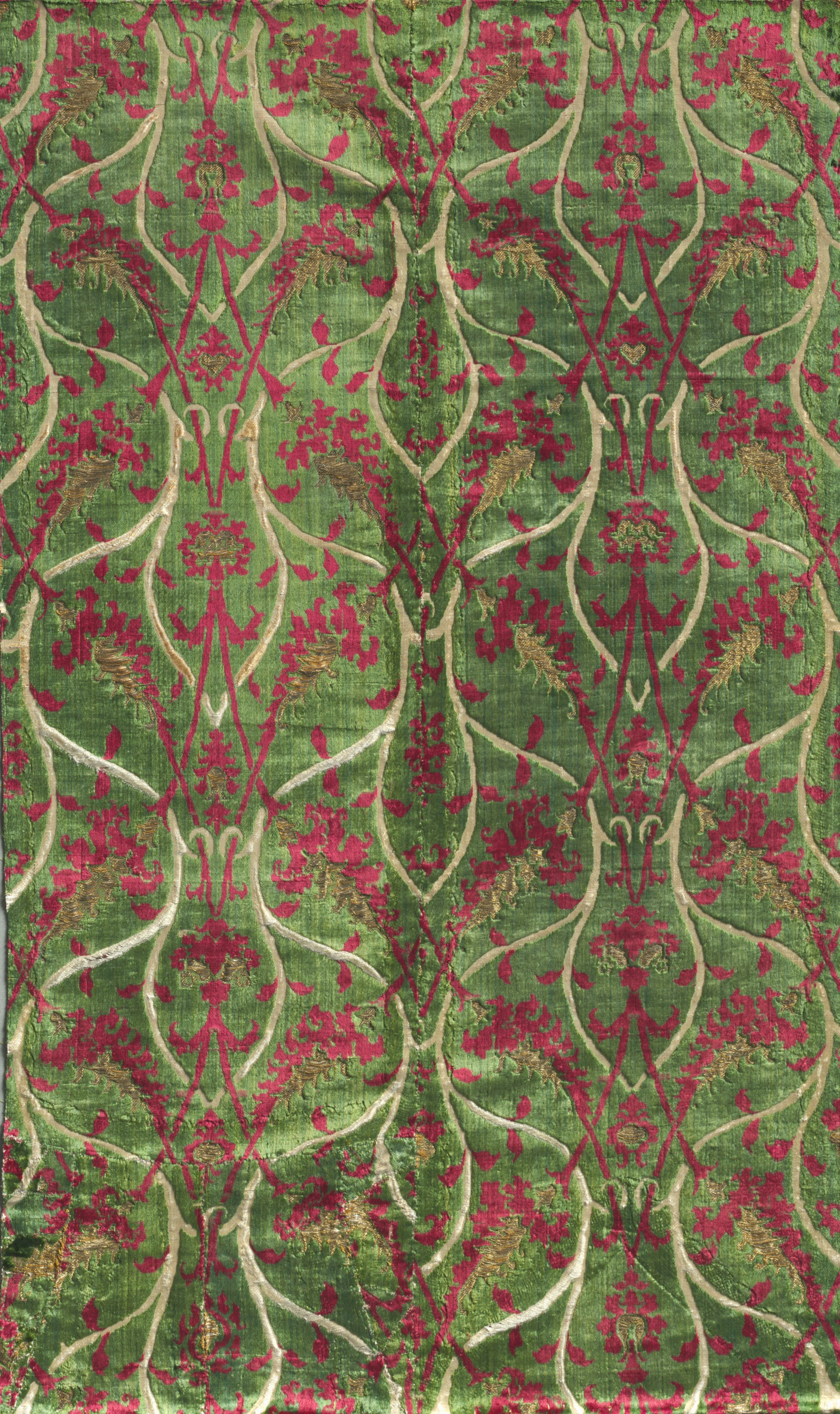
Deconstructing the Lattice: An Avant-Garde Analysis of 15th Century Florentine Velvet
In the hallowed archives of textile history, certain artifacts transcend mere fabric to become resonant dialogues between epochs. For Zoey Fashion Lab, the subject of this analysis—a fragment of two-color velvet with gold, originating from 15th century Italy, likely Florence—is not a relic to be preserved under glass, but a radical blueprint for deconstruction and reanimation. This polychrome velvet, executed in cut pile, brocaded, and voided techniques, presents a double curved lattice pattern interlaced with gold thread. Its technical mastery is undeniable, yet its true value for an avant-garde fashion house lies in its latent potential for rupture, inversion, and spectral reinterpretation. We shall dissect this artifact not as a finished object, but as a system of tensions, a choreography of light and shadow, and a coded narrative of power, faith, and material obsession.
I. The Lattice as a Radical Geometry of Restraint and Release
The defining motif—a double curved lattice—is far from a simple decorative element. In the context of 15th century Florence, such patterns were often derived from Islamic architectural and manuscript traditions, filtered through a Christian lens to symbolize the infinite, the celestial, and the ordered cosmos. The double curve, or ogee arch, introduces a dynamic, almost serpentine energy into the grid. For Zoey Fashion Lab, this is a primary site of deconstruction. The lattice is not a cage; it is a generative matrix.
Deconstructive Protocol: We propose to liberate the lattice from its two-dimensional plane. Consider the following interventions:
- Negative Space as Positive Form: The voided areas—where the pile is cut away to reveal the ground weave—are not absences but active protagonists. In an avant-garde garment, these voids can be exaggerated into architectural cutouts, creating a second, negative lattice that overlays the body. The gold thread, once brocaded into the surface, can be extracted and re-embroidered as a floating, independent web, suspended above the primary fabric.
- Curve as Collar, Lattice as Spine: The double curve can be isolated and scaled to form an exaggerated, structural collar that frames the face, or a spine-like exoskeleton that traces the vertebral column. The lattice becomes a system of articulation, not just a surface pattern.
- Asymmetrical Rupture: The perfect symmetry of the 15th century design is a product of its era’s desire for divine order. The avant-garde response is to introduce deliberate asymmetry—a lattice that fractures, dissolves, or re-forms at the shoulder, hip, or hemline, suggesting a system in a state of becoming or decay.
II. The Polychrome Velvet: A Symphony of Tactile Contradictions
The velvet itself is a triumvirate of techniques: cut pile, brocaded, and voided. Each technique creates a distinct tactile and visual register. The cut pile, with its dense, upright silk fibers, absorbs light, creating deep, velvety shadows. The brocaded gold thread, by contrast, reflects light with a sharp, metallic brilliance. The voided areas offer a flat, matte surface. This is a fabric of extreme contrasts—soft vs. hard, matte vs. gloss, deep vs. flat.
Avant-Garde Material Alchemy:
- Pile as Pixel: The cut pile can be digitally scanned and translated into a pixelated, low-resolution pattern on a modern synthetic mesh. The gold thread can be replaced with laser-cut metallic mylar, sewn onto the mesh in a chaotic, non-repeating pattern. This creates a ghost of the original, a memory trace that is simultaneously ancient and hyper-modern.
- Voided as Transparency: The voided technique, which originally revealed the ground silk, can be reimagined as sheer organza or laser-perforated leather. The body becomes the new ground, visible through the gaps in the pile. This transforms the garment from a covering into a screen, a liminal space between concealment and revelation.
- Gold as Circuitry: The gold thread, once a symbol of divine light and mercantile wealth, can be reinterpreted as conductive thread, embedded with micro-LEDs that pulse with a slow, arrhythmic glow. The brocaded pattern becomes a circuit board, a nervous system of light that animates the lattice from within.
III. The Gold Thread: From Divine Radiance to Post-Industrial Glitch
Gold thread in 15th century Florence was not merely decorative; it was a declaration of status, a materialization of spiritual light, and a store of value. The gold used was often gilded silver or gold leaf wrapped around a silk core, a painstaking process that rendered the thread both precious and fragile. In the context of the Archive Resonance reference—"a smooth silver mirror inlaid with gold, and a cold stone sarcophagus telling a life narrative"—the gold becomes a point of rupture between the reflective and the commemorative.
Avant-Garde Re-Contextualization:
- Gold as Glitch: The perfect, continuous gold lines of the brocaded pattern can be deliberately broken, frayed, or misaligned. Imagine a garment where the gold thread appears to have suffered a digital error—a "glitch" in the weave—creating jagged, broken paths that disrupt the lattice’s flow. This introduces a narrative of technological failure into a pre-industrial artifact.
- Mirror and Sarcophagus: The gold can be extracted and recast as small, irregular plaques, sewn onto a black, voided velvet base. These plaques would function like fragmented mirrors, catching light and reflecting the wearer’s environment, while the surrounding velvet absorbs it. The garment becomes a mobile, fragmented mirror—a surface that both reveals and obscures, much like the silver mirror and stone sarcophagus of the reference.
- Oxidation as Narrative: Allow the gold to tarnish or be chemically treated to create uneven patches of discoloration. This introduces a temporal dimension, a visible history of decay. The garment becomes a chronicle of its own material life, a counterpoint to the pristine, idealized preservation of museum textiles.
IV. The Florentine Context: A Blueprint for Spectral Power Dressing
15th century Florence was a crucible of humanism, mercantile capitalism, and artistic revolution. The velvet trade was dominated by powerful guilds, and sumptuary laws dictated who could wear such luxurious fabrics. This velvet was a tool of social and political demarcation. For Zoey Fashion Lab, this context is not historical trivia; it is a provocation for rethinking power dressing in the 21st century.
Deconstructing Power:
- Ritual and Deconstruction: The original garment would have been worn for religious or civic ceremonies. An avant-garde response could create a garment that is explicitly anti-ritual—a jacket that cannot be fully closed, a dress that is deliberately too long or too short, a train that is meant to be stepped on. The power of the original is subverted into vulnerability and dislocation.
- The Body as Archive: The garment can be designed to incorporate pockets, slits, or transparent panels that allow the wearer to carry or display fragments of the original fabric, or documents related to its history. The wearer becomes a living archive, a custodian of the textile’s memory.
- Hybridity and Anachronism: Combine the Florentine velvet with materials that are explicitly anachronistic: neoprene, recycled plastic, carbon fiber. The gold thread can be woven alongside fiber-optic cables. The lattice can be 3D-printed in resin and attached to the fabric like a parasitic growth. This creates a garment that exists in multiple temporalities simultaneously, a palimpsest of past and future.
V. Conclusion: The Lattice as a Living System
The 15th century Florentine velvet, with its double curved lattice of silk and gold, is not a static artifact. It is a dynamic system of tensions: between light and shadow, wealth and piety, order and ornament. For Zoey Fashion Lab, the act of deconstruction is not an act of destruction, but of revelation. By isolating its elements—the lattice, the pile, the void, the gold—and re-contextualizing them within the language of the avant-garde, we transform a historical object into a living, breathing garment that speaks to the anxieties and aspirations of our own time. The lattice becomes a code to be rewritten, the gold a glitch to be embraced, the velvet a screen for projecting new narratives. This is not a reproduction; it is a resurrection. The garment we propose will be a mirror that does not simply reflect, but refracts—a surface that holds both the memory of a Florentine workshop and the promise of a future yet to be woven.