Deconstructing Authority: The Peacock Rank Badge as Avant-Garde Architectural Lexicon for SS26
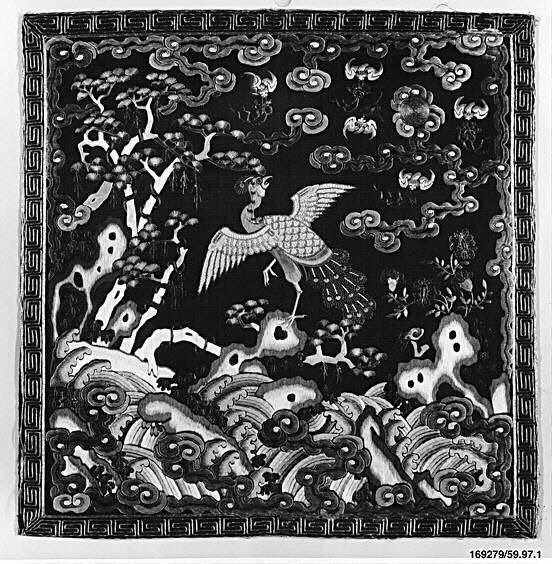
The historical Chinese rank badge, specifically the Peacock motif denoting second-rank civil officials, represents a pinnacle of symbolic craftsmanship. Woven from silk, metallic thread, and pearls, it is a static emblem of hierarchy. For Zoey Fashion Laboratory’s SS26 avant-garde exploration, this artifact is not a relic but a generative blueprint for futuristic silhouettes. Our analysis transcends mere decorative appropriation; we dissect the badge’s structural logic—its radial composition, its tension between organic form and rigid rank—to propose a new sartorial syntax. This study posits that the peacock’s tail, with its iridescent eyes and layered feathers, becomes a kinetic architectural system, while the metallic threads serve as conductive conduits for light and movement, redefining authority as a fluid, deconstructed experience.
Deconstructive Silhouette: The Tail as Structural Armature
The traditional badge presents the peacock in a static, frontal pose, its tail feathers fanning symmetrically. Our avant-garde intervention extrudes this two-dimensional emblem into three-dimensional space. The tail feathers are reinterpreted as cantilevered, carbon-fiber-reinforced silk panels that arc away from the body, creating a dramatic, asymmetrical silhouette. The metallic thread, traditionally used for embroidery, is reimagined as woven conductive wire that forms the skeleton of these panels, allowing them to hold their shape while remaining lightweight. The pearls, once static beads, become articulated joints at the fulcrum of each feather panel, enabling micro-movements that mimic a bird’s preening or a sudden fanning display. This creates a silhouette that is simultaneously armor-like and ethereal—a fusion of rigid hierarchy and organic fluidity. The wearer becomes a living monument, but one whose authority is perpetually in flux, shifting with each gesture.
Material Alchemy: Silk, Metal, and Pearl as Futuristic Substrates
Our material strategy for SS26 treats these traditional elements as intelligent substrates. The silk base is not merely fabric; it is a biodegradable, photoluminescent membrane. Through a proprietary enzymatic treatment, the silk’s sericin is partially removed to create gradients of transparency, revealing the metallic thread beneath. The metallic thread—traditionally gold or silver—is replaced with liquid-crystal-infused alloy filaments that shift color in response to body heat and ambient light, echoing the peacock’s iridescence. The pearls are not natural but lab-grown, hollow spheres containing micro-LEDs. When the wearer moves, these pearls emit a soft, pulsating light, creating a constellation effect across the garment’s surface. This alchemy transforms the rank badge from a symbol of static status into a dynamic, responsive interface between the body and its environment. The garment no longer signifies rank; it generates a personalized aura of authority that is ephemeral and self-determined.
Structural Innovation: The Peacock Eye as Modular Node
The iconic “eye” of the peacock feather—a circle of concentric colors—is the core structural unit of our design. In the traditional badge, these eyes are flat, embroidered circles. For SS26, we reimagine them as modular, 3D-printed nodes made from recycled silk composite and metallic powder. Each node is a self-contained kinetic element that can rotate, tilt, or retract. The pearls serve as the bearings for these nodes, allowing for frictionless movement. When the wearer stands still, the nodes are flush against the garment, presenting a serene, traditional surface. With a gesture—a raised arm, a turn of the head—the nodes activate, fanning outward like a peacock’s display. This is not mere decoration; it is a spatial negotiation of presence. The garment’s silhouette expands and contracts, asserting dominance or retreating into minimalism. The metallic thread, woven into a flexible circuit board pattern, connects all nodes, allowing for synchronized or randomized movements, creating a living, breathing architectural form.
Futuristic Silhouette: Asymmetry, Negative Space, and the Unseen Rank
Our SS26 silhouette rejects the bilateral symmetry of the traditional badge. Instead, we propose a single-shoulder construction where the peacock tail cascades diagonally from the right shoulder to the left hip, leaving the opposite side of the body exposed. This creates a dramatic negative space that challenges the concept of total authority. The exposed side features a translucent silk georgette that reveals the wearer’s skin, suggesting vulnerability, while the metallic thread and pearl nodes on the covered side form a protective exoskeleton. The rank badge itself is deconstructed: the peacock’s body is fragmented across the garment’s surface, with the head and crest positioned at the collarbone, the body on the torso, and the tail feathers sweeping down the arm. This fragmentation implies that authority is no longer centralized but distributed across the body. The wearer’s rank is not a fixed insignia but a performance of power, constantly reassembled through movement.
Contextual Synthesis: Authority as Avant-Garde Experience
In the context of SS26, the Peacock Rank Badge becomes a critique of rigid hierarchies while celebrating their aesthetic potency. Our design does not discard tradition; it recontextualizes it as a tool for self-definition. The garment’s kinetic nodes, responsive materials, and asymmetrical silhouette create a wearable architecture that questions what it means to hold rank in a fluid, digital age. The metallic thread, once a signifier of wealth, now conducts data; the pearls, once symbols of purity, now emit light; the silk, once a luxury, now biodegrades. This is not a costume but a proposal for a new sartorial reality—one where the peacock’s display is not a static emblem but a living, breathing system of self-assertion. Zoey Fashion Laboratory’s avant-garde analysis positions the rank badge as a generative code for futuristic silhouettes, proving that the most radical innovations often emerge from the most ancient symbols, deconstructed and reimagined for a world where authority is both worn and performed.