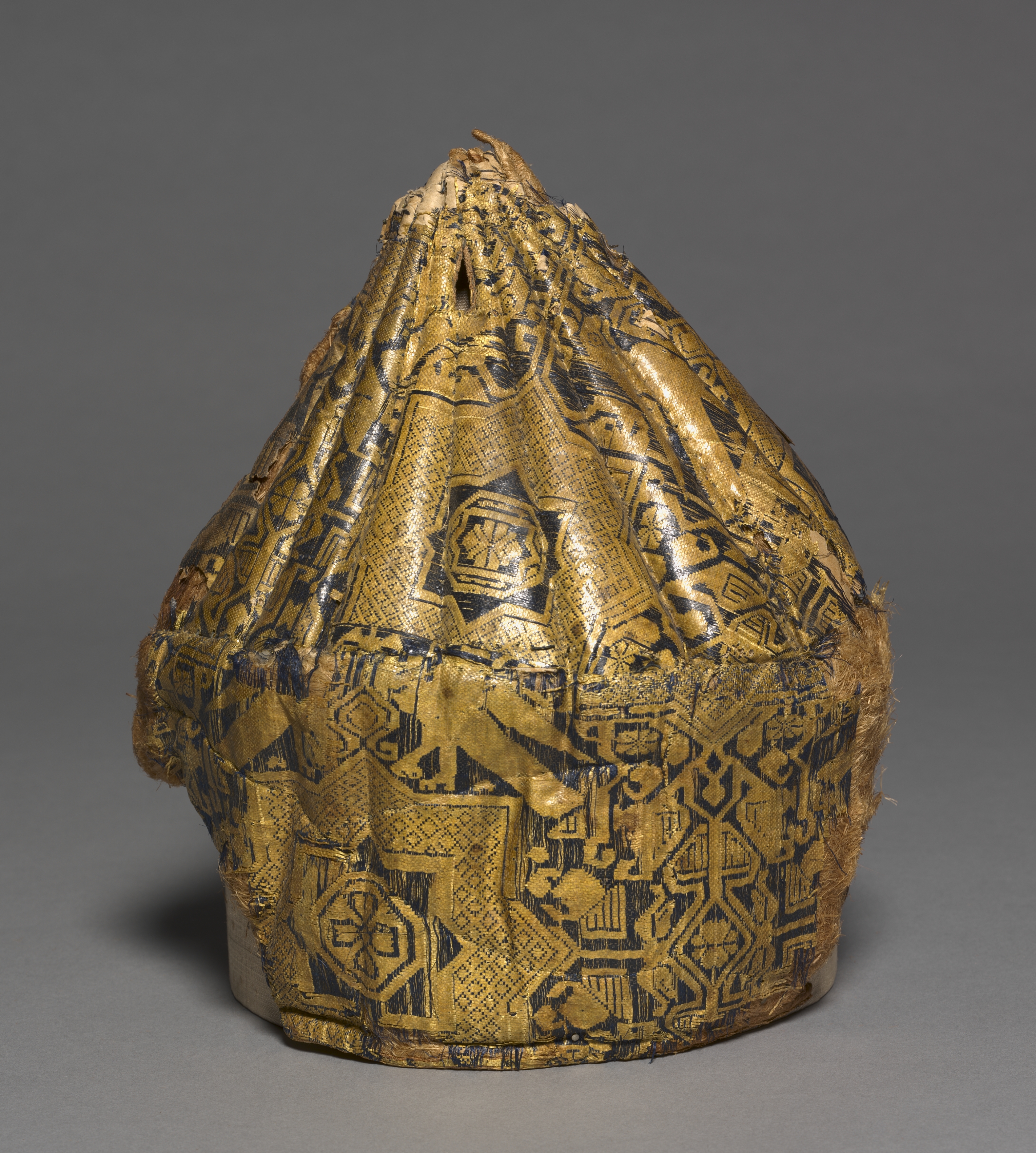
Deconstructing the Celestial Carapace: A Technical and Avant-Garde Analysis of the Buyid-Seljuq Quilted Star-Silk Cap
At Zoey Fashion Lab, our mission is to dissect historical artifacts not merely as relics, but as blueprints for radical, forward-thinking design. The subject of this analysis—a quilted cap from the Buyid or Seljuq period, originating in Iran or Iraq, crafted from star-patterned silk lampas—presents a profound case study in the fusion of structural engineering, celestial symbolism, and tactile luxury. This piece, which we have designated as a New DNA Strand, offers a template for an Avant-garde reinterpretation that challenges contemporary notions of headwear, textile physics, and narrative form.
I. Technical Autopsy: The Lampas Lattice and Quilted Armature
To understand the cap’s revolutionary potential, we must first dissect its material and structural DNA. The fabric is lampas, a compound weave that creates a complex, multi-layered structure. Unlike simpler weaves, lampas integrates a ground weave (typically a plain or twill) with a pattern weave (often a satin) that floats on the surface. In this cap, the pattern weave depicts a star motif—likely an eight-pointed or hexagonal star—executed in lustrous silk. The star pattern is not merely printed or embroidered; it is woven into the very architecture of the textile, creating a dynamic interplay of light and shadow as the cap shifts.
The quilted construction adds a second layer of structural sophistication. Quilting, in this context, is not merely decorative but functional. The stitching—likely running in geometric or radial lines—creates a cellular matrix that traps air, providing insulation and rigidity. This armature transforms a supple silk fabric into a three-dimensional, almost architectural form. The cap’s shape—a rounded, close-fitting dome—is achieved through the tension of the quilting stitches, which compress the fabric into a stable, curved geometry. This is a pre-industrial form of structural engineering, where the textile itself becomes a load-bearing membrane.
From a materials science perspective, the silk lampas offers unique properties: high tensile strength, natural luster, and a capacity for intricate patterning. The star motif, when quilted, creates a haptic and visual rhythm—a pattern that is felt as much as seen. The combination of lampas and quilting results in a textile that is both rigid and flexible, protective and expressive. This duality is the core of the cap’s avant-garde potential: it is a wearable sculpture that simultaneously honors the body’s contours and the sky’s geometry.
II. Cultural and Symbolic Resonance: The Star as a Cosmic Codex
The star pattern is not arbitrary. In Buyid and Seljuq visual culture, stars were potent symbols of celestial order, divine light, and royal authority. The eight-pointed star, in particular, is a recurring motif in Islamic geometric art, representing the throne of God, the eight gates of paradise, or the directional points of the cosmos. By wearing this cap, the original owner—likely a member of the elite or a learned scholar—was not merely adorning their head; they were encoding their identity within a cosmic narrative.
For Zoey Fashion Lab, this symbolic layer is a narrative engine. The star pattern becomes a codex—a system of signs that can be deconstructed and recontextualized. In an avant-garde context, the star can be read as a symbol of digital networks, quantum entanglement, or fractal geometry. The cap’s quilted cells mimic the structure of a neural network or a cosmic web. This is not a mere historical reference; it is a translation of an ancient visual language into a contemporary technological metaphor. The cap becomes a wearable interface between the microcosm of the individual and the macrocosm of the universe.
III. Avant-Garde Reinterpretation: The New DNA Strand
As a New DNA Strand, this cap is a genetic blueprint for a new species of fashion—one that merges historical rigor with speculative futurism. Our Avant-garde approach will not replicate the cap but mutate its core principles into a radical new form. Here are the key design vectors:
1. Structural Deconstruction and Reassembly: We will extract the quilted armature from the silk lampas and reimagine it using smart textiles and 3D-printed polymers. The star pattern will be laser-cut into a flexible, breathable lattice that can be worn as a standalone exoskeleton or integrated into a larger garment. The quilting stitches will become conductive threads, enabling the cap to respond to touch, light, or sound. The cap’s original function as a protective, insulating shell will be repurposed as a biometric sensor array that monitors the wearer’s neural activity or environmental data.
2. Pattern as Code: The star motif will be abstracted into a generative algorithm. Using computational design, we will create a series of star patterns that evolve in real-time based on the wearer’s movements or external stimuli. This transforms the cap from a static object into a living, adaptive interface. The stars are no longer woven; they are projected, printed, or grown using bio-fabricated materials. The cap becomes a canvas for dynamic celestial cartography.
3. Material Alchemy: The silk lampas will be replaced with lab-grown silk or recycled microfibers that mimic its luster and strength. The quilted cells will be inflated with aerogel or phase-change materials that regulate temperature. The cap’s historical function as a status symbol will be subverted: instead of signaling wealth, it will signal technological literacy and ecological awareness. The star pattern will be embedded with UV-reactive pigments that shift color in sunlight, creating a living, breathing garment.
4. Wearable Architecture: The cap’s dome shape will be reimagined as a modular building block. Multiple caps can be connected to form a larger structure—a wearable pavilion or a portable shelter. This references the cap’s original function as a protective head covering while expanding it into a nomadic, adaptive environment. The star pattern becomes a structural truss, supporting the form while encoding meaning.
IV. Conclusion: The Cap as a Portal
This Buyid-Seljuq quilted cap is not a museum piece; it is a portal between ancient craftsmanship and future possibility. By deconstructing its technical, symbolic, and structural DNA, Zoey Fashion Lab can extract a new grammar of design—one that honors the past while violently propelling it into the Avant-garde. The star-patterned silk lampas, the quilted armature, the celestial symbolism—all become raw material for a radical sartorial evolution. This cap is not an end; it is a beginning. A New DNA Strand that will mutate, replicate, and redefine what fashion can be.