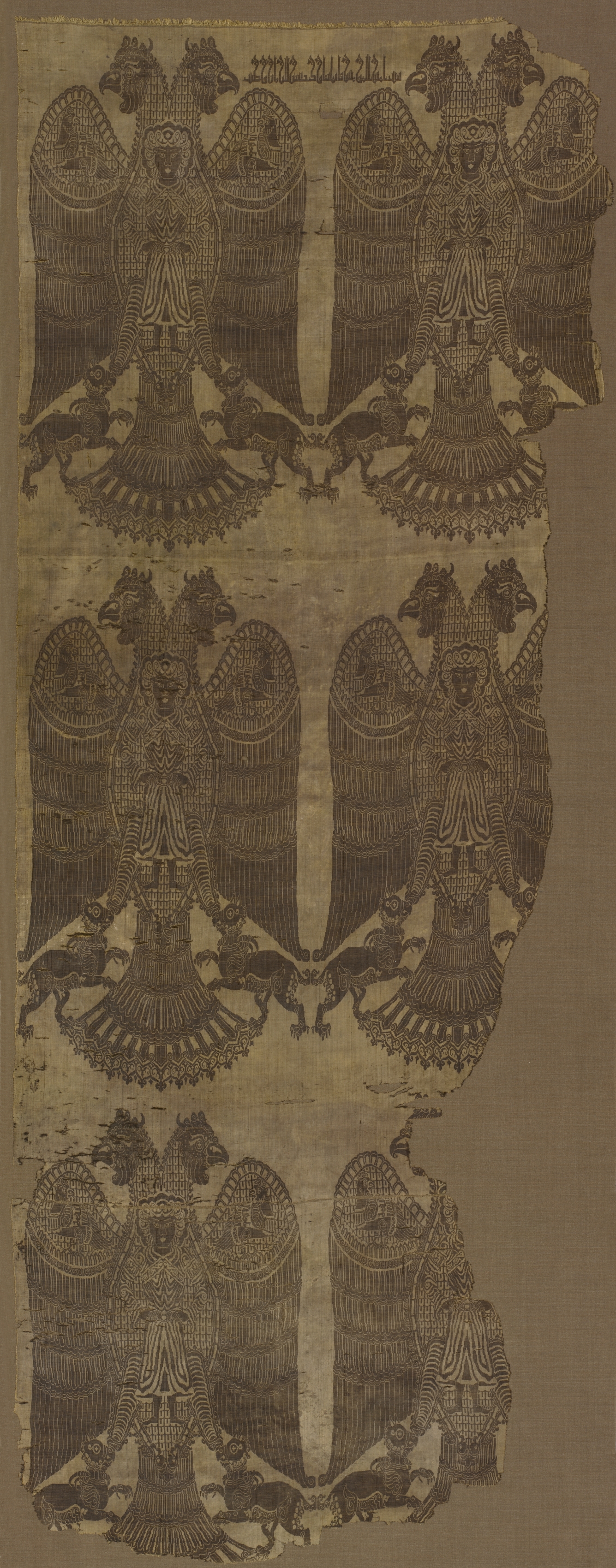
Deconstructing the Threads of Time: A Zoey Fashion Lab Analysis of a Buyid Period Fragment
At Zoey Fashion Lab, our core mission is to unearth the latent narratives woven into historical textiles, reinterpreting them through a radical, avant-garde lens. The subject of this analysis—a silk fragment with an inscription, originating from Iran during the Buyid period (945–1055) and executed in a lampas weave—presents a profound challenge and an extraordinary opportunity. This is not merely a piece of fabric; it is a coded document of power, faith, and aesthetic ambition. For the contemporary fashion designer, it offers a blueprint for subverting traditional luxury and redefining the relationship between text, texture, and the body.
Technical Mastery: The Lampas Weave as a Structural Canvas
The choice of lampas weave is the first critical element to deconstruct. Unlike simpler weaves, lampas is a compound structure, typically involving a main warp and weft for the ground fabric and a second, often silk, warp and weft for the pattern. This allows for a complex, two-sided fabric where the pattern is clearly defined on the face, while the reverse shows a negative version. For an avant-garde designer, this technical duality is a goldmine. It suggests a garment that is not monolithic but possesses an inside and an outside, a front and a back, each telling a different story. The fragment’s inscription, likely in Kufic script, is not printed or embroidered; it is structurally integral to the textile. This is a radical concept: the message is the material. In our practice, this inspires a design philosophy where the garment’s construction is its primary ornament, where seams, weaves, and structural details become the “inscription” of the designer’s intent.
The technical precision of the Buyid weavers is staggering. They achieved a high thread count and a crisp definition of the script, often using a contrasting color—perhaps a deep indigo or madder red against an ivory or buff ground. This interplay of ground and pattern is a lesson in chromatic tension. For the avant-garde, we can push this further. Imagine a modern lampas weave where the ground is a high-tech, recycled microfilament and the pattern is woven with a conductive thread that can change color with body heat or ambient light. The ancient inscription, once a static declaration of blessing or sovereignty, becomes a dynamic, responsive element, echoing the original fragment’s role as a living communication.
Cultural Resonance: The Buyid Inscription as a Proto-Avant-Garde Gesture
The Buyid period was a time of Persian cultural renaissance under a Shi’a Muslim dynasty. The use of Arabic script on luxurious textiles was not merely decorative; it was a political and religious statement. The inscription, likely a blessing, a name, or a Quranic phrase, transformed the fabric into a portable monument. This is the core of the fragment’s avant-garde potential. It challenges the boundary between the sacred and the profane, the permanent and the ephemeral. A garment made from such a textile would have been a walking declaration of faith and status, a literal embodiment of the word.
For Zoey Fashion Lab, this concept of the body as a bearer of text is a powerful starting point. We can reimagine this not as a literal reproduction of Kufic script, but as a typographic deconstruction. The fragment’s inscription is a series of vertical, angular strokes and horizontal bars. This visual rhythm can be abstracted into a pattern of pleats, folds, and cutouts that mimic the script’s cadence. A dress might feature a series of sharp, vertical darts that read as a “sentence” of structural lines, or a jacket with horizontal slashes at the hem that echo the baseline of the text. The message is no longer verbal but purely tactile and architectural.
Furthermore, the fragment’s status as a “fragment” is itself a radical aesthetic choice. It is incomplete, a piece of a larger whole. This resonates deeply with the avant-garde sensibility that celebrates the unfinished, the deconstructed, and the raw. A modern garment inspired by this fragment could intentionally expose its own construction—raw edges, dangling threads, visible seams—treating the “incompleteness” as a design feature. The inscription, partially cut off or obscured by a fold, becomes a mystery, an invitation for the viewer to complete the narrative. This is a direct challenge to the polished, seamless aesthetic of mainstream luxury.
Avant-Garde Application: Weaving the Past into the Future
How does a Zoey Fashion Lab collection translate this 11th-century Iranian fragment into a wearable, avant-garde statement? The process begins with abstraction. The lampas weave’s structural duality inspires a collection of reversible garments. A coat might be constructed with a smooth, patterned face in a deep, oxidized copper—a nod to the original silk’s potential metallic sheen—and a reverse side of raw, unbleached organic linen, with the inscription pattern appearing as a negative, ghost-like impression. The wearer can choose which narrative to present: the public, opulent face or the private, raw interior.
The inscription’s rhythm informs the silhouette. The verticality of the Kufic script suggests elongated, columnar forms: floor-length coats, narrow trousers, and high-necked tunics. The horizontal bars of the letters inspire strategic banding—perhaps a series of leather or metal strips sewn across a garment’s surface, creating a visual and tactile “alphabet.” These bands could be functional, serving as closures or adjustable elements, further blurring the line between ornament and utility.
Finally, the fragment’s cultural weight is honored through a process of respectful deconstruction. We do not simply copy the pattern; we interrogate its meaning. The blessing or name on the original is replaced with a new “inscription” that speaks to our time. This could be a series of abstract symbols representing data streams, a pattern derived from the wearer’s own biometric data, or a typographic treatment of a contemporary poem in Farsi or Arabic, rendered in a fragmented, deconstructed font. The garment becomes a palimpsest, a surface upon which multiple layers of history and meaning are written and erased.
Conclusion: The Fragment as a Manifesto
The Buyid period silk fragment with inscription is far more than an archaeological curiosity. It is a manifesto for a new kind of fashion that is intellectually rigorous, technically innovative, and culturally aware. At Zoey Fashion Lab, we see in its threads a blueprint for an avant-garde practice that treats the garment as a text, the body as a page, and history as a living, malleable material. By deconstructing its weave, decoding its script, and re-contextualizing its cultural resonance, we can create fashion that is not just worn, but read, felt, and debated. The fragment is incomplete, but its potential is infinite.