Deconstructing the Etruscan Fibula: An Avant-Garde Resonance for Zoey Fashion Lab
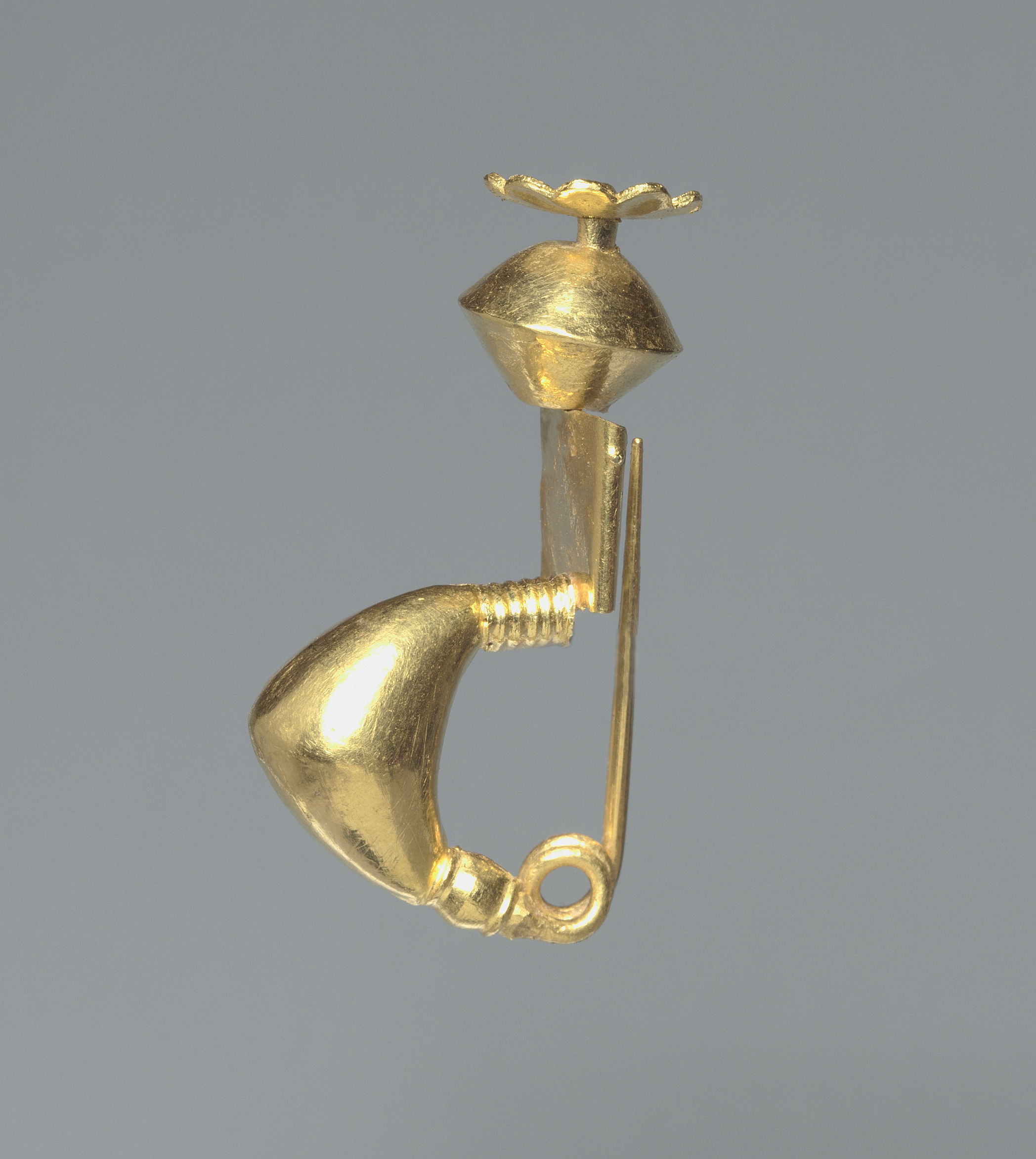
As Chief Fabric Deconstructionist at Zoey Fashion Lab, my role is to excavate historical artifacts not as relics, but as architectural blueprints for future garments. The subject of this analysis—an Etruscan fibula (pin) crafted in gold—is a deceptively simple object. Yet, when viewed through the lens of our avant-garde methodology, it reveals a complex dialogue between structural necessity and ornamental excess. The reference text, “Mirror with Split-Leaf...”, provides a critical juxtaposition: one surface is a polished silver mirror inlaid with gold in a dense, chaotic pattern of split leaves; the other is a cold sarcophagus lid, where a life narrative is carved in bas-relief. This duality—the contrast between shimmering surface and profound depth—is the very essence of our design philosophy. The fibula is not merely a fastener; it is a compressed universe of tension, memory, and transformation.
I. Materiality and Technical Precision: Gold as a Conductor of Narrative
Etruscan goldwork is renowned for its granulation and filigree, techniques that transform a dense, heavy metal into a lace-like, almost ethereal structure. For Zoey Fashion Lab, this technical mastery is a lesson in negative space. The fibula’s gold is not a solid block; it is a network of tiny spheres and twisted wires, creating a surface that catches light from a thousand angles. This is not a static object—it is a kinetic sculpture that shifts with every movement of the wearer’s body.
In our avant-garde context, we interpret this as a challenge to conventional garment construction. The fibula teaches us that strength can be achieved through fragmentation. A garment’s structural integrity need not rely on continuous seams or heavy interfacing. Instead, we can employ micro-connections: tiny, gold-toned metallic links or laser-welded titanium nodes that join disparate fabric panels. The result is a garment that breathes, moves, and reconfigures itself like the fibula’s intricate lattice. The reference to the “silver mirror” with “gold inlaid palm leaves” further informs this: the gold is a foreign element embedded in a reflective, cold surface. Our fabrics can similarly host metallic “inlays”—not as decoration, but as structural seams that also serve as light traps, creating a shimmering, disorienting effect that echoes the Etruscan’s mastery of surface tension.
II. The Duality of Surface and Depth: The “Mirror” and the “Sarcophagus”
The reference text’s split—one side a mirror, the other a sarcophagus—is the philosophical core of our analysis. The fibula, as a pin, operates on the threshold between the body and the garment. It is a point of entry, a nexus where the external (the fabric) meets the internal (the flesh). The Etruscans understood that a fastening device is not merely functional; it is a ritual object that mediates between life and death, between the visible and the hidden.
For Zoey Fashion Lab, this duality manifests in our “dual-surface” construction technique. We design garments with two distinct faces: the outer layer is a highly polished, reflective surface—perhaps liquid silk or metallic-coated organza—that catches light and distorts the viewer’s gaze, much like the silver mirror. The inner layer, in contact with the skin, is a tactile, narrative-rich material—a raw linen embroidered with micro-sequences of text, or a heat-molded silicone that mimics the texture of carved stone. The fibula, in our reimagining, becomes a rotating clasp that allows the wearer to flip the garment’s orientation, revealing either the “mirror” or the “sarcophagus” at will. This is not a static garment; it is a performative object that changes meaning with each gesture.
III. Avant-Garde Reinterpretation: The Fibula as a Wearable Mechanism
Our avant-garde approach rejects the fibula as a mere accessory. Instead, we propose it as a functional joint—a hinge that connects multiple garment modules. The Etruscan fibula’s spring mechanism (often a coiled wire) is a primitive actuator. We modernize this with shape-memory alloys that respond to body heat, causing the pin to open or close as the wearer’s temperature rises. The gold’s weight and density are translated into micro-beaded chains that run through channels in the fabric, creating a dynamic, self-adjusting silhouette.
The “split-leaf” motif from the reference is particularly instructive. The leaves are not symmetrical; they are fractured, overlapping, and chaotic. In our designs, this translates to asymmetric, detachable panels that are anchored by a central fibula-like clasp. The garment becomes a living collage, where the wearer can rearrange the “leaves” (fabric panels) to create new forms. The fibula is no longer a static pin; it is a control node for a modular garment system. Imagine a coat that can be reconfigured into a cape, a skirt, or a shawl, all held together by a single, ornate clasp that bears the Etruscan’s goldwork DNA—but rendered in 3D-printed titanium with a matte black finish, a deliberate anachronism that bridges ancient technique and futuristic form.
IV. The Sarcophagus Narrative: Embroidering Life and Death
The reference’s “cold sarcophagus lid” with its “relief-carved life narrative” is a powerful metaphor for textile storytelling. In Etruscan culture, the fibula was often buried with the dead, serving as a talisman for the afterlife. For Zoey Fashion Lab, we embed this concept into our “memory weave” technique. Using conductive threads and micro-LEDs, we create garments that can display digital narratives—text, images, or abstract patterns—that are activated by touch or proximity. The fibula becomes the activation key: when the pin is inserted into its catch, it completes a circuit, illuminating a hidden story on the fabric’s surface. This is the “sarcophagus” side—a cold, stone-like fabric (perhaps a densely woven black wool) that suddenly reveals a glowing, ephemeral narrative. The wearer becomes a living monument, their garment a repository of personal or collective memory.
V. Conclusion: The Fibula as a Threshold Object
The Etruscan fibula, in its original context, was a functional ornament that held together the fabric of daily life and ritual death. For Zoey Fashion Lab, it is a threshold object—a point of convergence between the ancient and the avant-garde, between structure and chaos, between the reflective surface and the profound depth beneath. Our deconstruction yields a new design language: micro-connections, dual-surface construction, modular mechanisms, and digital memory weaves. The gold is no longer a precious metal; it is a conductive metaphor for the flow of energy, narrative, and transformation. The fibula, reborn, is not a pin—it is a portal. And in our garments, the wearer steps through.