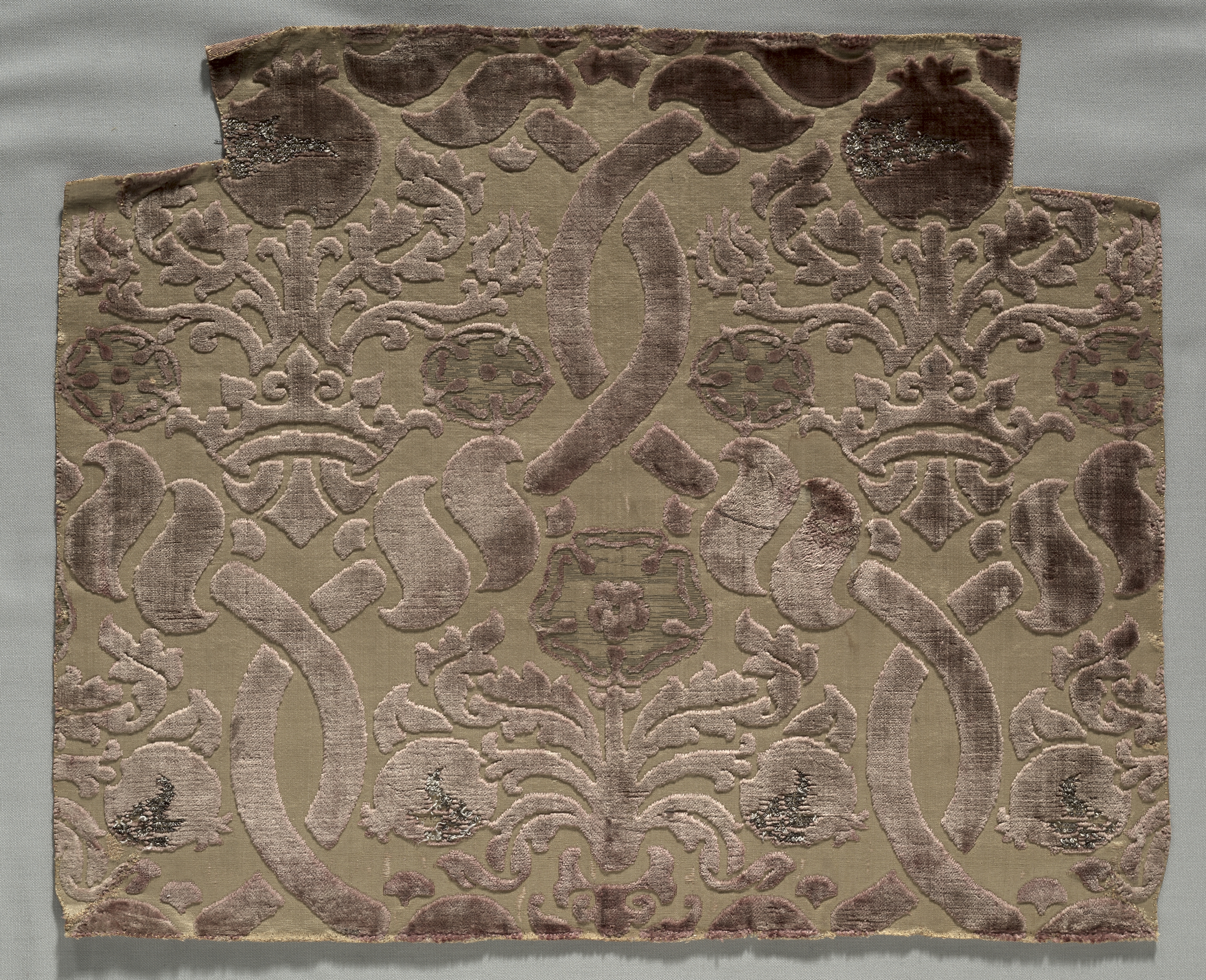
Technical Deconstruction & Material Analysis: The 16th Century Italian Velvet Fragment
The submitted fragment is a masterclass in late Renaissance textile engineering, representing the zenith of Italian silk weaving during the Cinquecento. Its primary substrate is a high-twist, multi-ply silk filament, indicative of the superior sericulture and spinning techniques of the Italian peninsula, likely from centers like Lucca, Venice, or Genoa. The true complexity lies in its velvet construction, which is not a singular technique but a sophisticated interplay of multiple methods.
We observe a compound structure utilizing both cut and uncut pile loops, creating a tactile topography of light-absorbing (cut) and light-reflecting (uncut) surfaces. This is further complicated by voided velvet technique, where the pile is selectively woven to create precise, bare (voided) ground areas that form part of the pattern. Most significantly, the fragment incorporates brocaded velvet, where supplementary wefts of contrasting color—likely gold or silver-wrapped thread—are introduced to create raised, metallic motifs that sit atop the velvet ground. The density of the pile is exceptional, suggesting the use of a double-cloth method on a drawloom, where two cloths are woven simultaneously and later cut apart to create two mirrored velvet lengths.
The "New DNA Strand" Reference: A Conceptual Framework for Regeneration
The directive to reference a "New DNA Strand" is pivotal. It moves our analysis from pure archaeology to avant-garde methodology. We are to treat this fragment not as a relic, but as a genetic blueprint. Its material composition (silk proteins, metallic ions, dye mordants) and structural code (warp/weft sequences, pile height ratios, voided pattern algorithms) form the original "base pairs" of its aesthetic DNA.
Our task is splicing and recombinant design. The Zoey Fashion Lab must isolate these core sequences—the lustrous helix of silk, the binary of cut/uncut texture, the recessive/dominant traits of voided pattern—and hybridize them with contemporary genetic material. This could mean translating the velvet's structural code into parametric 3D knit algorithms, or using the brocading principle to integrate electroluminescent wire as a "supplementary weft" for a luminous, interactive pile. The DNA strand is a metaphor for inherent structural logic made mutable and open to replication with variation.
Avant-Garde Translation: From Archive to Archetype
The avant-garde mandate requires a radical, non-nostalgic reincarnation. This is not about reproducing historical costume but distilling the fragment's core disruptive energies—its opulence, its dimensional complexity, its status as a technological marvel of its time—and projecting them into future forms.
Proposed Design Vectors for Zoey Fashion Lab:
1. Dimensional Inversion & Substrate Displacement: The voided velvet technique creates positive/negative space in the plane. We propose a macro-scale architectural voiding. Imagine a garment constructed not from woven cloth, but from laser-sintered bio-polymer or molded silicone "pile" units, assembled to create vast areas of intentional, wearer-revealing void. The body itself becomes the ground cloth. Alternatively, the plush texture is replicated through non-textile means: aerogel-infused fabrics or multi-density foam laminates that mimic the tactile shock of velvet through insulative or protective properties, transforming luxury into performance.
2. The Recombinant "Brocade": The brocaded motif—a foreign element applied for luxury—is our key to modern ornament. We replace precious metal thread with embedded technology or recycled material narratives. "Brocaded" panels could be made from upcycled circuit boards, creating a topography of electronic waste re-contextualized as precious ornament. Alternatively, using shape-memory alloy wires as brocading threads would create motifs that morph with temperature, making the pattern dynamic and responsive to the wearer's environment.
3. Velvet as Interface, Not Just Surface: The deep, light-trapping quality of cut velvet is a perfect metaphor for absorption. We propose developing a photovoltaic or capacitive velvet. The pile could be engineered from conductive microfibers, turning the entire garment surface into a touch-sensitive interface or a low-grade energy harvester. The tactile act of stroking the velvet—a primal human response to the material—could trigger light, sound, or data exchange, embedding interactivity into the very fiber of the luxury experience.
Conclusion: The Fragment as Progenitor
This 16th-century Italian fragment is far more than a sample. It is a progenitor text. Its value to Zoey Fashion Lab lies in its encrypted instructions on manipulating light, shadow, texture, and status through material intelligence. By decoding its technical DNA—the double-cloth genesis, the brocaded intervention, the voided absence—and splicing it with the nucleotides of contemporary technology, biotechnology, and conceptual fashion, we can cultivate a new species of garment.
The avant-garde outcome will bear no literal resemblance to Renaissance drapery. Instead, it will be its phylogenetic descendant: a garment that shares the ancestral fragment's fundamental principle of being a tactile, multi-dimensional, and technologically advanced artifact of its specific time. It will honor the past not through imitation, but through an equal and opposite application of pioneering spirit, making the velvet fragment not an endpoint, but the first link in a new and revolutionary chain.