Deconstructing the Pauldron: A Technical and Aesthetic Analysis for Zoey Fashion Lab
Introduction: The Specimen as a Catalyst for Innovation
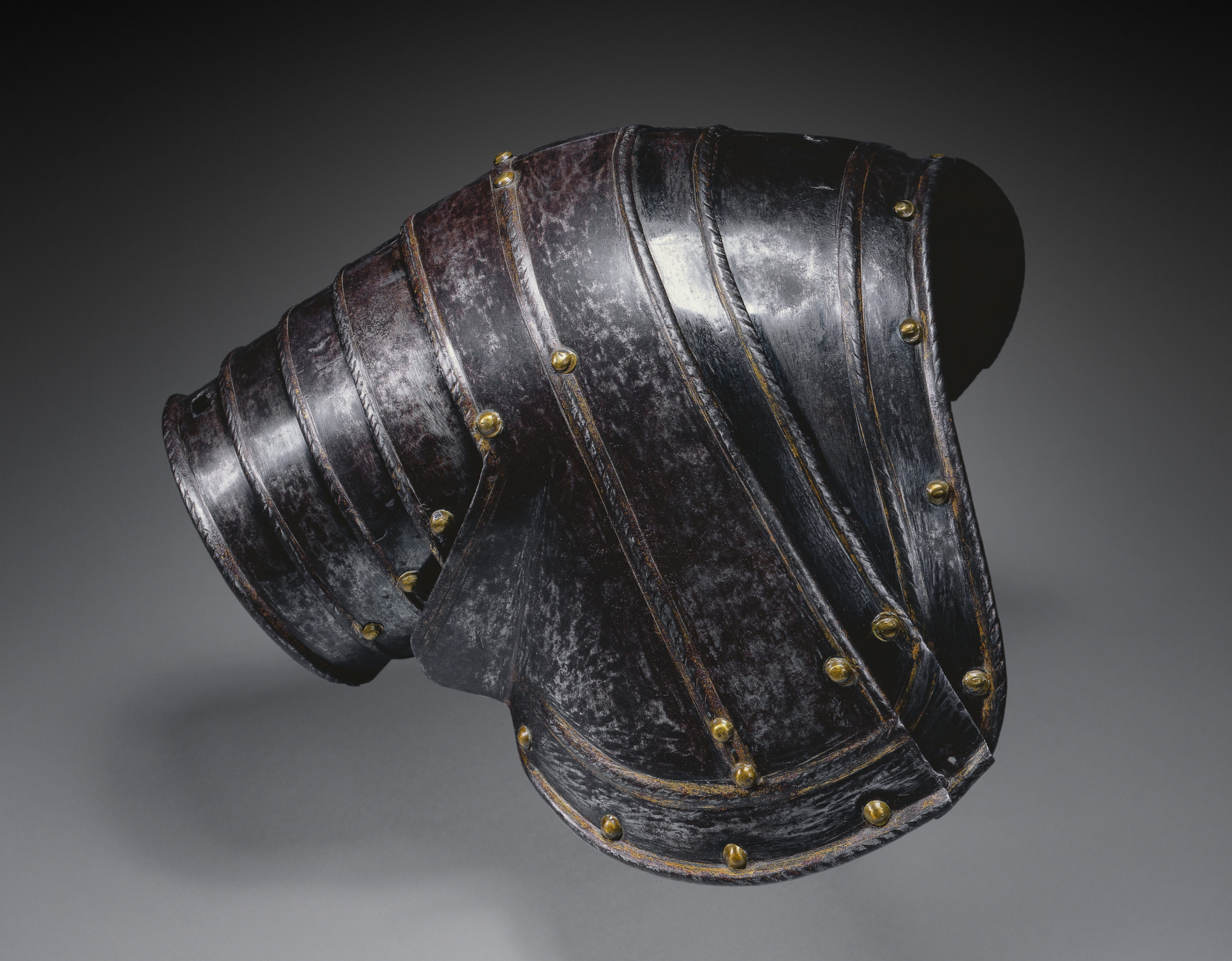
The subject of this analysis is a single, right-shoulder pauldron, originating from 16th-century Italy. Crafted from steel that has been both blued and gilded, this artifact represents a pinnacle of Renaissance armor technology and aesthetic ambition. For Zoey Fashion Lab, this is not merely a historical object; it is a New DNA Strand—a genetic code for an avant-garde design language. The pauldron’s fusion of protective function, material alchemy, and sculptural form provides a rich template for deconstruction, allowing us to extract principles that can be recontextualized into contemporary, boundary-pushing fashion.
Technical Deconstruction: The Metallurgical and Craft Legacy
Material Alchemy: Bluing and Gilding
The pauldron’s surface treatment is a masterclass in controlled oxidation and precious metal application. Bluing is a chemical process that creates a thin, protective layer of magnetite (Fe₃O₄) on the steel, resulting in a deep, lustrous blue-black finish. This was not merely decorative; it offered corrosion resistance and a non-reflective surface for combat. For Zoey Fashion Lab, this process suggests a design philosophy where material transformation is both functional and expressive. The blued steel evokes a sense of depth, night sky, and liquid metal—a visual language that can be translated into high-tech fabrics, reactive dyes, or laser-etched leathers that shift in light.
The gilding, applied via mercury amalgam or fire-gilding, involves a toxic and labor-intensive process where gold is fused to the steel. The result is a stark, luminous contrast: the cold, dark blue of the steel against the warm, radiant gold. This juxtaposition of protection and opulence is central to the pauldron’s DNA. In an avant-garde context, this duality can be replicated through metallic embroidery, gold-leaf appliqué on dark technical fabrics, or even digital prints that simulate the interplay of matte and gloss surfaces.
Structural Engineering: The Pauldron’s Anatomy
The pauldron is a complex, multi-layered assembly designed to articulate with the wearer’s movement while providing maximum coverage. It typically consists of overlapping lames (horizontal plates) riveted to leather straps, allowing the shoulder to rotate. The right-shoulder pauldron is often larger and more pronounced than its left counterpart, as it was the primary weapon arm. This asymmetry is a key design feature—it communicates dynamic imbalance and functional hierarchy.
From a construction standpoint, the pauldron’s articulation system—the rivets, sliding rivets, and leather backing—is a precursor to modern ergonomic design. For Zoey Fashion Lab, this suggests a reimagining of garment construction: using flexible yet rigid panels, modular components, and adjustable fastenings. The pauldron’s weight distribution, centered over the shoulder’s acromion process, can inform the design of avant-garde shoulder pieces that are both sculptural and wearable, perhaps using carbon fiber, 3D-printed polymers, or structured neoprene.
Aesthetic Deconstruction: The Visual Vocabulary of Power and Protection
Silhouette and Scale
The pauldron’s silhouette is aggressive and commanding. Its pronounced curvature, flaring outward from the neck to the upper arm, creates a triangular, fortress-like profile. This shape amplifies the wearer’s presence, echoing the architectural forms of Renaissance fortifications. In avant-garde fashion, this translates to exaggerated shoulder lines—think of the work of Rei Kawakubo or Thierry Mugler, where the body becomes a canvas for structural expression. The pauldron’s scale is also telling: it is not merely functional but deliberately oversized, suggesting a performative aspect. This can be adapted into detachable, dramatic shoulder pieces for runway presentations, or integrated into everyday wear through subtle padding and structured seams.
Surface Texture and Light Interaction
The blued steel offers a velvety, non-directional matte finish that absorbs light, while the gilded areas reflect it with a sharp, mirror-like quality. This creates a chameleon effect: the pauldron appears to change character under different lighting conditions. For Zoey Fashion Lab, this suggests a fabric strategy involving matte and metallic finishes, perhaps through the use of liquid silicone, metallic leathers, or iridescent coatings. The textural contrast between the smooth, cold steel and the raised, intricate gilding can be replicated through embossing, laser cutting, or mixed-material layering—such as combining matte jersey with reflective PVC or metal mesh.
Symbolism and Narrative
The pauldron is a symbol of chivalric authority, martial prowess, and aristocratic status. Its gilding often featured intricate motifs—heraldry, floral patterns, or mythological scenes—that told a story of lineage and power. For an avant-garde collection, this narrative layer is crucial. The pauldron can be reimagined as a wearable sculpture that challenges gender norms, power dynamics, and the very concept of protection. A blued and gilded pauldron on a contemporary garment might signify emotional armor or digital resilience, using motifs like circuit boards, QR codes, or abstract data streams in place of heraldic beasts.
Avant-Garde Recontextualization: The New DNA Strand
Deconstructing the Form
To extract the pauldron’s DNA, we must break it down into its core components: asymmetry, articulation, surface treatment, and symbolic weight. For Zoey Fashion Lab, these elements can be reassembled in unexpected ways. Imagine a modern jacket where the right shoulder features a detachable, blued steel pauldron with gilded rivets, while the left shoulder is left bare or covered in a soft, deconstructed fabric. This creates a visual tension that speaks to the wearer’s duality—strength and vulnerability, tradition and rebellion.
Material Innovation
The blued and gilded steel can be translated into advanced materials. For instance, a thermochromic fabric that shifts from deep blue to gold when exposed to body heat, or a 3D-printed polymer that mimics the pauldron’s structure while being lightweight and flexible. The gilding could be replaced with conductive threads or LED filaments, turning the pauldron into a piece of wearable technology that responds to the environment. The leather backing can be reinterpreted as a sustainable, plant-based alternative, such as mushroom leather or recycled polyester.
Silhouette and Movement
The pauldron’s articulation system inspires a new approach to kinetic fashion. Garments could feature modular, overlapping panels that slide and lock into place, allowing the wearer to adjust the silhouette from a sharp, armored look to a relaxed, fluid one. This could be achieved through magnetic closures, adjustable straps, or inflatable structures. The asymmetry of the right-shoulder pauldron can be exaggerated into a signature design element, where the entire garment is built around a single, dominant shoulder piece, creating a dramatic, off-balance aesthetic that challenges conventional symmetry.
Conclusion: From Armor to Avant-Garde
The 16th-century Italian pauldron is far more than a historical artifact; it is a blueprint for radical design. Its technical mastery of material transformation, its structural intelligence, and its potent symbolism offer a rich vocabulary for Zoey Fashion Lab’s avant-garde explorations. By deconstructing its form, surface, and function, we can extract a New DNA Strand that informs a collection where protection becomes expression, asymmetry becomes narrative, and history is reborn as the future of fashion. This pauldron is not a relic; it is a starting point. The challenge is to honor its legacy while breaking every rule it once embodied.