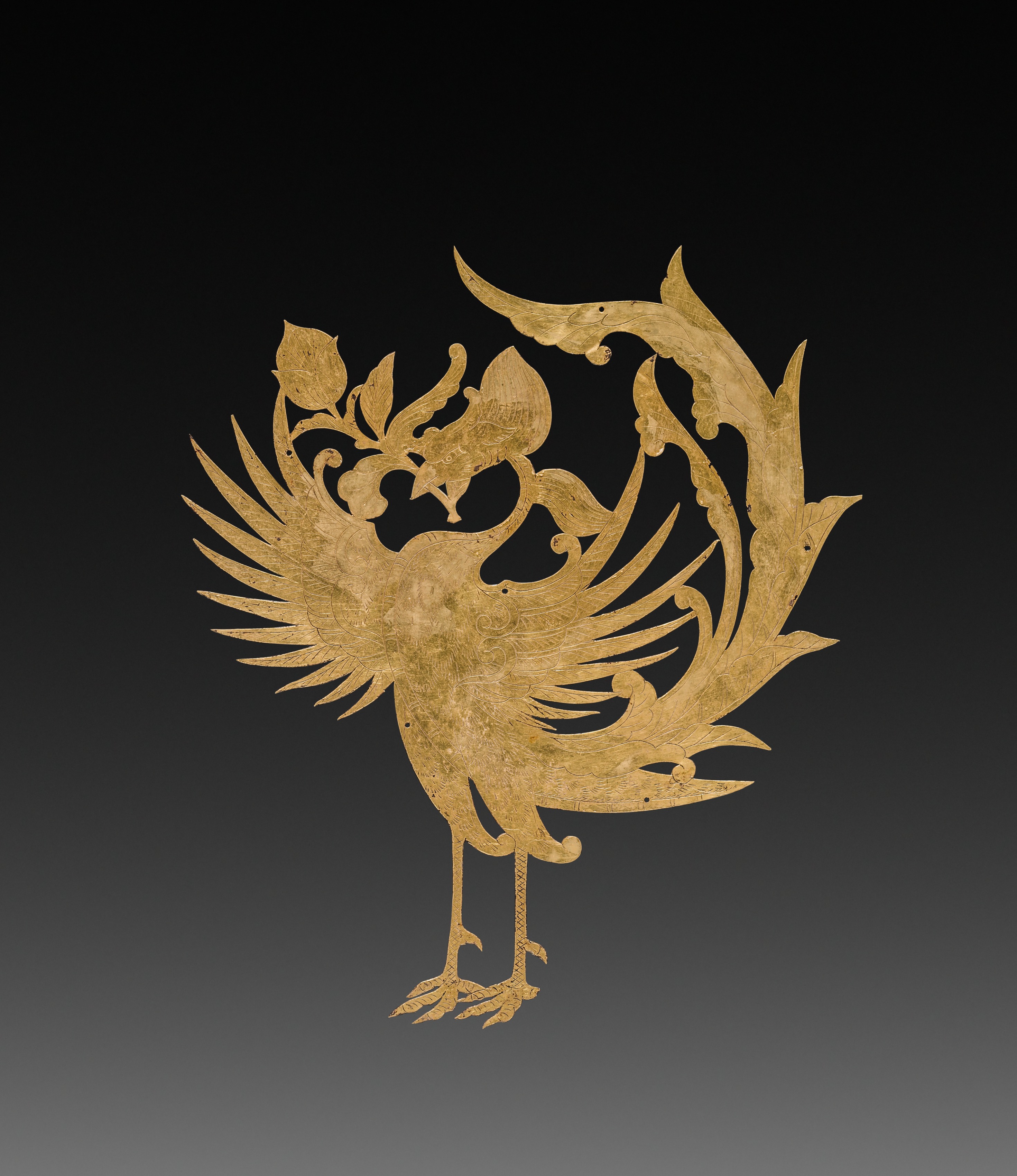
Deconstructing the Tang Dynasty Phoenix: A Study in Beaten Gold and Avant-Garde Resonance
At Zoey Fashion Lab, our practice of textile deconstruction is not merely an act of unmaking; it is a rigorous dialogue between historical artifact and contemporary form. The subject of this analysis—a Phoenix ornament from China’s Tang dynasty (618-907), executed in beaten gold with chased detail—presents a profound challenge. This is not a fabric, but a metallic emblem of imperial power, rebirth, and celestial grace. Yet, within its hammered surfaces and chased contours, we find the very grammar of textile ornament: rhythm, repetition, surface tension, and the narrative of transformation. Our task is to transmute this static, precious object into an avant-garde textile language, one that speaks of flux, fragility, and the radical potential of ornamentation.
Materiality and the Avant-Garde: From Beaten Gold to Deconstructed Textile
The beaten gold technique, known as repoussé, is a process of violent creation. The metal is hammered from the reverse side to create a raised design, then refined with chasing—a precise, controlled hammering from the front to define details. This duality of force and finesse is the first point of resonance for our lab. In avant-garde textile design, we often seek to subvert the preciousness of material. A Tang-dynasty phoenix in gold is an icon of static, eternal value. To deconstruct it, we ask: What if the gold were not a surface but a structure? What if the beaten texture became a three-dimensional textile, a fabric of metalized threads, or a digitally woven pattern that mimics the hammer’s impact?
Consider the chased detail—the fine lines of the phoenix’s feathers, its crest, and its flowing tail. In our avant-garde interpretation, these lines are not decorative; they are structural seams. We propose a fabric where the phoenix’s form is not printed or embroidered but constructed through negative space. Using laser-cut leather or heat-bonded synthetics, we can recreate the chased lines as perforations, allowing light to pass through the garment like the gold’s reflective shimmer. The result is a textile that is both armor and air, a paradox of precious metal rendered as permeable skin.
Ornament as Narrative: The Phoenix and the Mirror-Split Leaf
The reference provided—“一面是光洁银镜上以黄金镶嵌的纷繁棕叶纹,另一面是冰冷石棺板上以浮雕诉说的生命叙事”—translates to “one side is a smooth silver mirror inlaid with intricate palm leaf patterns in gold; the other side is a cold stone sarcophagus where a life narrative is told in relief.” This duality is central to our deconstruction. The phoenix ornament is not a singular object; it is a hinge between two opposing surfaces: the reflective, decorative mirror and the funerary, narrative stone. The Mirror with Split-Leaf evokes this tension—ornament as both surface beauty and deep memory.
For Zoey Fashion Lab, this binary becomes a textile dialectic. On one side of the fabric, we have the phoenix as ornament: a golden, beaten, chased motif that catches the eye, a symbol of imperial splendor and cyclical rebirth. On the other side, we have the phoenix as narrative: the same form, but rendered as a relief on a stone-like ground, telling a story of death and resurrection. In an avant-garde garment, this could manifest as a reversible textile. One side is a smooth, reflective surface—perhaps a metallic-coated fabric or a mirror-like laminate—with the phoenix pattern inlaid in gold thread. The reverse side is a textured, matte fabric, perhaps a heavy wool or a bonded felt, with the phoenix pattern embossed or quilted, creating a tactile, narrative relief. The wearer becomes the curator of the ornament’s dual life: one moment a dazzling surface, the next a somber story.
Chasing the Phoenix: Techniques for Avant-Garde Textile Ornament
The Tang-dynasty phoenix is characterized by its dynamic asymmetry and flowing lines. Unlike the rigid symmetry of earlier dynasties, the Tang phoenix often appears in flight, its tail feathers curling into organic, almost calligraphic sweeps. This is a key point for deconstruction. Traditional embroidery would fix these lines in thread. Our avant-garde approach seeks to liberate the line.
We propose a technique inspired by chasing itself: hot-wire cutting or laser ablation on a multi-layered textile. Imagine a base fabric of raw silk or hemp, layered with a metallic organza and a top layer of fine leather or neoprene. The phoenix’s chased details are burned or cut into the top layers, revealing the gold beneath. But the cut is not clean; it is deliberately distressed, mimicking the hammer’s impact. The edges are left raw, frayed, or singed, suggesting the violent process of creation. This is ornament as scar—a mark of transformation rather than decoration.
Furthermore, the phoenix’s beaten gold texture can be translated into a textile surface through pleating and smocking. By creating a pattern of irregular, hammered-like folds, we can replicate the play of light on gold. The smocking is not uniform; it follows the contours of the phoenix’s body, with tighter pleats for its crest and looser, flowing folds for its tail. This creates a three-dimensional ornament that shifts with movement, echoing the chased detail’s ability to catch light from multiple angles.
Archive Resonance: The Phoenix as a Living, Breathing Ornament
The phrase Archive Resonance is crucial. This is not a reproduction; it is a resonance—a vibration through time. The Tang-dynasty phoenix was an emblem of the empress, of yin energy, and of the south. It was a symbol of renewal and virtue. In our avant-garde context, the phoenix becomes a symbol of fashion’s own cyclical nature: the constant death and rebirth of trends, the beating and chasing of new forms from old materials.
We see this resonance in the Mirror with Split-Leaf reference. The mirror is a surface of vanity and reflection; the sarcophagus is a surface of memory and finality. The phoenix ornament bridges these two realms. In a garment, this could be realized as a digital-printed textile that shifts from a reflective, metallic pattern to a matte, stone-like pattern through thermochromic or photochromic pigments. The phoenix appears and disappears depending on the light or temperature, a living ornament that responds to its environment. This is ornament as performance, not just decoration.
Conclusion: The Phoenix as a Deconstructive Manifesto
The Tang-dynasty phoenix in beaten gold with chased detail is not a relic to be preserved; it is a provocation for the avant-garde. At Zoey Fashion Lab, we see in its hammered surface a call to action: to beat new textures from old techniques, to chase new narratives from ancient forms. The ornament is not a static emblem; it is a process—a cycle of destruction and creation, of surface and depth, of mirror and stone.
Our deconstruction yields a textile that is reversible, layered, and responsive. It carries the phoenix’s dual identity: the golden, beaten surface of imperial power and the chased, narrative relief of mortal memory. This is not a costume; it is a phoenix garment—one that rises from the archive, not in ashes, but in beaten gold and avant-garde thread. The ornament, finally, is not on the fabric; it is the fabric—a living, breathing, deconstructive force.