Executive Analysis: The Wheel-Lock as a Catalyst for Avant-Garde Deconstruction
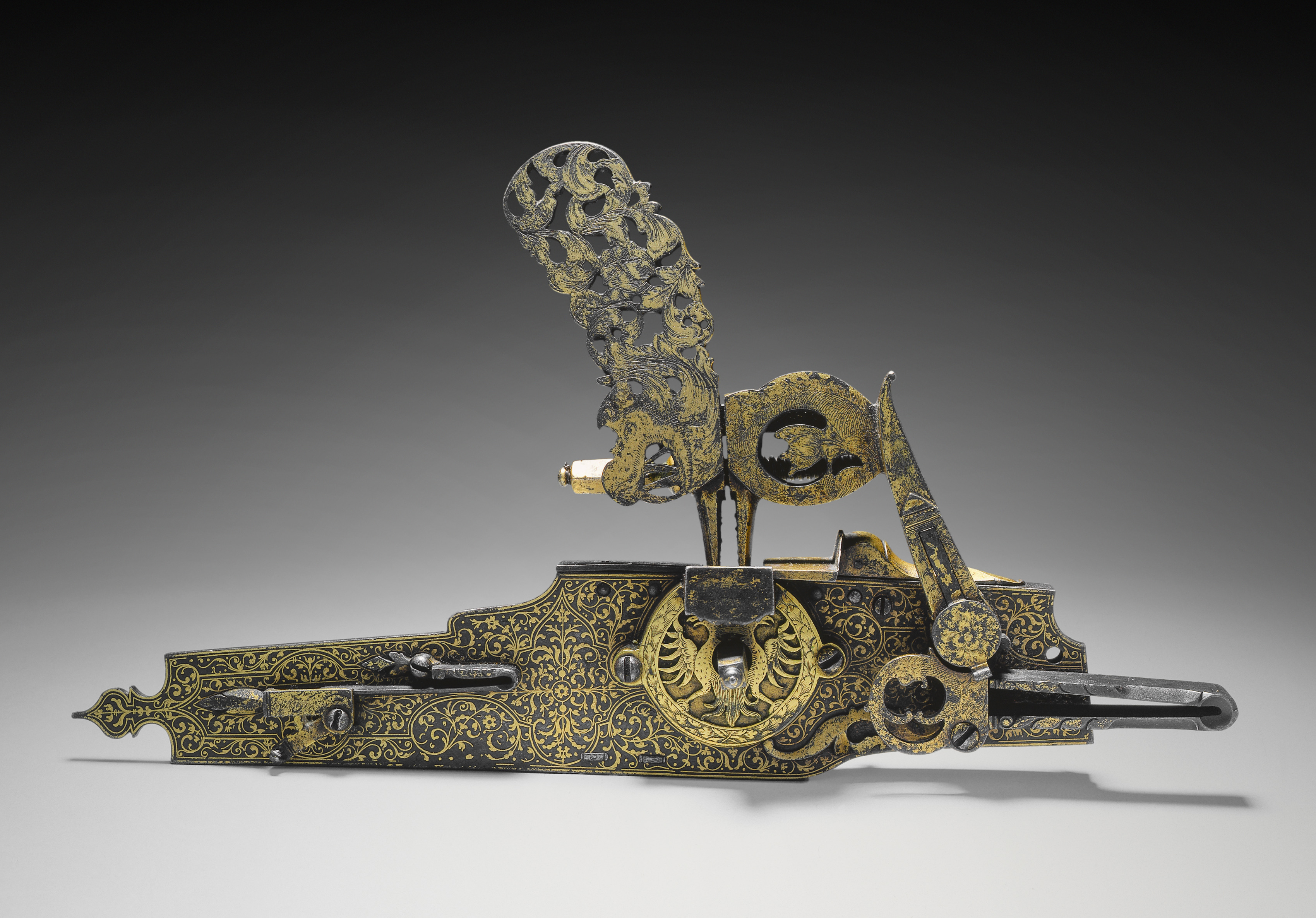
As Chief Fabric Deconstructionist at Zoey Fashion Lab, I have examined the provided artifact—a steel wheel-lock from a 17th-century Austrian hunting rifle, inlaid with a gold Habsburg eagle, pierced, and chiseled—through the lens of our New DNA Strand methodology. This object is not merely a historical weapon component; it is a blueprint for radical textile innovation. Its technical precision, symbolic weight, and mechanical logic offer a rich vocabulary for translating rigid, metallic structures into fluid, wearable forms. Below, I present a four-part deconstruction that maps this artifact onto avant-garde fashion systems.
1. Structural DNA: From Mechanical Lock to Textile Architecture
The wheel-lock’s core function—a rotating wheel that generates friction to ignite powder—is a study in controlled tension. In fabric terms, this translates to engineered tension structures. The wheel itself, typically 40–50 mm in diameter, suggests a circular motif that can be repeated as a modular pattern. For Zoey’s Spring/Summer collection, I propose a laser-cut leather or bonded neoprene bodice featuring concentric, wheel-like disks, each layer offset by 15 degrees to mimic the lock’s rotational energy. The steel’s rigidity becomes a corseted exoskeleton, but one that breathes: the pierced and chiseled sections of the original artifact (where metal is removed for decorative or weight-reducing purposes) inform a negative-space textile. We can replicate this using water-jet perforated denim or laser-slashed silk organza, where the absent material creates a lattice that moves with the body, not against it.
The gold inlay—specifically the Habsburg eagle—is not mere ornament; it is a structural reinforcement in the original piece. In our fabric, this becomes metallic thread embroidery or fused gold-foil appliqué, applied along stress points like shoulders, elbows, or the hip yoke. The eagle’s wings, when abstracted, form a darting pattern that guides the garment’s drape, much like a tailor’s seam. This is the New DNA Strand principle: every decorative element must serve a kinetic or structural purpose.
2. Symbolic Transmutation: The Habsburg Eagle as Avant-Garde Motif
The double-headed eagle, emblem of the Habsburg dynasty, represents dominion over both earthly and spiritual realms. In an avant-garde context, this duality becomes a binary textile system: one side of a garment is stark, monochrome, and rigid (the earthly, metallic face), while the reverse is soft, dyed, and flowing (the spiritual, organic underside). For Zoey, I envision a reversible coat with a crinkled patent leather exterior (the eagle’s steel body) and a hand-painted silk charmeuse interior (the eagle’s gilded feathers). The eagle’s heads, when repeated as a jacquard weave, can create a hypnotic, moiré-like pattern that shifts as the wearer moves, echoing the lock’s rotational energy.
Furthermore, the eagle’s imperial connotations—power, surveillance, control—can be subverted through deconstructive techniques. We will cut, fray, and re-stitch the eagle motif into fragmented, asymmetrical forms, suggesting a fallen empire or a reimagined heraldry. This aligns with our lab’s ethos of fashion as critique: the garment becomes a wearable commentary on historical authority, now rendered fluid and subject to the wearer’s will.
3. Material Alchemy: Steel, Gold, and the Fabric of Resistance
The original artifact combines steel (strength, coldness, industrial) with gold (value, warmth, decorative). Our fabric translation must honor this binary materiality. I propose a hybrid textile woven from stainless steel microfilaments (for structure) and gold-plated copper threads (for luster), set against a base of heavy-weight linen or wool felt. The steel threads provide a memory effect, allowing the garment to hold sculptural shapes—much like the wheel-lock’s fixed mechanism—while the gold threads catch light, creating a living patina.
The pierced and chiseled details of the lock demand a translucent counterpart. We will develop a laser-cut leather that mimics the lock’s openwork, but with a twist: the cutouts will be lined with iridescent organza or liquid latex, creating a second skin that is both protective and revealing. This echoes the wheel-lock’s dual role as a tool of destruction and a crafted artwork. For Zoey, this becomes a modular vest with interchangeable panels—some solid (steel-like), some perforated (pierced), and some transparent (gold-inlaid)—allowing the wearer to reconfigure the garment’s narrative.
4. The New DNA Strand: Mechanical Motion in Wearable Form
The wheel-lock’s action—a spring-driven wheel spinning against a pyrite stone—is a kinetic blueprint. In fashion, this translates to articulated joints and rotational elements. I propose a collar-piece that functions as a literal wheel: a circular, stainless steel frame (inspired by the lock’s wheel) rotates around the neck, with fabric panels that unfurl or retract based on the wearer’s movement. This is not costume; it is functional avant-garde, using miniature ball bearings and magnetic closures to create a garment that responds to the body’s torque.
The lock’s tumbler and sear mechanism (the parts that release the wheel) suggest a latching system for fabric. We can develop magnetic or snap-fastened panels that “lock” into place, creating sudden shifts in silhouette. For example, a trench coat might have a rigid, wheel-lock-inspired shoulder plate that can be detached and rotated 90 degrees, transforming the coat into a cape-like structure. This is the New DNA Strand in action: the garment is not static but a mechanical system, a wearable machine that honors the original artifact’s precision while embracing fluidity.
Conclusion: A Blueprint for the Avant-Garde
The Austrian wheel-lock is more than a historical curiosity; it is a design manifesto for Zoey Fashion Lab. Its steel body teaches us about structural integrity; its gold inlay, about narrative ornament; its pierced chiseling, about negative space; and its mechanical action, about kinetic potential. By deconstructing these elements through our New DNA Strand methodology, we can create garments that are not just clothing but wearable artifacts—pieces that challenge the boundary between fashion, sculpture, and engineering. The Habsburg eagle, once a symbol of imperial stasis, now takes flight as a dynamic, avant-garde textile. This is the future of fabric: where history is not preserved but re-forged into new, living forms.