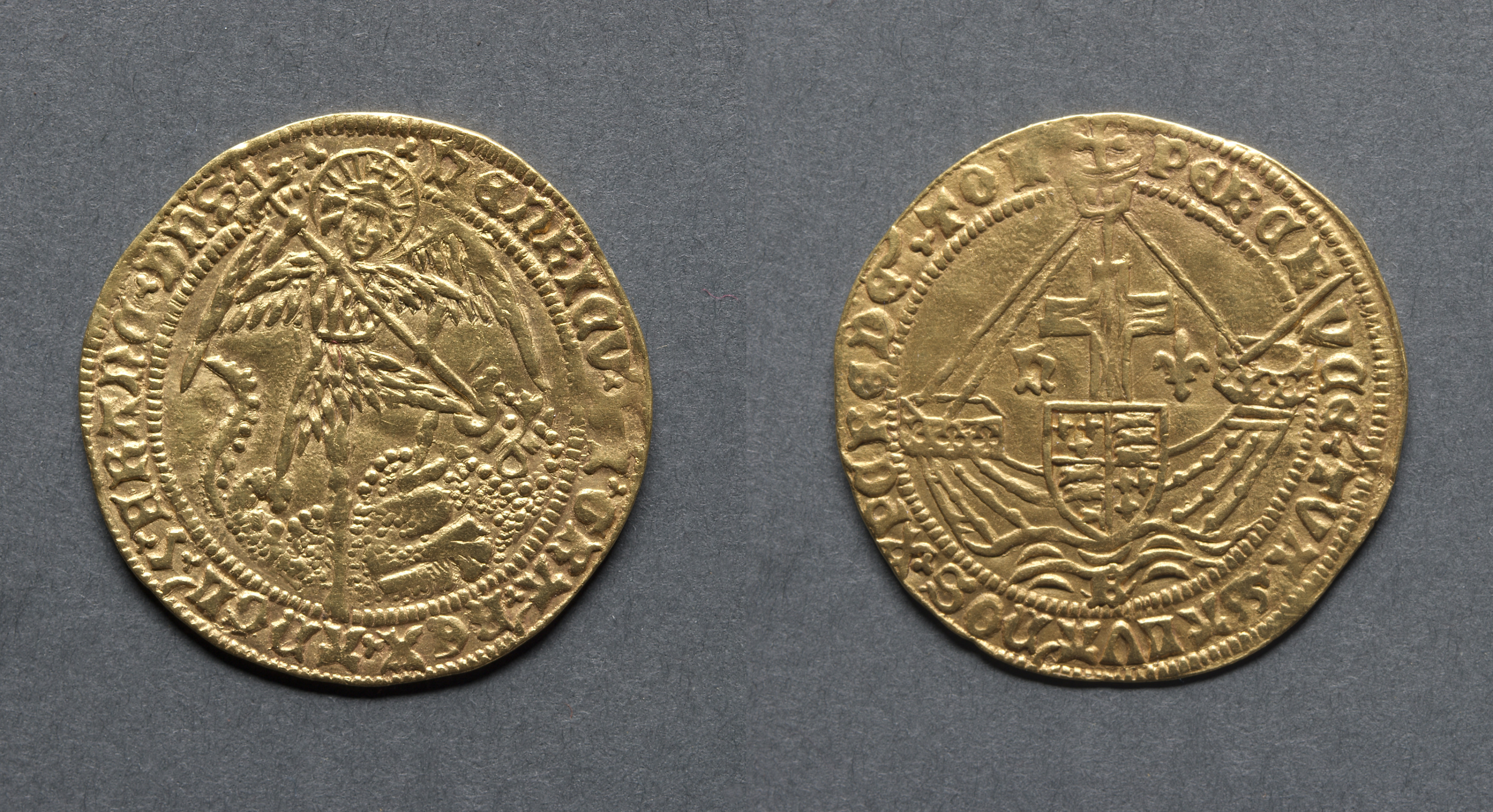
Deconstructing the Divine: The Angel of Henry VI as Avant-Garde Textile Narrative
In the realm of avant-garde fashion, the past is not a relic but a raw material. At Zoey Fashion Lab, our practice of Fabric Deconstructionism seeks to unearth the latent, often violent, narratives embedded within historical artifacts and translate them into wearable, disruptive textiles. The subject of this analysis—a gold Angel coin from the reign of Henry VI (1422-1461, restored 1470-1471), bearing St. George slaying the dragon on the obverse and a ship with the shield of arms and cross on the reverse—offers a profound case study. Its dual surfaces, as described in the Archive Resonance, present a dialectic: the obverse as a “光洁银镜上以黄金镶嵌的纷繁棕叶纹” (a clean silver mirror inlaid with intricate gold palm-leaf patterns) and the reverse as a “冰冷石棺板上以浮雕诉说的生命叙事” (a life narrative told in relief on a cold stone sarcophagus). This tension between gleaming surface and funereal depth is the precise entry point for our avant-garde intervention.
Surface as Armor: The Obverse and the Myth of Purity
The obverse of the Angel coin depicts St. George, the Christian martyr and dragon-slayer. In the context of the coin’s material—24-karat gold—this image becomes a study in sacred violence. The “silver mirror” quality described in the Archive Resonance suggests a reflective, almost narcissistic surface. In our deconstruction, we interpret this not as purity but as armored self-assertion. The gold inlay of the palm-leaf patterns, which frame the saint, evokes both victory (the palm frond) and the intricate, almost obsessive detail of courtly armor.
For Zoey Fashion Lab, this obverse is a textile of conquest. We propose a fabric that mimics this duality: a base of liquid silver lamé, mirror-polished to catch and distort light, upon which we appliqué gold-thread palmettes in a chaotic, deconstructed pattern. The palmettes are not orderly; they are torn, frayed, and re-stitched at violent angles, suggesting the dragon’s claws or the saint’s own wounds. The avant-garde gesture here is to make visible the aggression beneath the chivalric ideal. The fabric becomes a mirror that refuses to flatter, instead reflecting the wearer’s own complicity in the myth of righteous violence. The gold, traditionally a symbol of divine light, is rendered as a scar—a gilded wound that speaks to the cost of sainthood.
Depth as Narrative: The Reverse and the Ship of State
Turning to the reverse, we encounter the ship bearing the shield of arms and cross. The Archive Resonance describes this as a “life narrative told in relief on a cold stone sarcophagus.” This is a profound shift from the mirror-like obverse to a tactile, funereal depth. The ship is not merely a vessel; it is a metaphor for the body politic—the Church and the Crown navigating the turbulent waters of the Hundred Years’ War and the Wars of the Roses. The shield and cross are emblems of authority and sacrifice, carved into the metal as if into a tombstone.
In our deconstruction, this reverse becomes a textile of memory and decay. We envision a fabric that is the antithesis of the obverse’s shine: a heavy, matte black jacquard woven with a raised, almost sculptural pattern of a ship’s hull and rigging. The shield and cross are not printed but embroidered in oxidized silver thread, tarnished to a dull gray that evokes aged stone. The “sarcophagus” quality is achieved through a process of fabric burial—the textile is treated with a clay-based finish that cracks and flakes, creating a relief that feels excavated. The narrative is not smooth; it is fragmented, as if the coin’s story has been partially erased by time. This is the avant-garde’s rejection of linear history. The ship does not sail triumphantly; it lists, its mast broken, its hull scarred by the weight of the arms it carries.
Dialectical Weave: The Tension Between Mirror and Tomb
The true power of the Angel coin for Zoey Fashion Lab lies in the dialectical relationship between its two faces. The obverse is a surface of eternal present—a golden mirror that captures the viewer’s gaze and deflects it. The reverse is a depth of historical past—a stone relief that demands touch and contemplation. In our avant-garde textile, we refuse to choose between them. Instead, we create a Janus-faced fabric that can be worn both ways, forcing the wearer to embody the contradiction.
One side of the garment is the obverse: the silver-mirror lamé with gold palmettes, sharp and blinding. The other side is the reverse: the black jacquard with oxidized embroidery, heavy and textured. The garment itself—a deconstructed doublet or a draped cape—is cut so that both surfaces are visible simultaneously, often through asymmetrical seams and raw edges. The mirror side catches light and throws it onto the tomb side, illuminating the ship’s scars. The tomb side, in turn, casts a shadow over the mirror, dulling its shine. This is the avant-garde’s core operation: to make visible the interdependence of glory and ruin, of myth and mortality.
Material Alchemy: Gold as Grief and Glory
The technical specification of the coin—gold—is not merely a material fact but a conceptual anchor. In our deconstruction, gold is not a symbol of wealth but of alchemical transformation. The coin’s gold was mined, smelted, and stamped with violence. For Zoey Fashion Lab, we treat gold thread as a bloodline. We weave it into the fabric not as a pattern but as a nervous system—thin, branching lines that map the dragon’s wounds and the ship’s rigging. The gold is allowed to tarnish in places, creating a patina that suggests both age and decay. This is a deliberate rejection of the coin’s original purpose—to circulate as a stable value. Instead, the gold becomes unstable, mutable, and vulnerable.
We also introduce a third material: crushed glass beads in deep red and black, sewn into the fabric at irregular intervals. These beads represent the dragon’s blood and the ship’s cargo of souls. They catch the light from the mirror side and refract it into the tomb side, creating a stochastic pattern of illumination that mimics the chaos of history. The garment becomes a reliquary of conflict, holding within its folds the memory of St. George’s lance and the ship’s sinking.
Wearable Narrative: The Body as Battlefield
Finally, we consider the body as the site of this narrative. The Angel coin was a medium of exchange, passed from hand to hand, touched by kings and commoners. In our avant-garde garment, the body becomes the coin’s new surface. The wearer is both St. George and the dragon, both the ship and the stone sarcophagus. The garment’s asymmetry forces the body into a state of perpetual torsion, as if caught between two opposing forces. The mirror side reflects the world, but the tomb side absorbs it. This is the avant-garde’s ultimate critique: that identity is not a fixed surface but a dialectical process of assertion and erasure.
In conclusion, the Angel of Henry VI is not a relic to be preserved but a text to be rewritten. Through Fabric Deconstructionism, Zoey Fashion Lab transforms its gold into grief, its mirror into memory, and its ship into a vessel of existential doubt. The resulting textile is not beautiful in the conventional sense; it is beautiful in its violence, its fragmentation, and its refusal to resolve. It is a garment that asks the wearer: What does it mean to carry history on your back? And it answers: It means to be both the mirror and the tomb, forever in conflict, forever in translation.