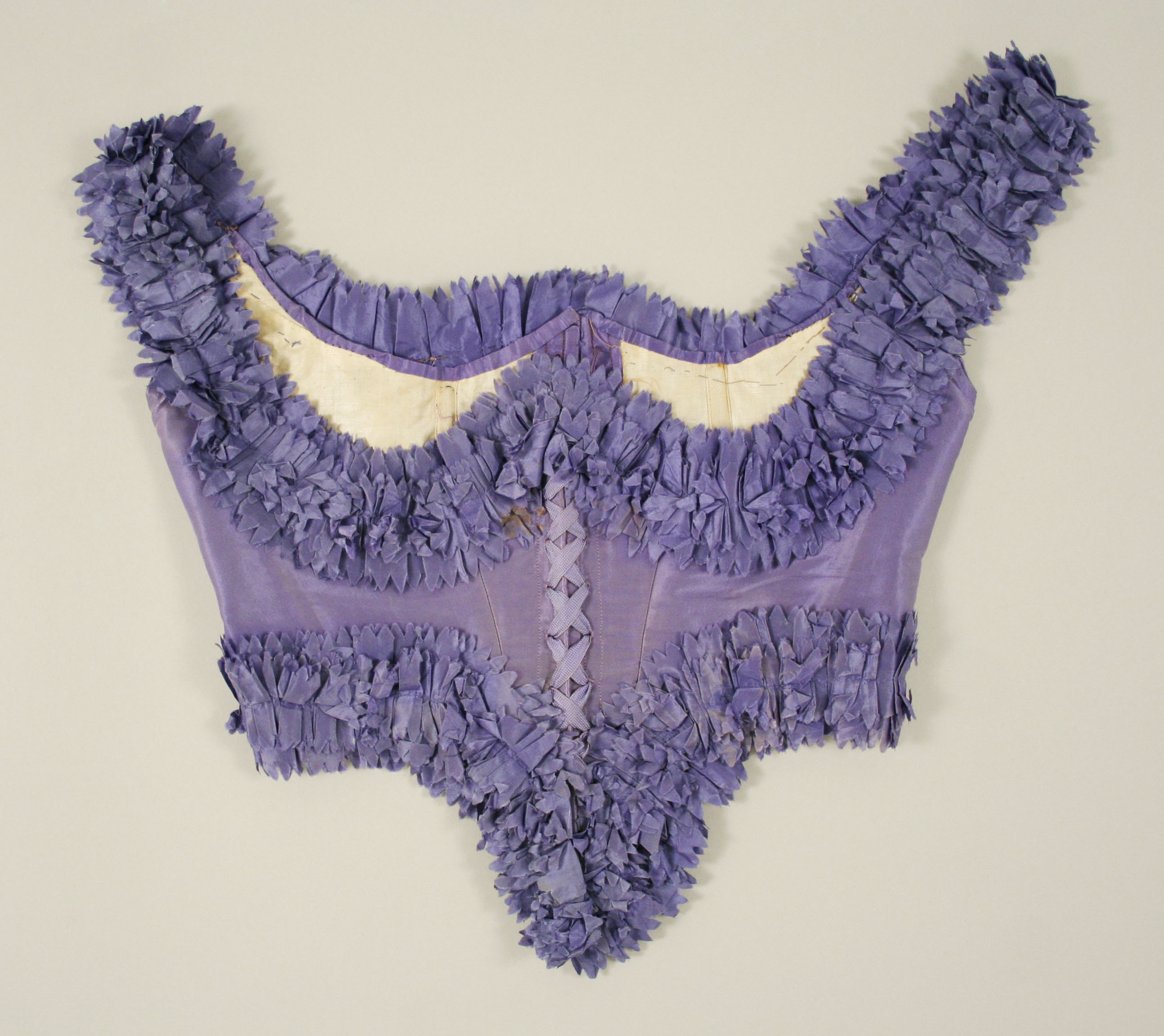
Deconstructing the Corselet: A Futurist Manifesto for SS26
The corselet, historically a bastion of rigid femininity and thoracic confinement, undergoes a radical metamorphosis in Zoey Fashion Laboratory’s SS26 avant-garde analysis. No longer a tool of compression, it emerges as a liberated architectural membrane—a second skin that negotiates between the organic and the synthetic. This study, rooted in American and European sartorial heritage but projected into a post-humanist future, reimagines the corselet as a dynamic, structural interface. The material of choice, silk, traditionally associated with fluidity and luxury, is subverted through deconstructive techniques, transforming its innate softness into a vehicle for tensile strength and sculptural defiance. The result is a garment that does not merely clothe the body but redefines its spatial and kinetic potential.
Material Alchemy: Silk as Structural Foil
Silk, in its conventional form, drapes and yields. In the SS26 corselet, it is weaponized. Through heat-set pleating and resin-infused filament weaving, the fabric is coerced into permanent, angular folds that mimic exoskeletal armor. The American influence is evident in the pragmatic engineering: silk panels are laser-cut into precise geometric scales, then reassembled with micro-silicone bonding rather than stitching, creating seams that are both invisible and impossibly strong. European craftsmanship, however, dictates the finish: each scale is hand-polished to a high-gloss, creating a lacquered effect that catches light like the carapace of a futuristic beetle. This duality—American industrial efficiency married to European artisanal obsession—yields a corselet that feels both machine-made and impossibly delicate. The silk’s natural luster is preserved, yet its tactile quality is alien: rigid where it should be soft, sharp where it should be fluid.
Silhouette as Architecture: The Floating Thorax
The SS26 corselet abandons the hourglass. Instead, it proposes a floating thoracic cage—a silhouette that hovers above the waist, disconnected from the hips. The garment’s lower edge terminates in a sharp, asymmetrical curve that does not touch the body, suspended by internal carbon-fiber boning sheathed in silk. This creates a negative space, a void between garment and skin that is both visually and conceptually provocative. The upper edge, meanwhile, extends into collar-like spires that rise behind the neck, echoing the gills of a deep-sea creature. The back is left almost entirely open, save for a single, tensile silk strap that bisects the spine—a nod to the deconstructive aesthetic of Rei Kawakubo, but rendered with the precision of a Swiss chronometer. The overall effect is one of controlled chaos: the body is simultaneously armored and exposed, protected and vulnerable.
Deconstructive Innovation: The Seam as Scar
In this analysis, seams are not closures; they are narrative scars. Each joint in the corselet is deliberately exaggerated, with raw silk edges left unhemmed and fraying into fine, hair-like tendrils. These tendrils are then woven back into the garment’s surface, creating a bio-mimetic lattice that suggests growth and regeneration. American innovation appears in the use of 3D-printed silk composite nodes—small, organic-shaped connectors that join panels without traditional stitching. These nodes are dyed in gradient hues of oxidized copper, creating a patina effect that contrasts with the silk’s pristine white or deep indigo. European sensibility, however, demands that these nodes be placed with mathematical precision, following the body’s meridian lines of tension and release. The result is a garment that looks as if it has grown from the wearer’s own flesh, a second skeleton that is both alien and intimately familiar.
Futuristic Silhouette: The Kinetic Carapace
The SS26 corselet is not static. It is engineered for movement, but movement of a specific kind—jerky, robotic, and insectoid. The silk panels are cut on the bias but then rotated 45 degrees, creating a torsional tension that resists natural body motion. When the wearer breathes, the corselet does not expand; instead, it contracts, tightening in a spiral pattern around the ribcage. This is achieved through internal cable systems woven into the silk, which are triggered by micro-sensors embedded at the sternum. The effect is a garment that breathes with the wearer but in an uncanny, counter-rhythmic pulse. The silhouette, therefore, is not fixed but morphing—a carapace that shifts between protective shell and skeletal cage. At rest, it appears as a minimalist, almost brutalist sculpture. In motion, it becomes a living, breathing organism.
Contextual Resonance: The Post-Human Corselet
This is not a garment for the street. It is a provocation—a manifesto against the passive consumption of fashion. In the context of SS26, where sustainability and technology converge, the corselet represents a new paradigm of wearability. It asks: What if clothing did not adapt to the body, but the body adapted to clothing? The silk, sourced from regenerative sericulture (an American innovation in ethical farming), is dyed using European botanical pigments—indigo from woad, crimson from madder. Yet the final product is anything but natural. The corselet is a hybrid: part armor, part exoskeleton, part ceremonial regalia. It rejects the notion of comfort as softness, proposing instead a comfort in constraint—a liberation through structural discipline. The wearer is not a passive mannequin but an active participant in a dialogue between flesh and fabric, history and future.
Conclusion: The Corselet as Threshold
Zoey Fashion Laboratory’s SS26 corselet is a threshold object. It stands at the intersection of American pragmatism and European idealism, of silk’s ancient luxury and silicon’s futuristic precision. It is a study in structural innovation that refuses to be pinned down—literally or metaphorically. The garment does not end at its edges; it extends into the space around it, creating an aura of tension and possibility. For the avant-garde connoisseur, this corselet is not a piece of clothing but a philosophical artifact—a question posed in silk and carbon fiber, waiting for a body to answer. In the landscape of SS26, it is a beacon, illuminating a path toward a fashion that is not merely worn, but inhabited.