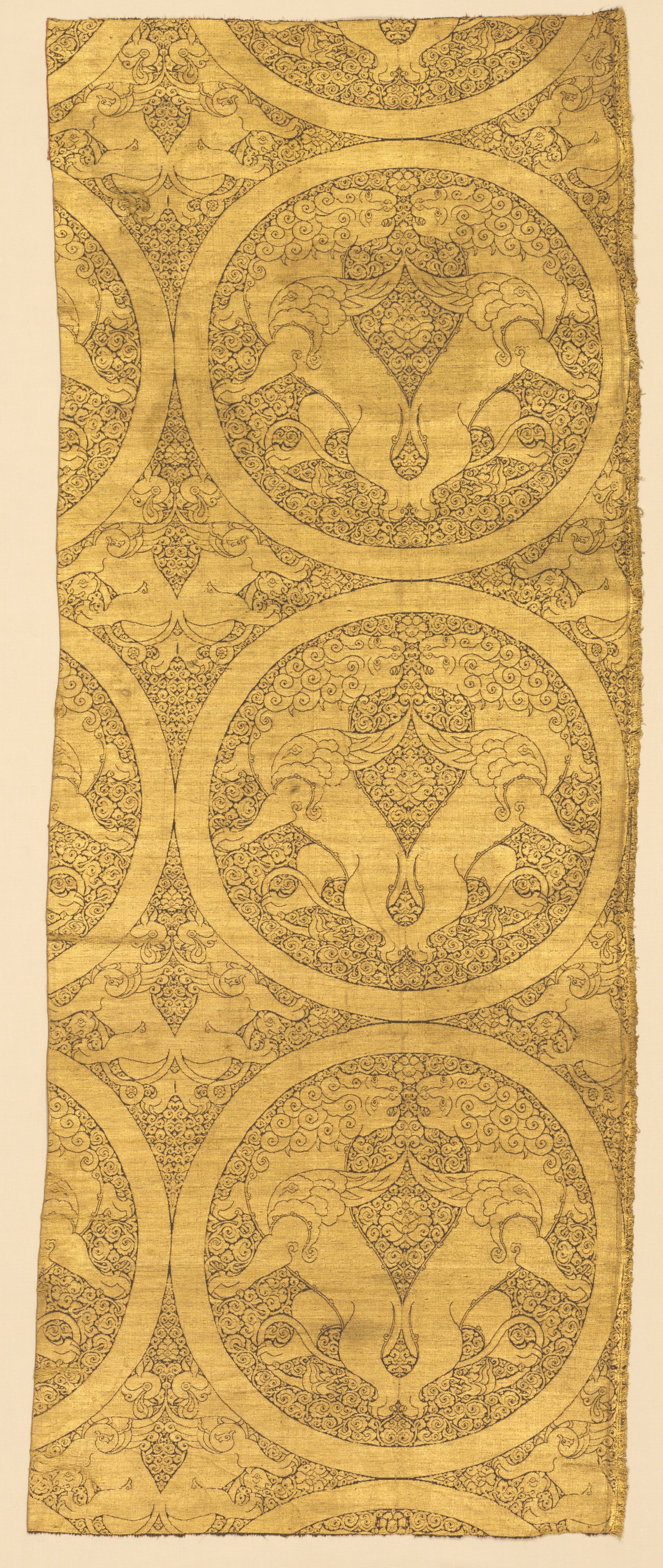
Deconstructing the Divine: Cloth of Gold with Winged Lions and Griffins
At Zoey Fashion Lab, we approach historical textiles not as relics, but as living algorithms of power, belief, and material mastery. The subject of this analysis—a Central Asian lampas weave of silk and gold thread, featuring winged lions and griffins—is a profound case study. It is a fabric that speaks in a forgotten language of celestial authority and terrestrial wealth. Our task is to deconstruct this language, translating its dense grammar into a vocabulary for the avant-garde. We will break down its technical DNA, decode its symbolic iconography, and finally, re-synthesize its essence into a radical, contemporary design proposition.
Technical Autopsy: The Lampas Structure and Material Alchemy
The weave structure is lampas, a sophisticated compound weave that was the pinnacle of medieval textile engineering. Unlike simpler weaves, lampas allows for a pattern in one weave structure (the figure) to be floated over a ground weave (the foundation). In this specific artifact, the ground is a fine, tightly packed silk, likely a deep, now-faded crimson or indigo, providing a stable, matte canvas. The figure, however, is executed in a discontinuous supplementary weft of pure gold thread—gilded silver or gold strip wrapped around a silk core. This is not mere decoration; it is a structural statement of value.
The material dichotomy is the first point of deconstruction. The silk ground is organic, supple, and absorbs light. The gold weft is inorganic, rigid, and reflects light with blinding intensity. This creates a deliberate, almost violent visual tension. The gold does not sit flush with the silk; it rises slightly, creating a palpable texture, a topography of power. For the avant-garde, this is a direct instruction: do not blend materials; let them conflict. The gold thread’s stiffness also dictates the fabric’s drape. It does not flow; it holds its shape, creating architectural folds. This suggests garments that are not draped but constructed, armatures that mimic the rigidity of ceremonial armor or the formal geometry of a sacred icon.
Furthermore, the technical limitation of the discontinuous weft is key. The gold thread only appears where the pattern requires it, leaving the silk ground to breathe. This creates negative space, a deliberate emptiness that frames the opulent figures. In our deconstruction, we recognize this as a principle of economy of excess. The most powerful statement is not made by covering everything in gold, but by using gold sparingly to carve out a commanding silhouette. This is a lesson in restraint, a core tenet of high avant-garde design.
Iconographic Decoding: The Winged Lion and the Griffin as Archetypes
The motifs—the winged lion and the griffin—are not mere decorative flourishes; they are complex, syncretic symbols born from the Silk Road’s cultural fusion. The winged lion, often associated with the zodiac sign of Leo or, more powerfully, with the Buddhist guardian deity and the Zoroastrian symbol of royal glory (khvarenah), represents a fusion of terrestrial strength and celestial aspiration. The griffin, with the body of a lion and the head and wings of an eagle, is a guardian of divine treasures, a creature of dual nature—earth and sky, predator and sentinel.
In the context of Central Asia, these figures were not just mythological; they were political. They adorned the robes of rulers, the trappings of horses, and the hangings of palaces. To wear this cloth was to embody the creature’s power. The griffin’s vigilance and the lion’s courage were transferred to the wearer. The fabric was a form of wearable armor for the soul, a declaration of sovereignty that was both earthly and divine.
For deconstruction, we analyze the formal arrangement. Are the lions and griffins arranged in mirror-image pairs, facing each other? Are they in a repeating, regimented grid? Or do they float in a dynamic, asymmetrical field? A typical Central Asian lampas would feature them in strict, heraldic symmetry, often within a medallion or a repeating lattice. This symmetry implies order, control, and the eternal cycle of power. The avant-garde can subvert this by breaking the symmetry, isolating a single creature, or distorting its proportions. We can take the griffin’s dual nature literally—splitting the garment into two distinct, conflicting halves: one half rigid, structured, and gold (the eagle), the other half fluid, draped, and dark (the lion).
The reference to the “Mirror with Split-Lea…” is crucial here. It suggests a duality, a reflection that is both identical and reversed. The cloth of gold is a mirror reflecting an idealized, powerful self. But the “cold stone sarcophagus” speaks to the mortality that power seeks to transcend. The avant-garde reading is one of memento mori—the fabric of eternal life is woven on the loom of inevitable decay. The gold, which never tarnishes, is a lie against the silk, which will fray and fade. This tension is the heart of our design concept.
Avant-Garde Synthesis: The “Mirror of Split Power” Collection
From this deconstruction, Zoey Fashion Lab proposes a capsule collection: “Mirror of Split Power.” The core concept is the deliberate, violent separation of the cloth’s dual nature—the celestial gold and the terrestrial silk, the guardian and the guarded, the eternal and the mortal.
Garment One: The Armature of the Griffin. A sculpted, almost architectural bustier. The front is constructed from a modern reinterpretation of the lampas: a laser-cut, rigid black neoprene base, overlaid with a skeletal, gold-plated metal mesh that traces the exact outline of a griffin’s wing. The wing is not a flat image; it is a three-dimensional, articulated structure that fans out from the shoulder. The back of the bustier is bare, raw silk, left intentionally unfinished, fraying at the edges. This is the “cold stone sarcophagus”—the vulnerable, human back, exposed and mortal, in stark contrast to the armored, golden front.
Garment Two: The Drape of the Winged Lion. A floor-length, asymmetric skirt. One half is a heavy, liquid silk satin in a deep, blood-red, falling in soft, Grecian folds. The other half is a rigid, gold-lamé panel, cut on the bias to create a sharp, geometric flare. The gold panel is embroidered not with a complete lion, but with a single, disembodied, golden lion’s paw, claws extended, as if tearing through the silk. The waistband is a wide, leather corset belt, embossed with a repeating pattern of split-palmette leaves—a direct nod to the “Mirror with Split-Lea” reference, but executed in matte black leather, a material of utility and mortality.
Garment Three: The Deconstructed Lamé. A full-length, transparent organza coat, printed with a ghostly, inverted image of the original griffin and lion pattern. Over this, a series of separate, floating gold-thread elements—a single wing, a lion’s mane, a griffin’s beak—are attached with delicate, almost invisible monofilament. They sway and shift independently as the wearer moves, creating a disorienting, fragmented silhouette. This is the “mirror” shattered. The garment is a deliberate, unsettling artifact, a memory of power that is no longer whole. The gold is present, but it is unmoored, floating, a ghost of its former self.
In conclusion, the Cloth of Gold with Winged Lions and Griffins is not a historical curiosity; it is a blueprint for a radical, contemporary aesthetic. By deconstructing its technical rigor, its symbolic density, and its inherent material contradictions, we at Zoey Fashion Lab can forge a new language. A language that speaks of power as fragile, of eternity as a performance, and of the human form as the ultimate, contested ground between the celestial and the mortal. The avant-garde is not about rejecting the past; it is about dissecting it, understanding its mechanisms, and then reassembling the parts into something that terrifies and inspires in equal measure. This cloth is our scalpel.