Deconstructing the Lacquered Archive: Inrō as Proto-Avant-Garde Architecture for SS26
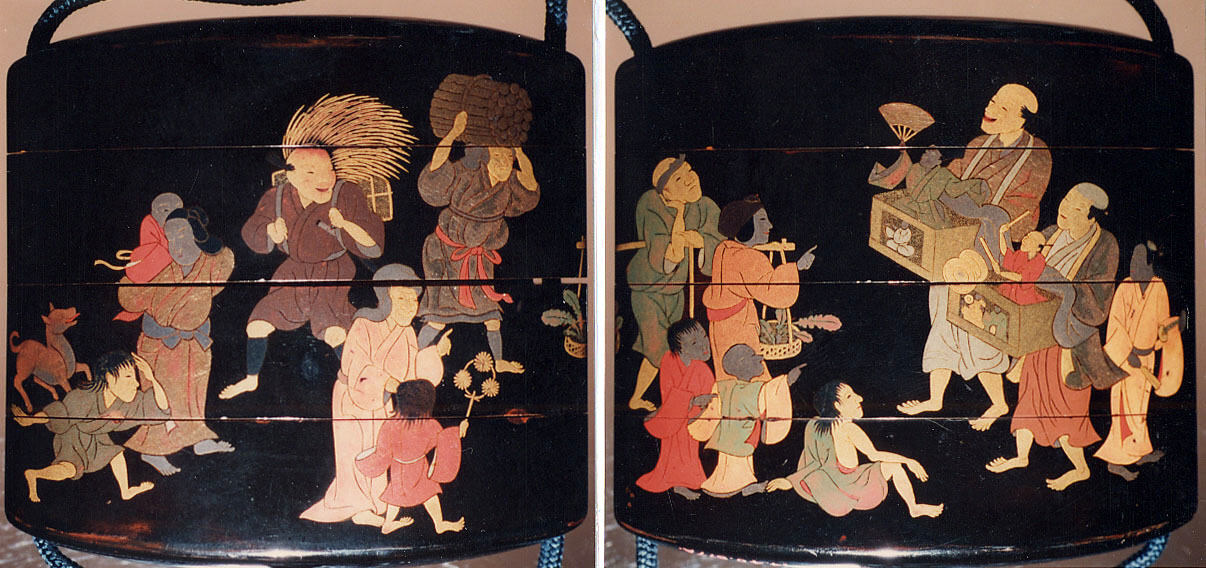
The 18th-century Japanese Inrō, a portable medicine case suspended from the obi, is often relegated to the domain of decorative arts, a relic of Edo-period craftsmanship. Yet, for the SS26 avant-garde proposition at Zoey Fashion Laboratory, this object—specifically the piece depicting a street festival on its obverse and a puppet show on its reverse—is not a historical artifact. It is a proto-futurist manifesto in lacquer, wood, and gold. Its three-tiered construction, its narrative duality, and its material tension between rigid case and organic netsuke offer a radical blueprint for garment architecture that defies temporal constraints. This analysis deconstructs the Inrō’s structural and narrative DNA to propose a collection where the body becomes a mobile, layered stage.
Case as Chassis: The Three-Tiered Silhouette
The Inrō’s most immediate avant-garde provocation is its modular, stacked geometry. Three distinct cases—each a self-contained volume—are connected by a single cord, creating a vertical, articulated form. For SS26, this translates directly into a silhouette of segmented, floating panels. Imagine a garment where the torso is not a unified shell but a series of independent, lacquered-like “cases” suspended from a central spine. A jacket, for instance, could feature three horizontal tiers: a rigid shoulder yoke, a floating midriff section, and a detached hemline. Each tier is separated by a gap of air or translucent mesh, creating a negative space that mimics the cord’s visual break. The futuristic innovation lies in the kinetic connection—these panels would not be sewn but linked via invisible magnetic or cable systems, allowing them to shift and realign with movement, just as the Inrō’s cases slide along its silk cord. The silhouette is no longer static; it is a responsive architectural stack that redefines proportion.
Lacquer as Second Skin: The Material Dialectic
The Inrō’s togidashimaki-e technique—where gold, silver, and color (iroko) are polished flush with a black lacquer ground—creates a surface that is simultaneously reflective and absorptive. This is a critical material lesson for SS26. The lacquer is not a mere coating; it is a buried narrative, a layer of pigment and metal that has been ground down to reveal a unified, luminous plane. For fashion, this suggests a fabric treatment that embeds imagery within the textile matrix rather than printing on top. Consider a garment constructed from laminated silk panels where gold and silver foils are sandwiched between layers of matte, black-dyed cellulose. Through laser ablation or controlled abrasion, the underlying metallic layers are selectively exposed, creating a futuristic “burnished” pattern that echoes the festival’s revelry. The black ground becomes a void from which light emerges, and the garment’s surface changes with viewing angle and wear—a dynamic, living lacquer.
The Netsuke as Suspension System: Functional Sculpture
No avant-garde analysis is complete without addressing the netsuke—the carved teakwood toggle of a peach with a monkey inside, signed by Kagetoshi. This is not an ornament; it is the structural anchor of the entire Inrō system. It prevents the cases from sliding off the cord. For SS26, the netsuke becomes a focal point of tension and release. Imagine a garment where the central closure is not a zipper or button but a sculptural, oversized toggle that bears the weight of the entire construction. A coat could be anchored by a single, carved teakwood “monkey-peach” at the nape of the neck, from which all other panels are suspended. This transforms the wearer into a living tension structure. The monkey inside the peach—a symbol of hidden vitality—suggests a secret interior: pockets, pouches, or even detachable modules that are revealed only when the toggle is unclasped. The netsuke is not decorative; it is ergonomic architecture.
Narrative Duality: The Obverse and Reverse as Garment Layers
The Inrō’s dual imagery—a bustling street festival on one side, a puppet show on the other—creates a binary narrative that challenges linear perception. One side is public, chaotic, and communal; the other is intimate, theatrical, and controlled. For SS26, this duality is translated into garment reversibility and layered storytelling. A single piece could feature two completely different lacquer-like surfaces: the obverse, a chaotic explosion of gold and iroko figures mimicking festival crowds; the reverse, a quieter, monochrome scene of spectators watching a puppet show. The wearer chooses which narrative to present. More radically, the garment could be constructed with a sliding panel system—a second skin that rotates around the body, revealing the reverse side through a controlled twist. This creates a performative garment that enacts the very act of watching and being watched, collapsing the distance between festival participant and puppet spectator. The body becomes a mobile diorama.
Ojime as Micro-Engineering: The Precision Closure
The ojime, a carved teakwood bead with floral design, is the smallest yet most critical component. It cinches the cord, controlling the tension and position of the cases. In SS26, this becomes a precision closure mechanism that dictates silhouette. Imagine a series of micro-beads—each carved from teak or resin—that function as adjustable cinches along a garment’s seams. A dress could have a vertical cord running its length, with ojime-style beads that the wearer slides to raise or lower the hemline, to tighten or loosen the waist. This is user-driven architecture. The floral design on the ojime is not merely decorative; it suggests a biomorphic interface—the bead’s carved petals become tactile grips, a haptic guide for adjustment. The futuristic element is the integration of micro-engineering into couture, where every bead is a functional node in a system of variable volume.
Conclusion: The Inrō as Temporal Collapse
The Inrō with its street festival and puppet show is not a historical curiosity for Zoey Fashion Laboratory. It is a temporal collapse—an object that fuses Edo-era craftsmanship with a futuristic, modular sensibility. The SS26 collection derived from this analysis will not imitate lacquer or wood; it will abstract their structural logic. Stacked, suspended panels replace sewn seams. Burnished metallic textiles replace painted surfaces. Functional, carved toggles replace conventional fasteners. The garment becomes a mobile, narrative architecture that shifts between public and private, between rigid case and organic toggle. The Inrō teaches us that the most radical future is often hidden in the most refined past. The avant-garde is not a rejection of history but its deconstruction and reassembly into a new, kinetic language. For SS26, the body is the cord, and the garment is the case—suspended, layered, and ready to be cinched into a new form.