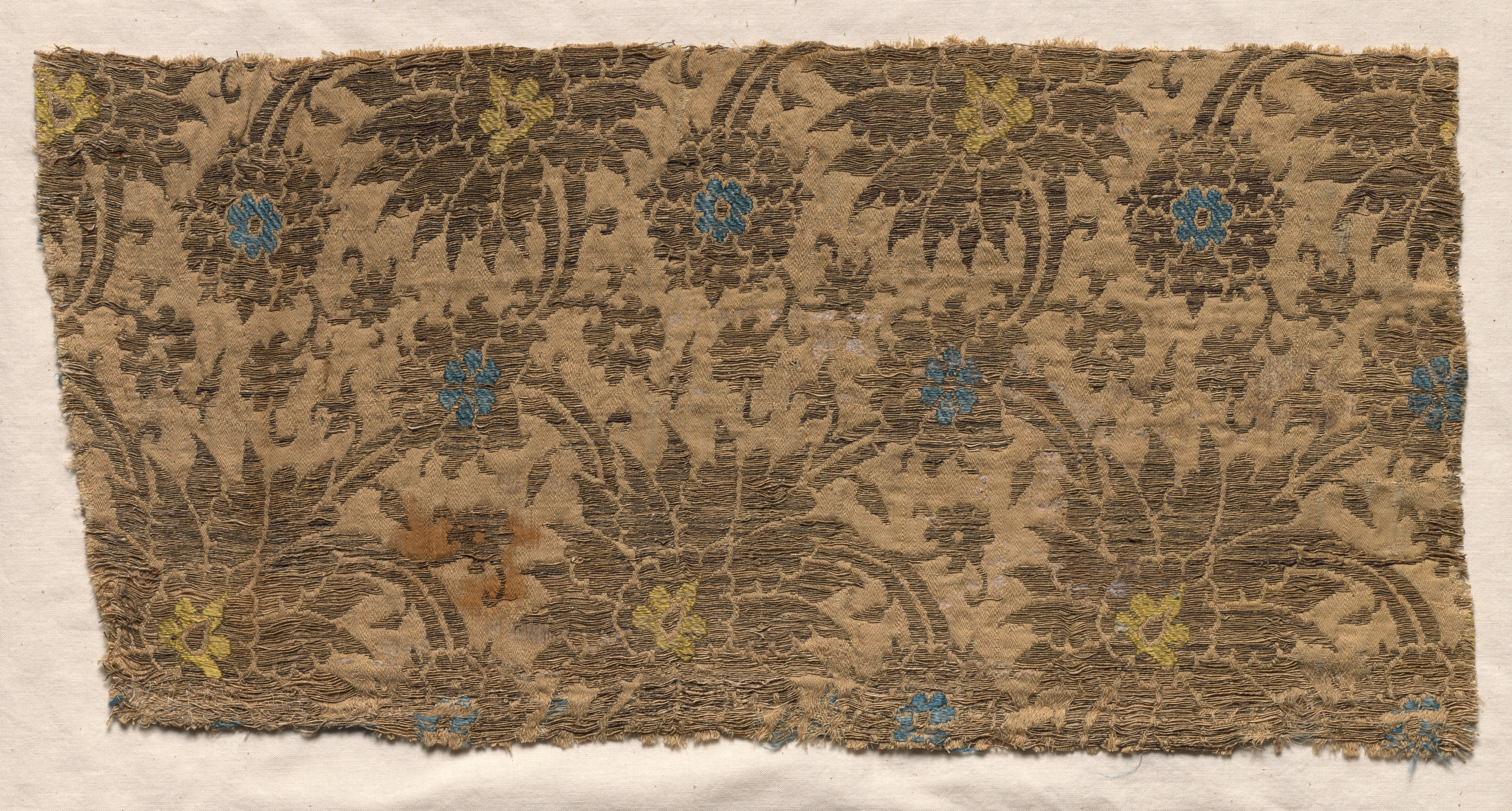
Deconstructing the Threads of Time: A Technical and Aesthetic Analysis of a 14th-Century Italian Silk Fragment for Avant-Garde Application
At Zoey Fashion Lab, our mandate is not merely to preserve historical textiles but to deconstruct their DNA—to extract the structural, material, and symbolic codes that define them, and then re-engineer those codes into radical new forms. The subject of this analysis, a silk and gold thread lampas fragment from mid-14th century Italy, presents a particularly rich case study. This piece, which we have designated as “New DNA Strand,” embodies a paradox: it is a relic of opulent, rigid courtly tradition, yet its intricate weave and material dialogue between matte silk and reflective metal offer a blueprint for avant-garde disruption.
I. Material Provenance and Structural DNA
The fragment originates from the second half of the 14th century, a period when Italian silk weaving, particularly in Lucca, Venice, and Florence, had reached a zenith of technical sophistication. The lampas weave—a compound structure where a main warp and weft form a ground fabric, while a second, supplementary warp and weft create a pattern—was the era’s most complex loom-based technique. In this fragment, the ground is a tightly woven silk, likely in a deep, oxidized crimson or sapphire (now faded to a muted, organic hue), while the pattern is executed in gilt silver thread (gold thread wrapped around a silk core).
Technical Specifications for Deconstruction:
- Weave Structure: Lampas, specifically a lampas à deux lats (two weft systems). The binding warp for the gold thread is typically a silk filament, creating a floating effect where the metal lies on the surface.
- Thread Count: Estimated 80-100 ends per centimeter for the ground silk; the gold thread is thicker, creating a raised, sculptural relief.
- Deterioration Markers: The silk has suffered from photochemical degradation, with some wefts becoming brittle and fractured. The gold thread shows tarnishing and loss of the outer gilt layer, exposing the silver core—a process we call “metallic fatigue.”
This technical profile is not a limitation; it is a generative constraint. The fragment’s fragility becomes a design parameter: we must honor its structural logic while introducing new tensile strength through synthetic or bio-engineered fibers. The gold thread’s degradation, for instance, can be mimicked in an avant-garde context using laser-etched mylar or recycled metallic microfilaments that deliberately tarnish in controlled patterns.
II. The Avant-Garde Lens: From Ornament to Disruption
In its original context, this lampas was a symbol of hierarchical power—used for liturgical vestments, courtly garments, or diplomatic gifts. The gold thread was not just decoration; it was a statement of wealth, divine favor, and technological monopoly. For Zoey Fashion Lab, however, we re-read this material as a precursor to digital pixelation. The lampas weave creates a binary system: silk ground (background) and gold pattern (foreground). This is a proto-digital matrix, where each thread is a data point.
Avant-Garde Reinterpretation Principles:
- Deconstruction of Hierarchy: We will invert the lampas logic. Instead of gold on silk, we propose a base of recycled carbon fiber (matte black, structural) with a pattern woven from biodegradable silk protein infused with thermochromic pigments. The “gold” becomes a reactive surface that shifts color based on body heat or environmental data.
- Disrupted Repeat: The original fragment likely featured a symmetrical pomegranate or palmette motif. For “New DNA Strand,” we will digitally scan the pattern, then apply a generative adversarial network (GAN) to produce a mutating, asymmetrical version. The repeat will be broken, with threads intentionally dropped or misaligned to create glitch-like interruptions.
- Material Alchemy: The gold thread’s deterioration will be accelerated and aestheticized. We will treat the silk ground with a microbial cellulose coating that grows in patterns mimicking the original metallic relief, then partially dissolve it—creating a fossilized, organic trace of the weave.
III. The “New DNA Strand” Collection: Conceptual Framework
This fragment is not a garment; it is a genetic template. Our collection will extract three core DNA sequences:
Sequence 1: Luminosity as Structure.
The original gold thread was a structural element, not just surface decoration. In our avant-garde iteration, we will weave optical fiber into the lampas ground, creating a garment that emits low-level, programmable light along the warp lines. The light will pulse in response to the wearer’s heartbeat or ambient sound—turning the historical “static gold” into a living, communicative surface.
Sequence 2: The Fractured Repeat.
The pattern of the fragment will be deconstructed into its constituent geometric units—circles, arcs, and tangent lines. These will be laser-cut from recycled aluminum and hand-stitched onto a base of deconstructed silk (threads pulled and re-loomed at irregular tension). The result is a garment that appears to be in a state of entropic collapse, yet is structurally reinforced by the metal components.
Sequence 3: Tactile Memory.
The original silk’s tactile quality—a soft, matte surface contrasted with the hard, cold gold—will be replicated through a dual-layer textile. The inner layer is a micro-modal jersey (soft, breathable) bonded to an outer layer of 3D-printed polyurethane that mimics the lampas’s raised pattern. The polyurethane will be embedded with haptic sensors that vibrate when touched, creating a sensory feedback loop that references the original fabric’s ritualistic, non-verbal communication.
IV. Preservation and Provocation: Ethical and Technical Synthesis
Working with a 14th-century fragment demands ethical precision. We are not replicating or copying; we are translating. The original lampas will be stored in a nitrogen-sealed case after digital scanning and thread-by-thread analysis. The “New DNA Strand” collection will include a holographic projection of the original fragment as a ghost layer over the avant-garde garment, visible only under UV light—a constant reminder of the source.
Technically, the biggest challenge is the tension differential between the historical silk (which has lost elasticity) and the modern materials. Our solution is to use a smart textile scaffold: a shape-memory alloy wire woven into the ground that contracts or expands to maintain the fabric’s original tension, even as the silk degrades further. This scaffold becomes part of the design, visible as metallic ribs that echo the original gold thread’s structural role.
V. Conclusion: The Fragment as Future
This 14th-century Italian silk fragment is not a dead object. In the hands of Zoey Fashion Lab, it becomes a living archive—a set of instructions for a new type of textile intelligence. The lampas weave teaches us about binary systems, material hierarchy, and the relationship between structure and ornament. The gold thread shows us how to embed value into surface. The deterioration reveals the beauty of entropy.
Our avant-garde collection will not look like a medieval garment. It will be asymmetrical, reactive, and technologically dense. But it will carry the genetic memory of that lampas—the way the silk and gold once held court, the way the threads once told a story of power and transcendence. We are not destroying history; we are rewriting its code for a future where fabric is alive, responsive, and radically free.
Zoey Fashion Lab — Deconstructing the past to weave the unprecedented.