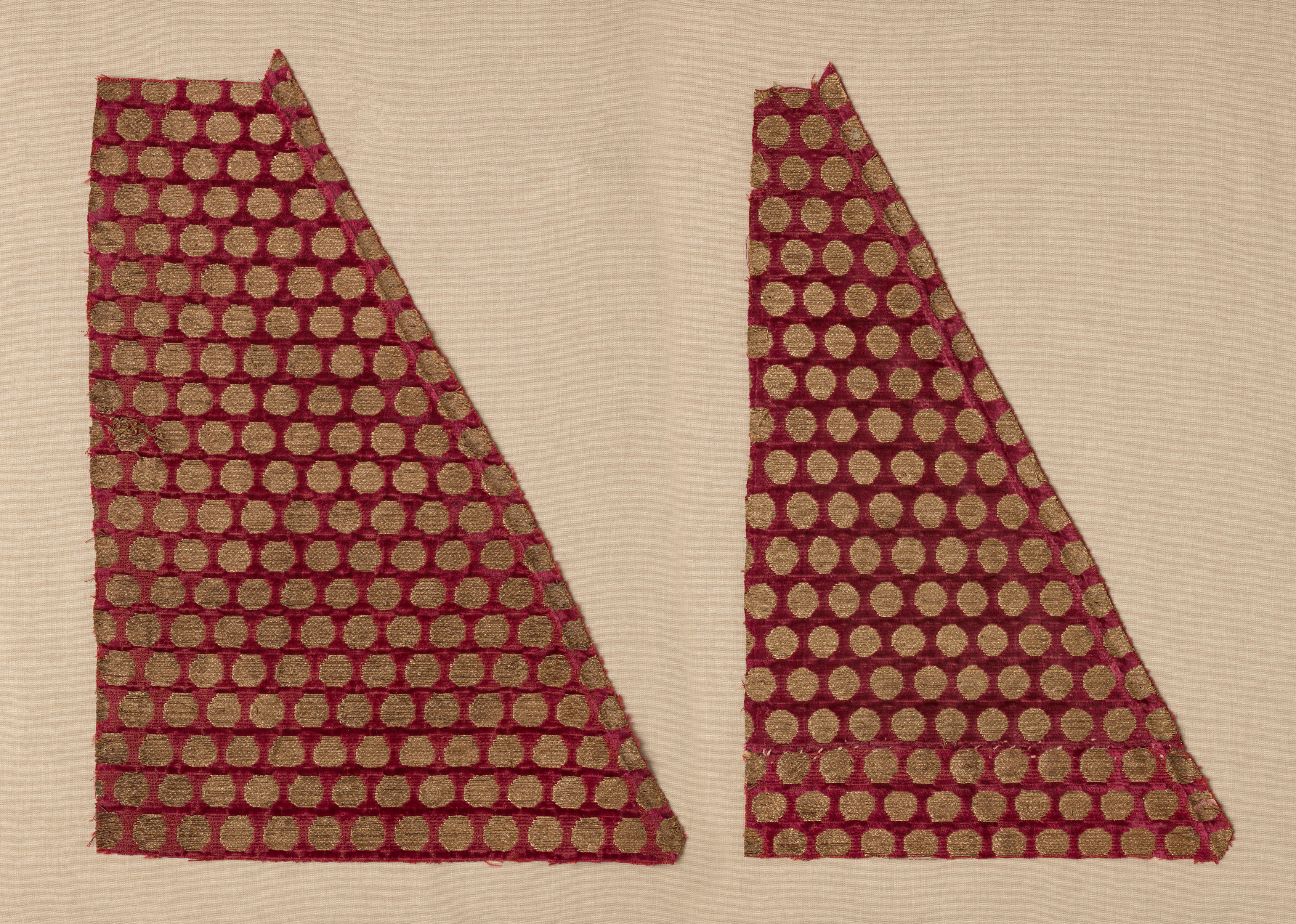
Deconstructing the Veil: A Zoey Fashion Lab Analysis of a 14th-Century Velvet Fragment
At Zoey Fashion Lab, we do not merely preserve historical textiles; we interrogate them, dissect their molecular whispers, and reanimate their latent narratives. The subject of this analysis—a 14th-century velvet fragment, originating from the Ilkhanate courts of Iran or Iraq, presented in two pieces—represents a profound intersection of luxury, power, and material intelligence. This is not a relic to be passively admired. It is a New DNA Strand within the fashion genome, a code that, when decoded through an avant-garde lens, reveals radical possibilities for contemporary design. Our deconstruction focuses on three core vectors: the technical paradox of its construction, the socio-economic story embedded in its materiality, and the conceptual bridge to a future of deconstructed opulence.
I. The Technical Paradox: Velvet, Lancé, and the Alchemy of Gold
The fragment’s technical specification—velvet, lancé, silk and Cyprian gold around a silk core—immediately signals a mastery of complexity. Velvet, in the 14th century, was not a simple pile fabric. It was a structural marvel, requiring a sophisticated drawloom and the coordination of multiple warp and weft systems. The creation of a voided velvet, where the pile is selectively cut to create pattern against a flat ground, demands extraordinary precision. This is where the lancé technique enters. Lancé weaving, the brocading of supplementary wefts, allowed for the introduction of discontinuous metallic threads. Here, the gold—specifically Cyprian gold, a term historically denoting high-quality gilded silver or gold thread from Cyprus—was meticulously wrapped around a silk core. This created a thread that was both structurally resilient and visually incandescent.
From an avant-garde perspective, this technical paradox is exhilarating. The velvet’s soft, tactile pile is deliberately interrupted by the rigid, reflective metallic thread. The fabric becomes a battlefield of textures: the absorbent, shadowy depth of the silk pile versus the hard, light-capturing surface of the gold. This is not a harmonious blend; it is a deliberate friction. For Zoey Fashion Lab, this friction is a design principle. We see in this fragment a premonition of deconstruction—a fabric that refuses to be uniform, that announces its own construction through the clash of materials. The two pieces of the fragment, likely separated by time or damage, further amplify this. They are not a complete image; they are a broken record, a stuttered pattern. In an avant-garde collection, this fragmentation would be celebrated. We would not attempt to restore the original pattern but rather isolate these two pieces as independent material statements, perhaps laser-cutting the velvet to expose the gold weft, or suspending the metallic threads as free-floating, unbound elements.
II. The Socio-Economic DNA: Power, Trade, and the Ilkhanate Court
Every thread in this fragment is a document of global trade and imperial ambition. The silk itself, likely originating from China via the Silk Road, speaks to the Ilkhanate’s position as a cultural and commercial nexus. The Cyprian gold, funneled through Venetian or Genoese trade networks, represents the intersection of Mediterranean mercantilism with Persianate aesthetics. This fabric was not merely decorative; it was a currency of power. Worn by courtiers, used in ceremonial robes, or perhaps adorning a religious or royal object, the velvet’s opacity and weight signified status. The gold, catching torchlight, was a visible assertion of wealth and divine favor.
For Zoey Fashion Lab, this socio-economic DNA is a narrative tool. The fragment is not just a textile; it is a political artifact. The two pieces, perhaps torn from a larger garment or hanging, evoke a history of use, of wear, of potential violence or decay. In an avant-garde context, we would amplify this narrative. Imagine a contemporary coat where the velvet fragment is inset as a literal patch of history, its gold threads frayed and exposed, juxtaposed against raw, unfinished seams. Or consider a deconstructed dress where the fragment is suspended like a relic within a transparent polymer, its materiality preserved but its function radically altered. The gold, once a symbol of static power, becomes a metaphor for the liquidity of value—a thread that can be pulled, unraveled, and re-spun into new forms of prestige.
III. The Avant-Garde Bridge: From Fragment to New DNA Strand
The designation of this fragment as a New DNA Strand is deliberate. In biological terms, DNA is a code that can be read, edited, and recombined. This velvet fragment, with its two pieces, is not a finished garment but a genetic sequence of design possibilities. The avant-garde designer does not replicate the original pattern; they extract its core principles: the tension between soft and hard, the interplay of light and shadow, the narrative of fragmentation and repair.
Consider a Zoey Fashion Lab collection inspired by this fragment. The silhouette would be architectural, perhaps asymmetrical, with one sleeve rendered in deep, voided velvet and the other in a sheer, metallic mesh that mimics the gold’s reflective quality. The two pieces of the fragment would be interpreted as dual states of being: one piece representing the historical, the other the contemporary. We might use digital printing to replicate the fragment’s pattern, but with a glitch effect—introducing pixelation or distortion that acknowledges the passage of time and the loss of original context. The Cyprian gold would be reinterpreted through modern metallics: perhaps a liquid gold foil applied to recycled silk, or a 3D-printed gold lattice that echoes the lancé weft structure.
Furthermore, the fragment’s material fragility becomes a design feature. In an avant-garde context, decay is not a flaw but a texture. We would explore techniques like degradation weaving, where the gold thread is intentionally left loose, or burn-out velvet, where the pile is chemically removed to reveal the ground fabric, mimicking the fragment’s worn edges. The two pieces would not be sewn together; they would be connected by a gap—a void that forces the viewer to complete the pattern mentally. This is the essence of deconstruction: the garment is not a finished object but a process, a conversation between the maker, the wearer, and history.
Conclusion: The Fragment as a Living Code
This 14th-century velvet fragment, in two pieces, is far more than a historical curiosity. It is a living code that challenges contemporary fashion to embrace complexity, contradiction, and narrative depth. At Zoey Fashion Lab, we see in its technical mastery a blueprint for material experimentation. In its socio-economic roots, we find a story of global exchange that resonates with today’s supply chains. And in its fragmented state, we discover a radical aesthetic of incompleteness—a refusal to be whole, a celebration of the torn, the frayed, and the recombined. This is the New DNA Strand of fashion: not a return to the past, but a reanimation of its most potent genetic material. The velvet fragment is not an end; it is a beginning.