Deconstructing the Sacred: A Futuristic Silhouette Analysis of Saint Stephen and Saint Emeric
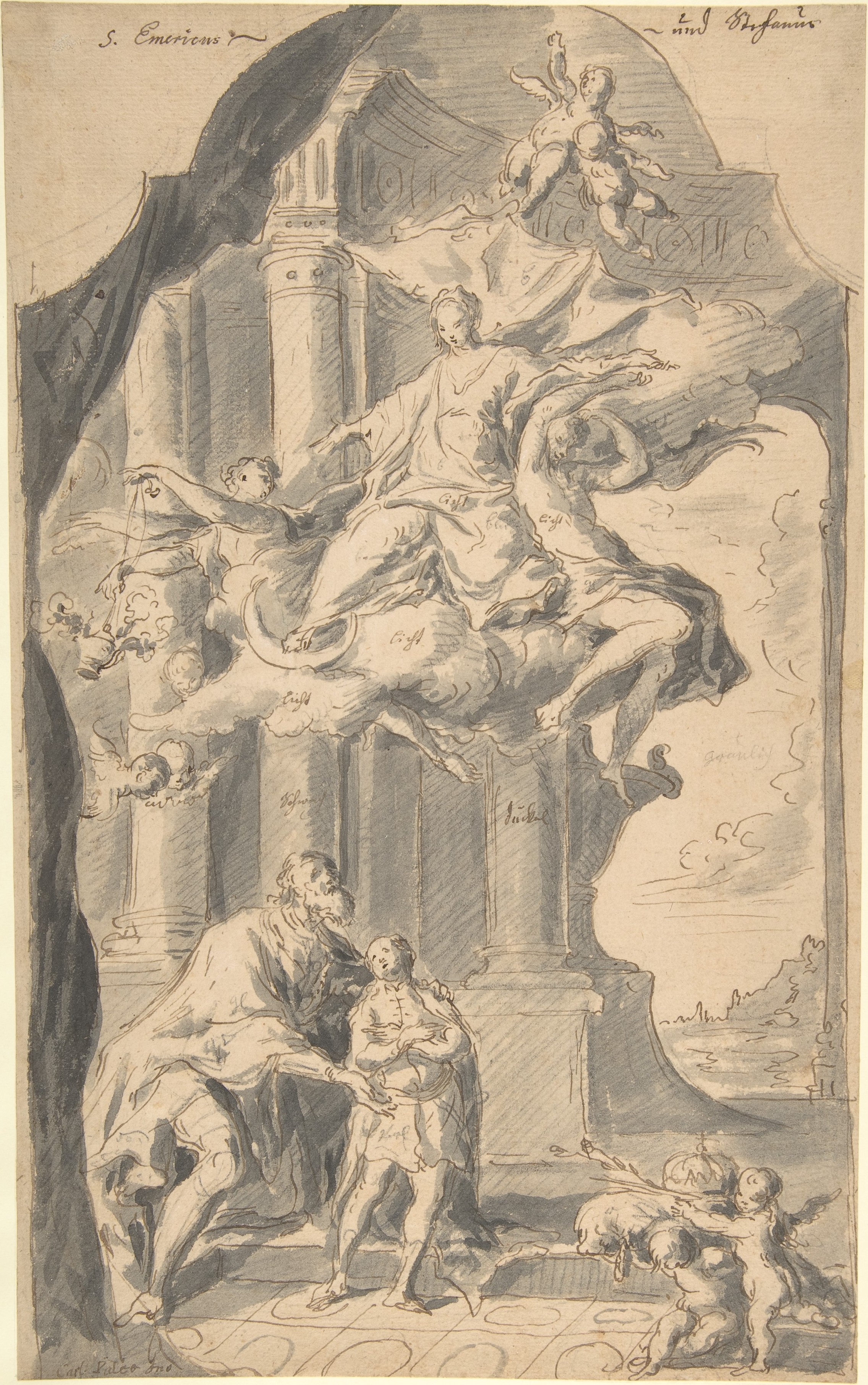
In the hallowed corridors of Zoey Fashion Laboratory, where the past is not merely referenced but violently deconstructed to birth the future, we turn our gaze to a singular artifact: the pen, brown ink, gray wash, and black chalk study of Saint Stephen of Hungary Presenting his Son, Saint Emeric, to the Virgin. This is not a relic of medieval piety; it is a blueprint for SS26. The Global Frontier demands we sever the sacred from its historical moorings and reforge it into a language of structural innovation. Here, the act of presentation—a father offering his son to a divine mother—becomes a metaphor for the avant-garde’s core imperative: the violent yet generative transmission of lineage into the unknown.
The materiality of the work—the pen and brown ink as a sharp, etched line, the gray wash as a spectral volume, and the black chalk as a grounding shadow—offers a three-dimensional grammar for our silhouettes. We are not copying the image; we are extracting its tectonic logic. The Virgin’s receiving hands, the angular drapery of Saint Stephen’s royal mantle, and the fragile, almost translucent form of the young Emeric become the zones of our design inquiry: the node of reception, the arc of transmission, and the void of potentiality.
I. The Node of Reception: The Virgin as Architectural Void
In the original study, the Virgin is not a static figure; she is a gravitational center. Her form, rendered in gray wash, suggests a negative space—a void that absorbs the linear energy of the two male figures. For SS26, we translate this into a futuristic silhouette that operates as a wearable absence. Imagine a jacket constructed from a single, continuous line of black chalk-inspired carbon fiber, its front panel cut away to reveal a void of iridescent organza. This is the “Virgin Node”—a structural aperture where the garment’s core becomes a receiver.
Structural innovation emerges from the interplay between the rigid ink lines (Saint Stephen’s authoritative posture) and the wash’s fluidity (the Virgin’s receptive grace). We propose a deconstructed bodice with a floating, cantilevered collar—a nod to the Virgin’s halo—that extends forward as if to catch an invisible offering. The shoulder line is asymmetrical, one side sharp and architectural (the father’s gesture), the other soft and draped (the son’s vulnerability). The fabric: a bonded wool with a laser-cut lattice that mimics the cross-hatching of the chalk, allowing the skin to appear as the “gray wash” beneath. This is the avant-garde’s reinterpretation of the sacred gesture: not a prayer, but a structural joint.
II. The Arc of Transmission: Saint Stephen’s Linear Mantle
Saint Stephen’s cloak, rendered in rapid, assertive pen strokes, is our primary source for futuristic silhouette engineering. The lines do not simply outline the body; they create a dynamic vector field, directing the eye from the king’s hand to the Virgin’s lap. For SS26, we extract this vectorial logic to design a coat that functions as a movable architecture. The silhouette is elongated, almost monastic, but the back is cut away to reveal a harness of brown ink-colored leather straps that trace the path of the original drawing’s lines.
The structural innovation lies in the “transmission sleeve”—a sleeve that does not end at the wrist but extends into a detachable, wing-like panel of gray wash silk. This panel can be folded, pinned, or left to trail, embodying the act of giving. The coat’s closure is not a zipper but a series of magnetic nodes that click into place like the precise dots of the pen, allowing the wearer to reconfigure the garment’s volume. The palette is monastic: charcoal black, sepia brown, and a ghostly white that references the paper’s ground. This is not a costume of a king; it is a prosthetic for a new era of ritual—a garment that enacts the transmission of power through its very construction.
III. The Void of Potentiality: Saint Emeric as the Unfinished Form
Saint Emeric, the son, is the most radical figure in the composition. He is drawn with a lighter touch, his form almost dissolving into the gray wash. He is the fragile, unfinished future. For the avant-garde, this is the ultimate frontier: the silhouette that refuses completion. We propose a dress that is literally two-dimensional—a flat, cut-out shape of black chalk felt that is suspended from a wire frame, creating a negative volume around the body. The wearer becomes the “void” that the son’s figure represents, a living negative space.
Structural innovation here is radical: the garment is not sewn but laser-welded at the seams, mimicking the sharpness of the pen line. A series of articulated joints—inspired by the folds of Emeric’s tunic—allow the flat shape to shift and warp as the body moves, creating a kinetic silhouette that is never the same twice. The material is a thermochromic polymer that changes from brown to gray when exposed to body heat, echoing the original study’s tonal shifts. This is not a dress for a body; it is a diagram of becoming, where the wearer completes the sacred act of presentation by simply existing within the form.
IV. Synthesis: The Global Frontier of Sacred Geometry
To present this study to the Global Frontier is to acknowledge that the sacred is not a fixed icon but a dynamic, structural language. The pen and ink are not tools of representation; they are blueprints for a new kind of wearable architecture. The brown ink becomes the rigid exoskeleton of a cybernetic gown; the gray wash becomes a holographic projection that shifts with the viewer’s angle; the black chalk becomes a grounding weight, a counterbalance to the ethereal.
Our SS26 collection will not feature saints or kings. Instead, it will feature silhouettes that are themselves acts of transmission—garments that receive, direct, and dissolve. The “Saint Stephen” jacket will have a pocket that is not a pocket but a negative space for an absent object. The “Virgin” gown will have a neckline that is not a neckline but a receiver for light. The “Emeric” shift will be a canvas for the wearer’s own gesture, unfinished until worn.
This is the definitive avant-garde position: to take a 16th-century study of filial piety and see not history, but futurity. The pen lines are the seams of tomorrow’s garments. The wash is the air between the body and the fabric. The chalk is the shadow that defines the form. We do not honor the sacred by preserving it; we honor it by reassembling its bones into a new, unthinkable shape. At Zoey Fashion Laboratory, the Virgin, the King, and the Son are not figures of devotion—they are the structural trinity of the SS26 silhouette: reception, transmission, and potentiality.