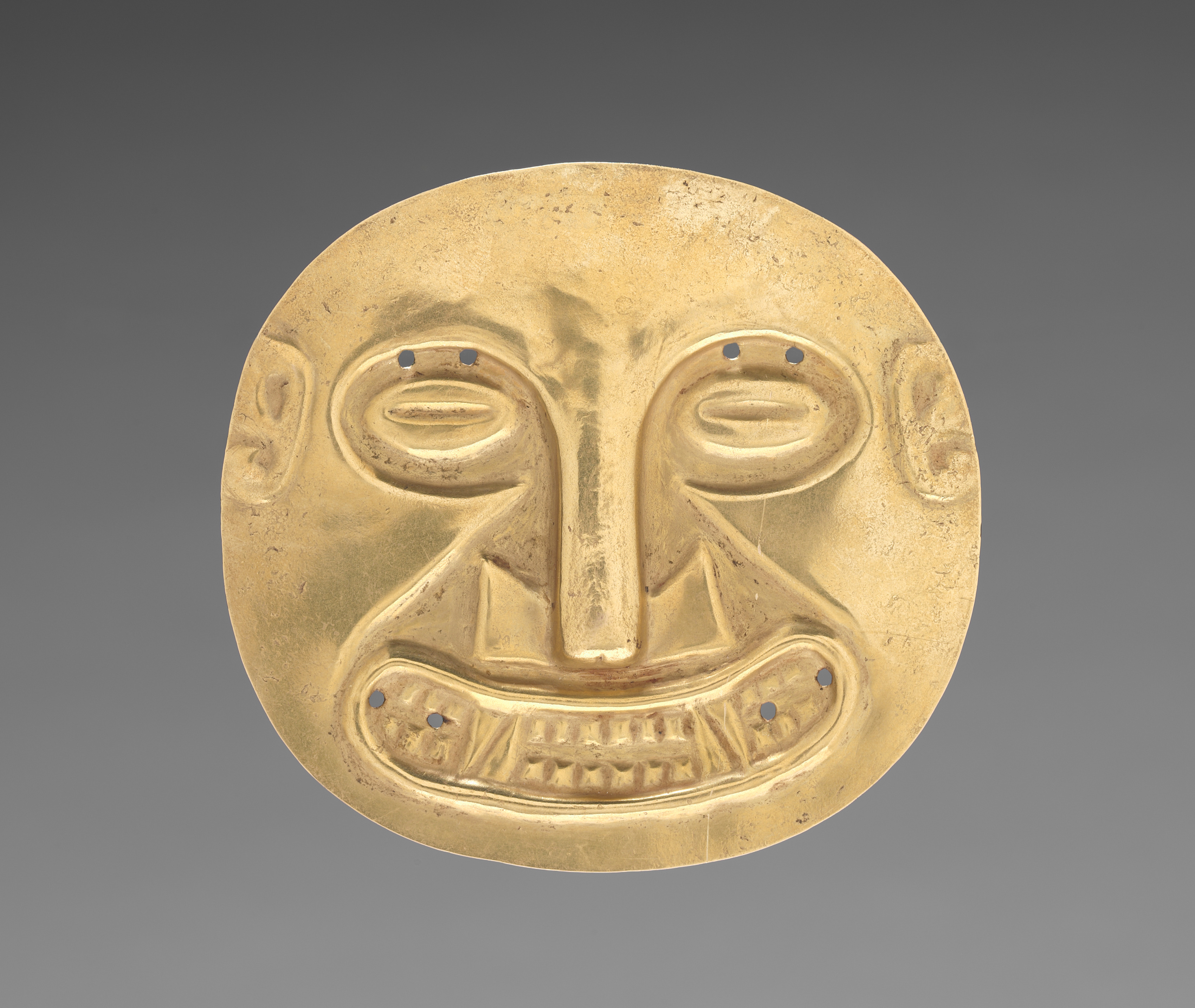
Deconstructing the Sitio Conte Plaque: A Study in Hammered Gold and Temporal Dissonance
At Zoey Fashion Lab, the act of deconstruction is not merely an analytical exercise; it is a creative imperative. We dissect artifacts not to reduce them, but to liberate the latent narratives trapped within their materiality. The subject of this analysis—a small, hammered gold plaque from Sitio Conte, Panama, dated to the 5th-10th century and executed in the Conte style—presents a profound challenge to contemporary fashion’s obsession with surface. This object, a relic of a sophisticated metallurgical tradition, is not a passive ornament. It is a compressed universe of power, ritual, and transformation. Our task is to fragment its historical and technical integrity, then reassemble its essence into an avant-garde design vocabulary that speaks to the tension between polished reflection and carved permanence.
Materiality as a Double-Edged Narrative
The plaque’s technical foundation—hammered gold—immediately situates it within a lineage of skilled labor and sacred value. Gold in Pre-Columbian Panama was not currency; it was a substance imbued with solar and spiritual potency, often associated with elite status and the mediation between earthly and celestial realms. The hammering process itself is a form of controlled violence: a cold, rhythmic assault on the metal that simultaneously compresses and expands its molecular structure. This technique creates a surface that is both resilient and malleable, capable of holding intricate relief while remaining thin enough to be worn or sewn onto textiles.
For Zoey Fashion Lab, this duality is paramount. The plaque’s hammered surface is not a uniform plane; it is a topography of tiny, overlapping strikes that catch light in unpredictable ways. In an avant-garde context, we reimagine this not as a finished surface, but as a generative texture. Imagine a garment where the fabric itself is constructed from thousands of individually hammered gold leaf scales, each one slightly angled to create a living, shimmering field. The wearer becomes a mobile source of light, their movement a choreography of reflected and refracted rays. This is not ornamentation for decoration’s sake; it is a material dialogue with the sun, echoing the plaque’s original ritual function.
The Motif: Between the Polished Mirror and the Carved Stone
The reference provided—“一面是光洁银镜上以黄金镶嵌的纷繁棕叶纹,另一面是冰冷石棺板上以浮雕诉说的生命叙事”—translates to a profound conceptual binary: one side is a polished silver mirror inlaid with intricate palm-leaf patterns in gold; the other side is a cold stone sarcophagus lid narrating life through relief carving. This juxtaposition is the intellectual core of our deconstruction. The Sitio Conte plaque, though singular, embodies this same tension. Its hammered gold surface is a mirror of the cosmos, reflecting the status and spiritual alignment of its wearer. Yet its small scale and portable nature also suggest a funerary or commemorative purpose, linking it to the stone sarcophagus’s role as a permanent record of a life.
In the Conte style, the iconography often features abstracted anthropomorphic figures, felines, and avian motifs that blur the line between human and animal, living and spirit. The “split-leaf” pattern mentioned in the reference is particularly resonant: it is a motif of bifurcation, of simultaneous growth and division. For our avant-garde analysis, this becomes a design principle of schism. The garment is no longer a unified whole but a series of opposing surfaces that converse. One panel might be a highly polished, mirror-like gold surface that reflects the viewer’s own image, while an adjacent panel is a deeply textured, almost corroded gold surface that evokes the stone relief’s narrative weight.
Deconstructing the Wearable: From Plaque to Performance
The plaque’s original function—likely sewn onto a textile or worn as a pendant—suggests a portable sacred object. In an avant-garde fashion context, we must consider how this portability translates into modern wearability. The plaque is not a garment; it is an attachment, an augmentation. This leads us to the concept of the modular ornament. Our design proposes a series of small, hammered gold elements that can be individually attached to a base garment—a sheer silk shroud, perhaps, or a raw linen tunic—via hidden magnetic clasps or tiny, hand-forged gold rings. The wearer becomes a curator of their own body’s narrative, adding or removing plaques to shift between states of reflection and revelation.
This modularity directly confronts the “mirror vs. stone” duality. When the plaques are densely clustered, the garment becomes a near-solid surface of gold, a mirror that obscures the body beneath. When they are sparse, the base fabric is revealed, allowing the body’s form and movement to become the “stone relief” narrative. The wearer can thus choose to be either the polished silver mirror—reflecting external gazes—or the cold stone sarcophagus—revealing an internal, carved story of life and death.
Texture as Time: The Avant-Garde Surface
The hammering technique of the Sitio Conte plaque is not merely decorative; it is a record of process. Each strike is a moment in time, a decision made by the ancient smith. In our deconstruction, we elevate this temporal dimension. We propose a fabric that is itself hammered—not with metal, but with heat and pressure applied to a thermoplastic polymer or a specially treated silk organza. The result would be a textile with permanent, three-dimensional indentations that mimic the plaque’s surface. This “fossilized” fabric would be both light and structured, capable of holding its shape while draping softly.
This approach aligns with the reference’s stone sarcophagus imagery. The hammered fabric becomes a textile relief, a soft stone that tells a story through its topography. The pattern would not be printed or embroidered but impressed, creating shadows that shift with the viewer’s perspective. The avant-garde garment thus becomes a palimpsest: the original plaque’s texture is overwritten onto a new material, creating a dialogue between ancient metallurgy and contemporary textile engineering.
Conclusion: The Plaque as Portal
The small, hammered gold plaque from Sitio Conte is not a static object. It is a portal between worlds: the polished mirror of the living and the carved stone of the dead, the reflective surface of social display and the narrative depth of ritual memory. For Zoey Fashion Lab, this analysis yields a design philosophy rooted in material contradiction. The avant-garde garment must be both mirror and sarcophagus, both surface and depth. It must be wearable yet monumental, reflective yet textured, portable yet permanent.
By deconstructing the plaque’s technical, iconographic, and functional dimensions, we arrive at a design vocabulary that honors its origin while propelling it into a future of radical wearability. The result is not a reproduction but a resonance—a garment that, like the plaque itself, captures light and time, reflecting the wearer’s present while carrying the weight of a thousand-year-old narrative. In this, the hammered gold becomes more than ornament; it becomes a philosophical statement on the nature of adornment, mortality, and the enduring human need to mark our passage through the world.