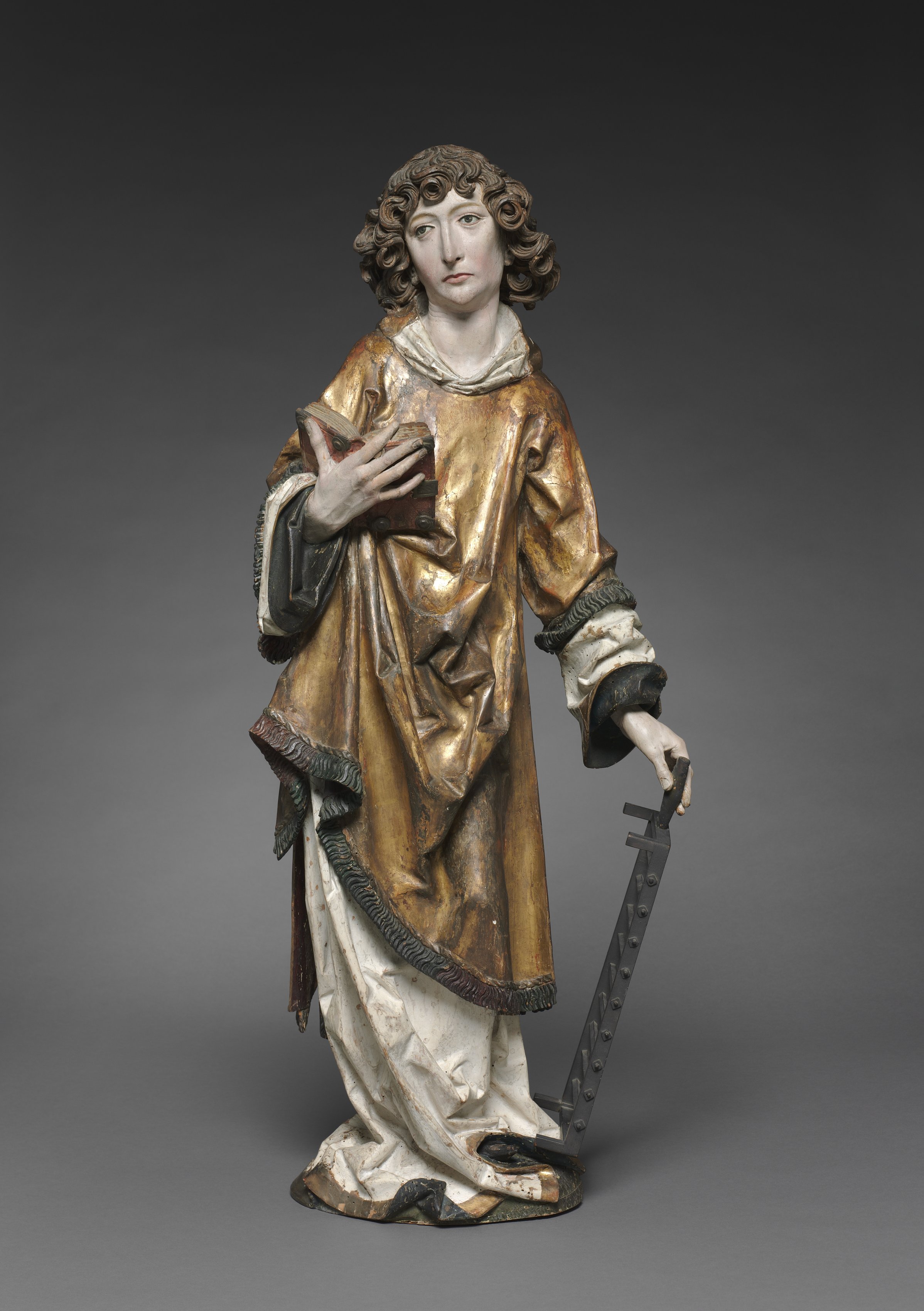
Technical Deconstruction & Material Resonance: The Saint Lawrence Sculpture
The assigned artifact, a 16th-century German polychrome lindenwood sculpture of Saint Lawrence, presents a profound case study in material intelligence and narrative contradiction. For Zoey Fashion Lab's avant-garde ethos, its value lies not in its hagiographic subject but in its embodied technical dialogue—a dialogue between material humility and transformative finish, between corporeal fragility and symbolic permanence. Lindenwood, or limewood, was the preferred medium of the German Renaissance master sculptors like Tilman Riemenschneider and Veit Stoss. Its fine, even grain and softness allowed for exquisite detail, from the delicate curls of hair to the intricate folds of drapery and the agonized expression of martyrdom. This wood is carvable to near-textile fluidity, yet inherently susceptible to time, temperature, and touch. It is a material of temporary solidity, whispering of eventual decay.
This inherent vulnerability is then aggressively denied and spectacularly elevated by the applied polychromy and gilding. The technical process—layers of gesso, bole, and then gold leaf or painted pigments—creates a second skin. It transforms the humble, pale wood into a vision of celestial radiance or gruesome physicality. The gilding captures and throws light, dematerializing the form into a spiritual emblem. The polychromy—the flushed skin, the blood, the rich colors of fabric—hyper-materializes it, anchoring the divine narrative in visceral, human reality. This tension between the wooden core and the crafted surface is our primary source. It is a pre-industrial prototype of engineered textile layering: a base substrate (lindenwood as wool or linen), a structural interface (gesso as interfacing or primer), and a performative surface (gilding and paint as jacquard, lamé, or digital print).
Narrative Duality & The Avant-Garde Framework: Mirror and Tomb
The provided reference—"一面是光洁银镜上以黄金镶嵌的纷繁棕叶纹,另一面是冰冷石棺板上以浮雕诉说的生命叙事" (On one side, intricate palmettes inlaid in gold on a smooth silver mirror; on the other, a life narrative told in relief on a cold stone tomb slab)—is not merely poetic but a precise methodological lens. It frames the essential duality we must extract and radicalize: the Mirror (surface, reflection, decoration, ideal) versus the Tomb (structure, narrative, depth, mortality).
In the Saint Lawrence artifact, the Mirror is the gilded, polychromed surface. It is the glorious, reflective ideal of sainthood, the divine light, the symbolic ornament (like the palmettes). The Tomb is the lindenwood core and the narrative of martyrdom—the story of a body on a gridiron, a life reduced to physical suffering and enduring witness. The avant-garde opportunity lies in violently reconciling these opposites. Not through harmony, but through deliberate, constructed collision.
Collection Manifesto: "The Linden Gridiron"
We propose a capsule collection titled "The Linden Gridiron." This collection will physically and philosophically engineer the tension between the Mirror and the Tomb, between surface glamour and structural narrative, between the ephemeral and the eternal.
The Tomb as Structure (The Lindenwood Core):
This translates to the foundational silhouette and fabric manipulation. Inspired by the carved, flowing robes and the supportive gridiron of the saint's martyrdom, we will employ architectural tailoring and internal armature. Imagine garments with hidden, flexible boning creating a subtle, grid-like structure beneath soft volumes. Silhouettes will reference sarcophagal forms—columnar, rectilinear—interrupted by the "carved" drapery of the sculpture. Fabrics will start with the "lindenwood" ethos: natural, matte, and malleable. Heavy, untreated linens, mouldable woolens, and vegetable-tanned leather will be cut and folded to appear as if shaped by a chisel, with seams exposed like tool marks, revealing the construction as the narrative.
The Mirror as Surface (The Polychromy & Gilding):
This is the disruptive, reflective layer applied *over* the tomb-like structure. We will not use literal gold leaf but its conceptual equivalents: high-tech laminates, laser-etched metallic films fused onto natural fabric, and iridescent coatings that shift like aged varnish. The "polychromy" will be expressed through strategic, violent flashes of color—vermilion reds (for blood/wound), lapis lazuli blues (for divinity)—applied as if painted onto the garment: as asymmetric inserts, dripped epoxy resin details, or heat-transferred prints that crack like old pigment. The "palmettes" become abstracted, gilded digital prints of fractured patterns, inlaid onto sleeves or panels like ceremonial armor.
Key Pieces & Technical Execution
1. The Gilded Cage Dress: A columnar dress in matte, bone-colored linen. Its interior is fitted with a flexible, grid-like silicone boning system (the gridiron/tomb). Over one shoulder and across the torso, a sweeping panel of fused gold-metalized organza (the mirror) is attached, seemingly melting into the linen. At points of contact, the linen is stained with a printed, weathered vermilion pigment.
2. The Polychrome Asymmetric Coat: A tailored, tomb-silhouette coat in grey felted wool. One side hangs straight, carved with deep, vertical pleats. The opposite side and one sleeve are entirely laminated with a cracked-mirror-effect film, reflecting the environment. The interior lining is a shocking, saturated lapis blue, revealed only in movement.
3. Deconstructed Relic Trousers: Wide-leg trousers in untreated leather, molded to hold a sculptural shape. One leg features a "polychromy" panel: a section of the leather is laser-engraved with a narrative pattern (echoing the tomb relief), then hand-painted with translucent resins in oxblood and gold.
Conclusion: The Avant-Garde Resonance
For Zoey Fashion Lab, the 16th-century Saint Lawrence is not a religious icon but a blueprint for engineered emotion. It teaches us that true avant-garde impact lies in constructing a palpable dialogue between opposites: the ephemeral and the eternal (decaying wood vs. eternal gold), the narrative and the abstract (story of pain vs. pattern of palmettes), the internal structure and the external surface. "The Linden Gridiron" collection seeks to wear this dialogue. It proposes garments that are both protective armor and vulnerable skin, both reflective mirror and inscribed tomb, offering the wearer not just an aesthetic but an embodied, contradictory, and deeply resonant experience—a modern martyrdom to the complexities of identity itself.