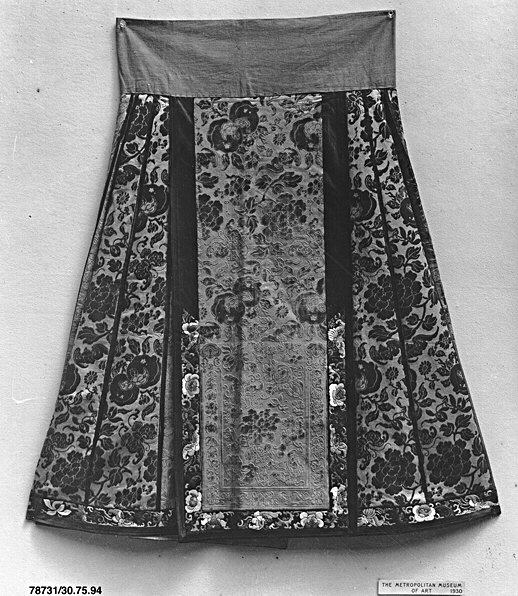
The Deconstructed Silhouette: Reimagining the Silk Skirt as a Futuristic Armature
In the relentless pursuit of sartorial evolution, the skirt—often relegated to a secondary role in the discourse of avant-garde design—demands a radical recontextualization. For the SS26 season, Zoey Fashion Laboratory presents a study of the skirt not as a garment of drape and modesty, but as a structural prosthesis, a kinetic sculpture born from the paradoxical marriage of China’s most ancient textile, silk, with the uncompromising language of futuristic architecture. This analysis dissects the skirt as a standalone object of high-concept engineering, challenging the very notion of volume, movement, and the female form.
Material as a Structural Paradox: The Recalcitrance of Silk
Silk, historically synonymous with fluidity, fragility, and organic grace, is here subverted into a medium of tensile strength and architectural rigidity. The conventional wisdom dictates that silk yields to the body; in our SS26 proposition, the body yields to the silk’s engineered geometry. Through a proprietary process of thermal-bonded lamination and asymmetric pleating, the silk is transformed into a semi-rigid composite. This is not a fabric that drapes; it is a fabric that holds its own volume, creating negative space between the textile and the wearer’s anatomy. The result is a skirt that breathes like a second skin but stands as an independent armature—a floating exoskeleton that defies gravity. The silk’s natural luster is retained, but it now catches light on sharp, unforgiving folds, akin to the surface of a lunar module or a deconstructed origami satellite. This material paradox is the foundation of the collection’s tension: the organic meets the engineered, the ancient meets the interstellar.
Silhouette as a Statement of Temporal Displacement
The silhouette of the SS26 skirt is defined by what we term “asymmetric volumetric displacement.” Abandoning the circular or A-line forms of tradition, this skirt occupies space through a series of non-repeating, polyhedral panels that project outward from a single, off-center waistband. The waistband itself is a minimalist carbon-fiber ring, a nod to industrial precision, from which the silk panels erupt like shards of a fractured mirror. One panel may cascade to the floor in a sharp, vertical blade, while its adjacent panel flares horizontally, creating a dynamic, wind-swept asymmetry that suggests motion even in stasis. This is not a garment for standing still; it is a garment for navigating a future where symmetry is obsolete.
Key to this silhouette is the “zero-gravity hemline.” By integrating micro-weights and internal tension wires (discreetly housed within the silk’s seams), the hem does not fall uniformly. Instead, it hovers, lifts, and dips at unpredictable intervals, creating a silhouette that appears to be in a state of controlled instability. The wearer becomes a living kinetic sculpture, with the skirt responding to air currents and body movement in a manner that is both unpredictable and mathematically precise. This is the antithesis of the traditional skirt’s function; it is a tool for spatial redefinition, not concealment.
Structural Innovation: The Architecture of Draped Tension
The structural innovation of this skirt lies in its internal skeleton—a hidden lattice of biomimetic silk ribs. Inspired by the tensile strength of spider silk and the geometric efficiency of honeycomb, these ribs are woven into the fabric’s back layer, invisible to the observer but dictating every fold and angle. This system allows the skirt to maintain its aggressive, futuristic silhouette without the need for bulky crinolines or petticoats. The engineering is minimalist, yet the visual impact is maximalist.
Furthermore, the skirt employs a modular fastening system that allows for real-time silhouette adjustment. Small, magnetic clasps embedded in the silk’s seams enable the wearer to reconfigure the volume—from a sharp, pencil-like column to a wide, asymmetrical bell shape—within seconds. This transforms the garment from a static object into a responsive, interactive tool. The skirt is no longer a fixed design; it is a platform for personal architectural expression. This innovation speaks directly to the SS26 zeitgeist of fluidity and adaptability, where the garment must evolve with the wearer’s environment and intent.
Cultural and Temporal Commentary: China’s Silk in the Year 2026
By sourcing the silk from China, we engage in a dialogue with a millennia-old craft tradition, yet we deliberately strip it of its historical context. The silk is not used to evoke heritage, nostalgia, or romanticism. Instead, it is a raw material for a future that has not yet been written. This is a deconstructive act of cultural reappropriation: the silk is liberated from its past and re-coded as a medium for techno-organic synthesis. The skirt becomes a symbol of a future where tradition is not preserved but deconstructed and rebuilt into something unrecognizable.
The color palette is deliberately monochromatic—a spectrum of lunar whites, industrial grays, and oxidized silvers—to emphasize form over ornament. Any surface decoration is derived from the fabric’s own structural folds, creating a self-generated pattern of light and shadow. This is the ultimate avant-garde statement: the garment’s beauty is intrinsic to its engineering, not applied.
Conclusion: The Skirt as a Prototype for the Future
The SS26 skirt from Zoey Fashion Laboratory is not merely a garment; it is a manifesto in silk and carbon fiber. It rejects the passive, draping nature of traditional skirts in favor of an active, sculptural presence. It challenges the wearer to inhabit a space of dynamic tension, where every movement is a deliberate act of architectural composition. By fusing the ancient material of Chinese silk with the futuristic language of structural innovation, we propose a new paradigm for the skirt: not as a covering, but as a standalone, self-sufficient object that defines the space around it. This is the definitive avant-garde study for SS26—a garment that exists not to follow the body, but to lead it into a future of controlled asymmetry and purposeful defiance. The skirt is no longer a garment; it is an armature for the future self.