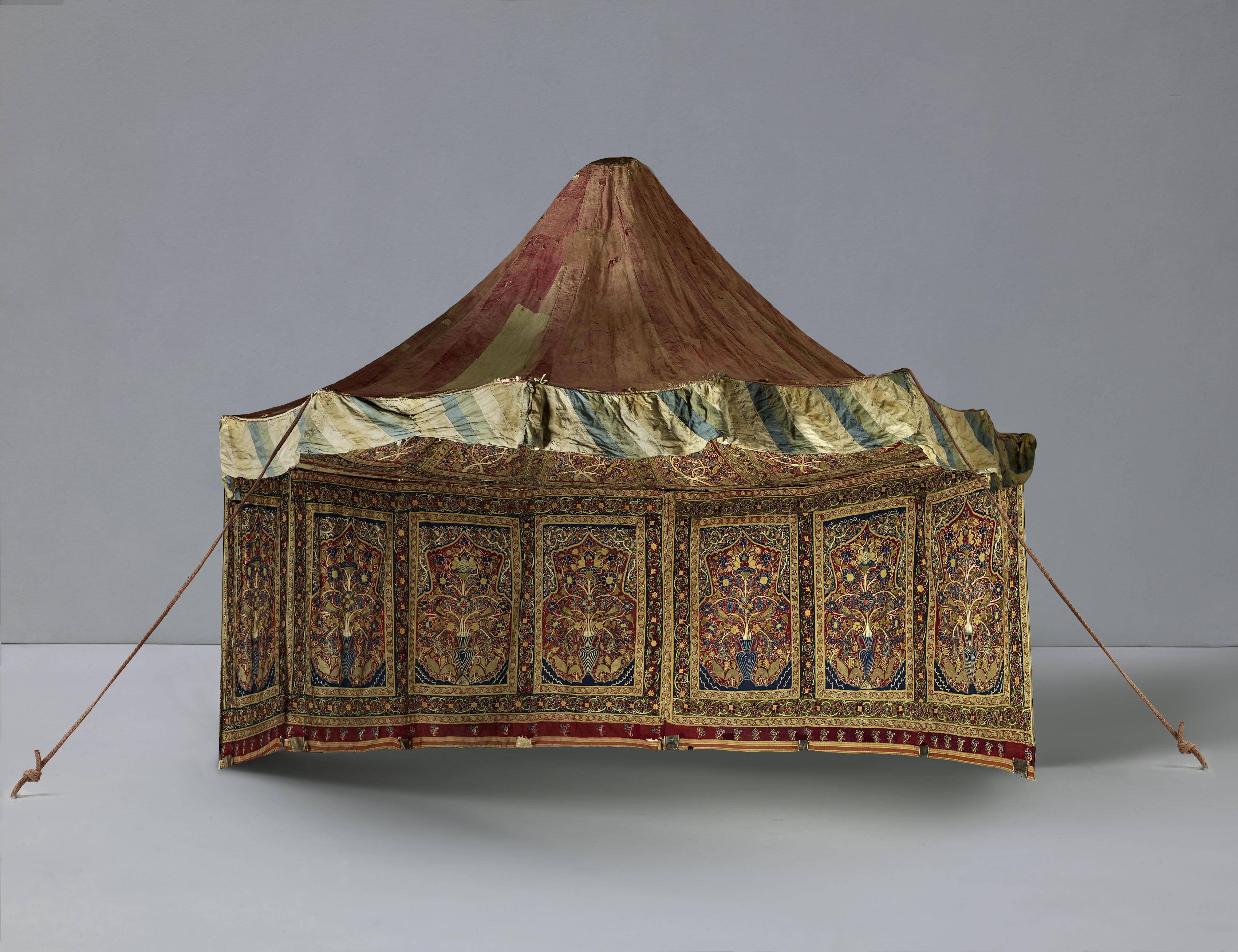
Deconstructing the Royal Round Tent: A Qajar Artifact Reimagined for the Avant-Garde
At Zoey Fashion Lab, our mission is to excavate historical artifacts and reinterpret their structural, material, and symbolic DNA through an avant-garde lens. The Royal Round Tent made for Muhammad Shah, originating from Rasht, Iran, during the Qajar period (1779-1925), presents a profound case study. This object is not merely a portable shelter; it is a microcosm of Persian imperial power, nomadic tradition, and sophisticated textile artistry. By dissecting its technical composition—the interplay of interior wool plain weave with inlaid work, silk chain-stitch embroidery, leather, and tape, against an exterior of cotton and wool plain weave reinforced by rope and iron ring—we uncover a blueprint for radical, contemporary fashion design. This analysis will deconstruct the tent’s materiality, spatial logic, and decorative language, proposing how these elements can be transposed into an avant-garde collection that challenges conventional garment construction and narrative.
Material Deconstruction: From Shelter to Second Skin
The tent’s interior is a study in layered opulence and functional restraint. The wool plain weave base provides a sturdy, insulating foundation, while the inlaid work—likely felt or appliqué—introduces a tactile, dimensional relief. For Zoey Fashion Lab, this suggests a garment where the primary fabric is a robust, matte wool base, onto which patches of contrasting materials are “inlaid” not as decoration, but as structural elements. Imagine a coat where sections of boiled wool are seamlessly fused with panels of raw silk or leather, creating a topographic map of warmth and movement. The silk embroidery in chain stitch is the tent’s most intimate voice. Chain stitch, with its looping, continuous thread, evokes both fragility and resilience. In an avant-garde context, this technique can be exaggerated and distorted. We envision garments where chain-stitch embroidery is not confined to borders but cascades across the surface like liquid metal—using metallic silk threads to create a dialogue between the tent’s historic luxury and a futuristic, almost cybernetic aesthetic. The leather elements—likely used for ties or reinforcement—translate into structural straps, harnesses, or corsetry that both bind and free the body, echoing the tent’s role as a controlled yet enveloping space.
The exterior, in contrast, is a study in raw utility. The cotton and wool plain weave is unadorned, a canvas for weathering and time. This dichotomy between interior opulence and exterior austerity is a core avant-garde principle. A garment inspired by this tent would feature a reversible or dual-layer construction: an outer shell of coarse, unbleached cotton or wool, perhaps with visible stitching or intentional fraying, that can be turned inside out to reveal a riot of embroidered silk and inlaid leather. The rope and iron ring are not mere hardware; they are architectural anchors. In fashion, these become oversized drawstrings, metal grommets, and D-rings that allow the wearer to adjust the garment’s silhouette—tightening or loosening the “tent” around the body. This introduces an element of performance and adaptability, transforming a static garment into a responsive structure.
Spatial Logic: The Body as Pavilion
The tent’s circular form is its most radical spatial statement. Unlike Western tailoring, which often prioritizes the vertical line, the round tent suggests a radial, non-hierarchical relationship to the body. For our avant-garde collection, this translates into garments that are not cut to follow the body’s contours but instead create a new volume around it. We propose a series of “pavilion pieces”: a circular cape that, when extended, becomes a full tent-like enclosure; a skirt constructed from concentric rings of fabric, each layer slightly offset, creating a spiraling silhouette. The iron ring at the apex of the tent is a literal crown. In fashion, this becomes a structural collar or a halo-like headpiece, made from forged metal or rigid resin, from which the garment drapes. This ring is not merely decorative; it is the point of tension from which the entire form is suspended, echoing the tent’s engineering.
The rope elements introduce a nomadic, tensile quality. Garments can incorporate adjustable rope lacing systems that cinch or release the fabric, allowing the wearer to modulate between a closed, protective cocoon and an open, flowing form. This reflects the tent’s dual nature as both a fortress and a permeable membrane. The plain weave of the exterior, when examined closely, reveals a grid-like structure. This grid becomes a template for deconstruction and reconstruction: we can cut and reassemble panels, leaving raw edges and exposed seams, to create a garment that is perpetually in a state of becoming—a nod to the tent’s portability and impermanence.
Decorative Language: Embroidered Narratives of Power
The tent’s silk embroidery is not arbitrary; it likely features floral motifs, geometric patterns, or calligraphic inscriptions that signify royal authority and divine protection. For Zoey Fashion Lab, we abstract these into a new visual lexicon. The chain stitch becomes a tool for creating “digital” textures—dense, pixelated patterns that mimic the tent’s intricate designs but are executed with a contemporary, almost glitch-like irregularity. We use iridescent silk threads that shift color under light, referencing the Qajar love for vibrant hues while introducing a modern, holographic quality. The inlaid work is reinterpreted as cut-out panels that reveal underlying layers of contrasting fabric or skin, creating a sense of depth and exposure. This is a direct translation of the tent’s interior-exterior dichotomy: the garment becomes a wearable artifact where the inside is always partially visible.
The leather elements are embossed with patterns derived from the tent’s structural seams and rope knots, turning functional details into ornamental motifs. This blurs the line between construction and decoration, a hallmark of avant-garde design. The cotton and wool plain weave of the exterior is treated with textural interventions: we may apply wax, resin, or metallic dust to create a patina that mimics the tent’s aged surface. This is not a nostalgic patina but a deliberate, accelerated aging process that speaks to the passage of time and the fragility of power.
Conclusion: A Tent for the Future
The Royal Round Tent of Muhammad Shah is a testament to the Qajar dynasty’s synthesis of nomadic practicality and imperial grandeur. For Zoey Fashion Lab, it is a rich repository of ideas that challenge the very definition of clothing. By deconstructing its materials—wool, silk, leather, rope, iron—and reimagining its spatial logic—circular, tensile, reversible—we create garments that are not just worn but inhabited. They are shelters for the body, monuments to craftsmanship, and provocations for a new aesthetic. This collection would be a dialogue between the tent’s historic resonance and an avant-garde sensibility that embraces imperfection, adaptability, and narrative depth. The result is fashion that is both a tribute to a lost world and a blueprint for the future of wearable architecture.