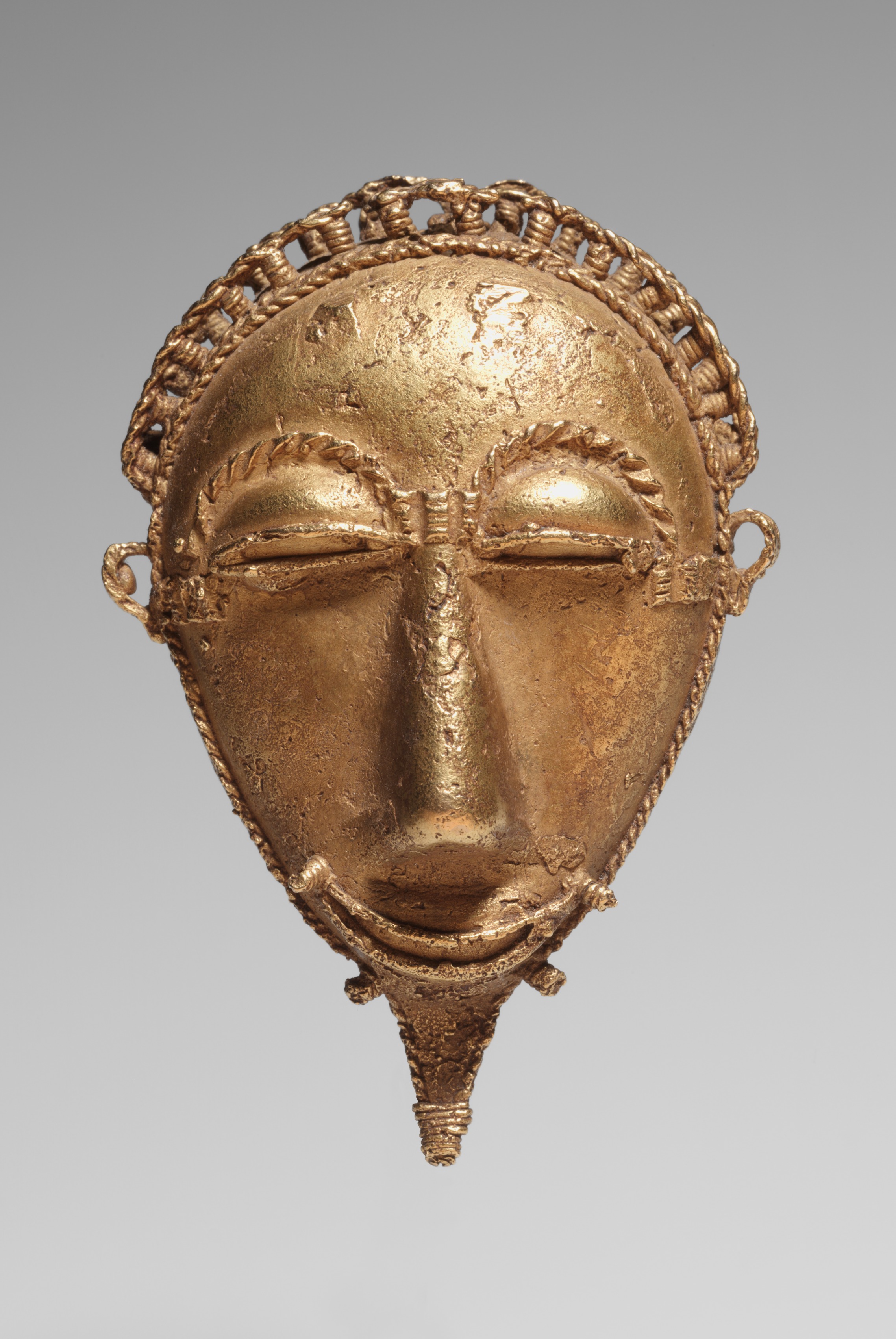
Deconstructing the Pendant: Face – A Baule-Inspired Avant-Garde Narrative
At Zoey Fashion Lab, the Pendant: Face represents a pivotal convergence of ancestral craftsmanship and radical futurism. Sourced from West Africa, specifically Côte d’Ivoire, and attributed to the Baule-style goldsmith tradition, this object is not merely an ornament but a deconstructed artifact. Its technical foundation in gold, paired with the evocative archive resonance—a duality of mirrored silver and narrative gold—propels it into the avant-garde. This analysis dissects the pendant’s materiality, cultural memory, and transformative potential within contemporary fashion’s deconstructive lexicon.
Material Dialectics: Gold as Memory and Medium
The choice of gold is both a technical and symbolic declaration. In Baule culture, gold (kaolin) is imbued with spiritual and political weight, often reserved for royal regalia and objects of ancestral communication. Yet Zoey Fashion Lab’s pendant recontextualizes this material through a lens of deconstruction. The gold is not polished to a mirror finish; instead, it carries the patina of age and ritual, suggesting a fragment excavated from a larger, lost narrative.
This aligns with the archive reference: “一面是光洁银镜上以黄金镶嵌的纷繁棕叶纹,另一面是冰冷石棺板上以浮雕诉说的生命叙事” (one side is a smooth silver mirror inlaid with intricate gold palm-leaf patterns, the other is a cold stone sarcophagus board narrating life through relief). The pendant’s face becomes a liminal surface—a threshold between the reflective present (the silver mirror) and the fossilized past (the stone sarcophagus). The gold, then, is the connective tissue, simultaneously adorning and disrupting. It is not a symbol of wealth but of memory’s weight, a material that carries the heat of the forge and the cold of the tomb.
Baule Goldsmithing and the Avant-Garde Imperative
The Baule are renowned for their lost-wax casting and intricate filigree, techniques that demand precision and spiritual intent. A traditional Baule pendant often depicts a face—a stylized mask or portrait—representing a spirit spouse (blolo bian or blolo bla) or an ancestor. These faces are not realistic; they are abstracted essences, with elongated features, closed eyes, and serene expressions. Zoey Fashion Lab’s pendant inherits this abstraction but pushes it into the avant-garde by fragmenting the face.
The avant-garde, in fashion, is defined by rupture and recontextualization. Here, the pendant’s face is not a complete visage but a composite of planes: a cheekbone rendered in high relief, an eye socket hollowed into a negative space, a mouth that is both present and absent. This echoes the Baule tradition of non-naturalistic representation, yet it also invokes the deconstructivist principles of Rei Kawakubo or Martin Margiela, where garments are unfinished, turned inside out, or reassembled from disparate parts. The pendant becomes a wearable ruin, a fragment of a larger, unknowable whole.
Archive Resonance: The Mirror and the Sarcophagus
The archive resonance is critical to understanding the pendant’s narrative duality. The “smooth silver mirror” suggests self-reflection and vanity, the modern individual’s obsession with surface. Yet the “intricate gold palm-leaf patterns” inlaid upon it are not decorative; they are symbols of life, death, and regeneration in many West African cosmologies. The palm leaf is a motif of victory over death in Baule art, often appearing on funerary objects. Thus, the pendant’s face is a memento mori, but one that celebrates rather than mourns.
Conversely, the “cold stone sarcophagus board” with its “relief narrating life” represents the permanence of narrative. Where the mirror is ephemeral—a reflection that vanishes with the viewer—the sarcophagus is eternal, its stories carved for millennia. The pendant, suspended between these two states, becomes a wearable paradox. It asks the wearer to confront their own mortality while simultaneously embodying the immortality of cultural memory. This is the essence of the avant-garde: to make the familiar strange, to force a reassessment of the object’s function.
Deconstructing the Wearable: Form and Function
In Zoey Fashion Lab’s context, the pendant is not merely an accessory; it is a deconstructive intervention on the body. Its weight—both literal and metaphorical—alters the wearer’s posture, drawing attention to the clavicle, the throat, the sternum. The face motif, when worn, creates a third face on the body, a prosthetic identity. This echoes the Baule belief that the spirit spouse pendant serves as a conduit between the physical and spiritual realms. Here, the conduit is between the wearer and the archive, between contemporary fashion and ancestral technique.
The technical execution of the gold is also deconstructive. Traditional Baule goldsmiths would polish and smooth their work, but Zoey Fashion Lab’s pendant retains textural irregularities: rough edges, asymmetrical contours, and a matte finish that resists light. This is a deliberate refusal of perfection, a hallmark of deconstruction. The pendant looks as though it has been excavated from a site, not cast in a mold. It is an object that refuses to be new, preferring to wear its history as a badge of authenticity.
Cultural Translation: From Baule Ritual to Global Avant-Garde
This pendant navigates a delicate ethical terrain. It is not a cultural appropriation but a cultural translation. Zoey Fashion Lab does not mimic Baule forms; it interprets their principles through an avant-garde lens. The abstraction, the spiritual weight, the material integrity—all are honored, yet the final object speaks a global language of deconstruction. This is crucial for the modern fashion lab: to respect origin while transcending origin, to create objects that are rooted yet rootless, belonging to no single time or place.
The pendant’s face, then, is not a portrait of a specific Baule ancestor but a universal face of memory. It could be any face, or no face. It is a mask for the modern self, a way to wear one’s own history and one’s own death simultaneously. In an age of fast fashion and disposable identity, this pendant demands contemplation, weight, and reverence.
Conclusion: The Pendant as Avant-Garde Archive
The Pendant: Face from Zoey Fashion Lab is a masterclass in deconstructive design. It takes the Baule goldsmith tradition—a lineage of spiritual and technical mastery—and fractures it through the lens of the avant-garde. The gold is not luxury but memory; the face is not representation but absence; the pendant is not adornment but existential statement. It embodies the archive resonance’s duality: the mirror’s fleeting reflection and the sarcophagus’s eternal narrative. For the wearer, it is a constant reminder of the thin line between life and death, between the self and the ancestor, between the polished surface and the raw truth. This is the future of fashion: not to create the new, but to reanimate the old with radical, unsettling life.