The Lattice of Tomorrow: Deconstructing the Woven Tapestry as Futuristic Armor
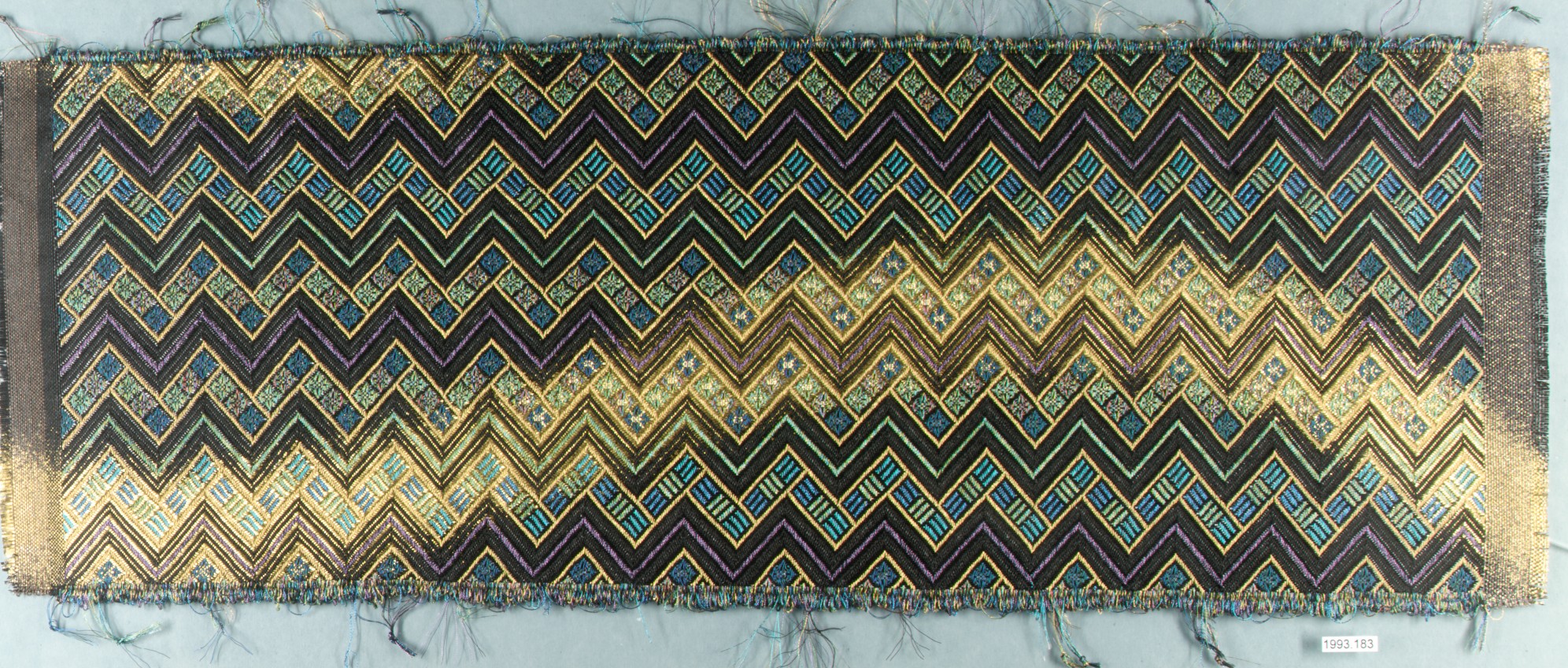
The crucible of Spring/Summer 2026 demands a radical departure from the ephemeral. At Zoey Fashion Laboratory, we do not merely clothe the body; we architect its next evolutionary state. The subject of this definitive analysis—a woven tapestry originating from the ancient looms of Japan, reimagined through a lens of gold and multicolor lacquered thread interwoven with synthetic fiber—represents a paradigmatic shift. This is not a textile; it is a structural manifesto. It is a lattice of tomorrow, a wearable relic of a future where craft and cybernetics have fused into a singular, breathtaking entity.
This tapestry, in its purest form, is a paradox. It embodies the meticulous, almost obsessive precision of traditional Japanese sashiko and nishijin-ori weaving, yet its materiality screams of a post-human era. The gold thread, lacquered to a brilliant, almost liquid sheen, catches light not as a reflection but as a captured energy source. The multicolor lacquered threads—electric cobalt, acid green, and a deep, arterial crimson—are not mere ornamentation; they are the circuitry of a new silhouette. The synthetic fiber, a high-tenacity, matte-finished polymer, acts as the silent, load-bearing skeleton. This is the foundational dialectic: the organic, human touch of the weave versus the cold, calculable strength of the machine.
Deconstructing the Silhouette: From Flat Tapestry to Three-Dimensional Exoskeleton
The conventional approach to a woven tapestry is to drape it, to let its weight dictate the form. We reject this passivity. For SS26, the tapestry is not a second skin; it is an exoskeleton. Our structural innovation begins with a radical re-engineering of the weave's tensile properties. By leveraging the synthetic fiber's inherent rigidity and the lacquered thread's brittleness, we can create a garment that holds its own shape—a self-supporting architectural volume.
Consider a cocoon jacket that is not sewn but woven in situ. The tapestry is cut into precise, geometric panels—triangles, trapezoids, and irregular hexagons—each edge finished with a micro-lacquered seal that prevents fraying while adding a rigid, almost metallic border. These panels are then laser-joined at their vertices, creating a honeycomb-like structure that expands and contracts with the wearer's movement. The gold thread, when concentrated in these joints, becomes a glowing nexus point, a visual anchor for the entire form. The silhouette is not soft; it is a sharp, angular, almost robotic carapace that simultaneously honors the textile's woven heritage and propels it into a sci-fi future.
The most audacious application is the “Aperture Gown.” Here, the tapestry is used as a living, breathing membrane. A full-length, A-line skirt is constructed from a single, continuous weave that has been strategically deconstructed. The gold lacquered threads are pulled loose in specific zones, creating gaping, organic apertures that reveal the synthetic fiber's underlying grid structure. These apertures are not random; they form a map of the human form's kinetic centers—the hip, the knee, the shoulder. As the wearer moves, the loose threads sway and catch the light, creating a shimmering, kinetic aura. The silhouette is simultaneously voluminous and fragmented, a ghost of a traditional kimono reimagined as a high-speed, data-streaming garment.
Material Alchemy: The Lacquered Thread as a Structural Agent
The true innovation lies in the lacquered thread's dual role. Traditionally, lacquer on thread is a finishing technique for durability and sheen. We have weaponized it. By controlling the thickness and cure time of the lacquer, we can create threads that are flexible at room temperature but become rigid when exposed to body heat or a specific wavelength of light. This is thermo-reactive structural weaving.
Imagine a “Lattice Bodysuit” where the torso is woven with a high-density grid of gold lacquered thread that, upon activation, hardens into a corset-like armor. The arms and legs, woven with a lower-density, multicolor thread, remain fluid and pliable. The result is a garment that is both a protective shell and a second skin, a dynamic silhouette that can shift from soft drape to rigid architecture in a matter of seconds. The multicolor threads, when activated, create a chromatic shift—a visual pulse that mimics a living organism's circulation. This is not fashion; it is a wearable, adaptive system.
The Futuristic Silhouette: Asymmetry, Exaggeration, and the Void
The SS26 avant-garde silhouette, as defined by this tapestry, is characterized by aggressive asymmetry and exaggerated proportions. The traditional Japanese concept of ma (the void, the negative space) is magnified to an extreme. The tapestry is not used to cover the body but to frame it. A single, massive shoulder piece, woven from a dense concentration of gold and synthetic fiber, extends outward like a bird's wing, while the opposite side of the torso remains entirely exposed, clad only in a translucent, woven lattice of the multicolor thread.
This creates a visual tension between mass and absence. The gold thread, when concentrated, reads as a solid, impenetrable surface. The synthetic fiber, when left bare, reads as a ghostly, data-driven net. The multicolor lacquered threads act as the connective tissue, the emotional pulse of the piece. The overall form is not human; it is a hybrid—a fusion of a samurai's armor, a cyborg's exoskeleton, and a digital avatar's glitched geometry.
Conclusion: The Tapestry as a Blueprint for the Future
This Japanese woven tapestry, when subjected to our deconstructive and structural methodologies, is no longer a relic. It is a blueprint for a new form of wearable architecture. The gold and multicolor lacquered threads, married with synthetic fiber, create a material language that speaks of both ancient craft and imminent technological singularity. The silhouettes it yields—the cocoon jacket, the aperture gown, the lattice bodysuit, the asymmetrical shoulder piece—are not garments for the current season. They are prototypes for a future where clothing is not worn but inhabited; where fabric is not draped but constructed; where every thread is a structural element, every lacquered line a circuit of light. This is the definitive avant-garde statement for SS26: a woven tapestry that has become a living, breathing, architectural prophecy.